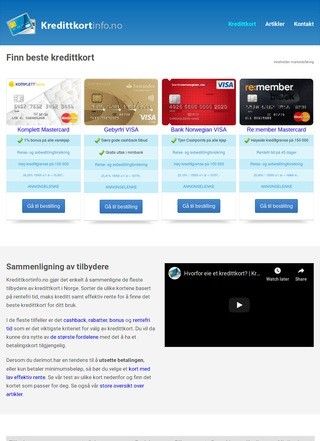
Kredittkortinfo.no lets a shopper sort Norwegian credit cards by what they actually want from one: cashback, travel insurance, or a discount at the fuel pump. That benefit-by-benefit filter is the heart of the site, and it is a sensible way to start a search that most people begin with only a rough idea of what they need.
The site sells itself on a ranking. Its title, "Beste kredittkort test: Topp 10 i Norge," promises a shortlist of the ten best Norwegian cards, and around that promise it wraps the tools to test the claim against a reader's own numbers. A ranking alone is easy to distrust. A ranking a reader can interrogate is more interesting.
The tools are the reason to open the page.
Norway has a busy credit-card market, dozens of cards from banks and retailers, each with its own perks, fees, and fine print, and comparing them one bank site at a time is slow and easy to get wrong. A site that pulls the whole field into one place is answering a real need, and that is the job Kredittkortinfo.no sets for itself.
How the card comparison works
Underneath the ranking sits a filterable database of card options. A user narrows the list by benefit type first, then sorts what remains by the numbers that decide the true cost of carrying a card: the interest rate, the credit limit, and the length of the interest-free period. Those three figures are where the marketing usually goes quiet, so surfacing them in sortable columns is the substantive part of what Kredittkortinfo.no does.
There is a comparison calculator alongside the table, and it addresses the part of card-shopping people get wrong most often. A card with a generous reward can still cost more over a year than a plain low-rate card, once interest on a carried balance is counted. A calculator that sets two cards against each other with real numbers is the tool that catches that mistake before it is made, and it turns a vague sense that one card feels better into an actual figure a person can act on.
The design of Kredittkortinfo.no assumes a reader who already knows roughly what they are after and wants to move fast. That suits a confident shopper and slightly disadvantages a complete beginner, who might want more hand-holding than a filter and a sort provide. The educational articles are meant to fill that gap, and mostly they manage it.
Filters, sorting, and the calculator
The filtering is where the site is strongest. Benefit-type filters handle the wish, cashback or fuel savings or travel cover, and the sortable columns handle the arithmetic, rate against limit against interest-free days. A disciplined user who clears the balance every month can ignore the interest rate and chase the richest reward. Someone who carries a balance can sort straight to the lowest rate and skip the perks that will never pay for themselves. One tool steers two opposite shoppers toward two different cards, which is precisely the point of comparison.
The interest-free period deserves its own mention, because it is the figure Norwegian shoppers most often overlook. A longer interest-free window is what makes a card safe to use as a short-term float, and letting a user sort on it directly is a small, practical touch that a lot of glossier comparison pages skip.
Beyond the tables, Kredittkortinfo.no publishes educational articles on using credit cards well, and the guidance splits along an honest line. Some of it speaks to disciplined spenders who treat a card as an interest-free loan they always repay in time. Some of it speaks to credit-dependent users, for whom the interest rate is the whole story and a rewards program is a distraction. Writing for both groups, instead of pretending every reader is the careful sort, is a quiet mark of seriousness.
Specific comparison pages back the general advice. A "Beste Mastercard kredittkort" page narrows the field to a single network, and a "Sammenlign kredittkort" page is the direct compare-these-cards route. These are the pages a shopper lands on straight from a search engine, and the site builds them deliberately to catch that traffic. That is ordinary search strategy, and it works, though it is worth remembering that a page built to rank in Google is built to be found, which is a separate thing from being impartial.
The social presence goes beyond what many comparison sites bother with. Alongside Facebook, X, and LinkedIn, Kredittkortinfo.no keeps a YouTube channel, which is a natural home for the sort of explainer a dense rate table cannot deliver on its own. Whether that channel is kept busy is another question, but the intent to teach across formats fits the educational streak running through the written articles.
Put together, the offering aims at one clear person: a Norwegian consumer who wants a card matched to how they actually spend, and who would rather work the comparison themselves than take a bank's word for it. Kredittkortinfo.no hands that person a filter, a sortable table, a calculator, and a set of articles, which is a complete enough toolkit for the decision in front of them.
How much to trust the rankings
A comparison site lives or dies on trust, and here Kredittkortinfo.no gets harder to judge. The pages checked carried an "Om oss" page and links out to Facebook, X, YouTube, and LinkedIn, and that was the extent of it. No phone number. No email. No postal address anywhere in view. For a site nudging people toward financial products, that thinness is a genuine caveat, and it belongs in any honest assessment.
A reader does not need to phone a comparison site to use it. What matters is that a ranking of financial products counts for more when the reader can see who compiled it and how the site is funded, and Kredittkortinfo.no keeps both largely out of view. An "Om oss" page that named the people behind the site and explained how it makes its money would settle most of the doubt. A row of social icons does not.
This is the standard tension of the whole comparison-site model. These sites are useful precisely because they aggregate and rank, but a ranking is only as trustworthy as the hand that ordered it, and a reader has no way to check that hand when the ownership and the funding stay hidden. The raw tools on Kredittkortinfo.no can be taken at face value, since a sortable table of rates is just data. The ordering of the "top ten" is what deserves more caution.
A crowded field of similar names
The reputation search adds a second complication, and part of it is simply a naming problem. Kredittkortinfo.no shares its patch with a cluster of near-identical names, Kredittkort.com, Kredittkort.no, Kredittkortlisten, and a searcher can land on the wrong one without noticing. One neighbour, Kredittkort.com, carries a 4.5 out of 5 rating on Traders Union, but that score belongs to the competitor and says nothing about the site reviewed here.
For Kredittkortinfo.no itself, no third-party review rating surfaced at all. A Kredittkortinfo Facebook page exists, without a visible rating on it, and the site turns up here and there in unrelated blog posts as one comparison option among several. That absence is not damning, since plenty of useful sites carry no review footprint. It does mean a reader gets no outside signal to weigh against the site's own claims, and has to lean on the quality of the tools instead.
For a Norwegian shopper who already clears the balance in full every month and simply wants the best cashback or travel card, Kredittkortinfo.no is a fast and useful first stop: filter by the perk that matters, sort the shortlist by the interest-free period, and run the two finalists through the calculator with real spending figures.
The one thing the site cannot do is confirm the winning card's fees and terms on the issuing bank's own page, and that step still falls to the shopper before applying. The tools are good enough to build a shortlist with. The final trust has to come from the bank, not the ranking.
Business address
Oslo,
Norway