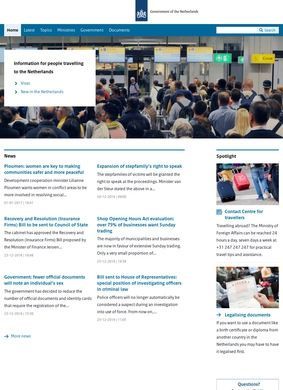
Every ministry of the Dutch national state feeds into one English-language address, and government.nl is where that material lands. The Government of Netherlands runs this portal as the single place where a foreign reader, a researcher, or a Dutch citizen who prefers English can reach news, policy, legislation, and official publications without bouncing between a dozen separate departmental sites. That consolidation is what makes it useful, worth saying plainly before anything else: the Government of Netherlands has built this portal around making the work of national government legible to people who do not read Dutch. The English here is a working channel that carries the full publication record, the same documents the Dutch pages hold and not a digest of them.
Policy areas across every ministry
The breadth of what sits here is considerable. News and press releases come from the individual ministries and from the prime minister directly, so the official line on a given day is reachable from its origin. Policy documents and legislation are published alongside material that you would otherwise have to dig for, and the topical coverage stretches across justice and security, housing and spatial planning, agriculture, fisheries and food quality, foreign affairs, defence, finance and taxation, health and welfare, education, culture and science, economic affairs, climate and energy, infrastructure, and water management.
Inside the digital government coverage
Digital government is treated as its own subject too, a fitting touch for a country that has put real effort into how the state operates online. A reader chasing a specific decision rather than a general overview is the person this site seems designed for, and it mostly delivers.
The document layer beneath the news
What gives the Government of Netherlands portal its depth is the document layer underneath the news. Royal decrees, coalition agreements, parliamentary letters, and budget documents are all published here. Anyone who has tried to cite a national government's position knows the difference between reading the decision and reading a paraphrase of it. This site keeps the decision itself within reach, which is the most useful thing a portal of this type can do for journalists and researchers.
Search tool and topic filters
A document search tool lets you go straight after a named publication, and news can be filtered by topic so that someone tracking energy policy is not wading through agriculture announcements to find it. The filters do real work, narrowing the document layer to the subject in hand instead of returning everything at once. For a site holding this much across this many subjects, that counts for more than any single design feature, because a slow archive defeats the whole point of gathering the material in one place.
Ministers and state secretaries listed
There is also a dedicated section listing every minister and state secretary alongside their portfolios, which sounds dry but solves a genuine problem. When a foreign government office or a reporter needs to know who currently holds a brief, that page answers it without guesswork. The same goes for the explanatory material on how the Dutch state is put together: the Council of Ministers, the monarchy, and the States-General as the parliament are each laid out, so a reader arriving with no background can understand the machinery before reading the decisions it produces. The Government of Netherlands has built the context and the content side by side, which is more thoughtful than assuming everyone already knows how the system works.
Linking out to ministries and Dutch pages
The Government of Netherlands site does not try to be the whole of Dutch officialdom under one roof. It links out to the individual ministry websites where deeper, department-specific material lives, and it links to its Dutch-language counterparts for anyone who wants the original instead of the English rendering. A central hub that pretended to hold everything would be unusable; this one points you onward at the right moments and trusts the ministries to carry the detail in their own domains.
An audience beyond Dutch citizens
The audience the Government of Netherlands addresses is wider than the usual government-site assumption of citizens only. Dutch citizens and businesses are part of it, but so are international visitors, researchers, journalists, and foreign governments who need an authoritative English account of Dutch positions and decisions. The Government of Netherlands carries the substantive material across, including the full publications and the explanations of how the state is structured, so the English reader works from the same documents a Dutch reader would, down past the headline items to the record beneath them. That is a deliberate choice, and it pays off for the people who depend on it.
Transparency behind foreign affairs decisions
For someone working on foreign affairs or defence questions, the coverage of those areas alongside the published parliamentary letters means the reasoning behind a stance is often traceable rather than merely an announced outcome. That is a meaningful difference for anyone whose job is to understand why a decision was made. The Government of Netherlands has clearly decided that transparency of process is part of what the portal is for. A budget document or a coalition agreement read in full tells a researcher far more than a press release ever could, and both forms live here together.
Where does this portal fall short?
If there is a limit to be honest about, it is the one common to every site of this kind: the volume of material is large, and the portal rewards a reader who already knows roughly what they are after more than one browsing without a destination. The search tool and the topic filters soften that, yet the sheer span across finance, climate, health, education, and the rest means the front door can feel like a lot at once. That is the cost of consolidation, and it is a fair trade for having everything reachable from one address. The Government of Netherlands has chosen completeness over stripped-down simplicity, and for an official record that is the correct call.
A tone that stays plain
It is also worth noting how stable and unhurried the whole thing feels. There is no push to make the portal exciting, no attempt to dress up a parliamentary letter as breaking news. The Government of Netherlands presents the material at the temperature it deserves, which is exactly what a reader citing it wants. An official source that tried to be lively would undercut its own authority. The Government of Netherlands does not make that mistake. The tone is plain because the material demands plainness, and that discipline is part of why the portal reads as trustworthy.
How does the Government of Netherlands compare with leaning on a general news outlet such as DutchNews to follow what The Hague is doing? The outlet gives you interpretation, context, and pace; this portal gives you the source text those outlets are working from, the royal decrees and budget documents and coalition agreements in their official form. A reader who wants the conclusion fast may stay with the news site, and there is nothing wrong with that. A reader who needs to quote the actual decision, or to read the parliamentary letter and not someone's gloss on it, will keep returning to the Government of Netherlands portal, because the primary record is the thing it holds and the aggregator simply does not.