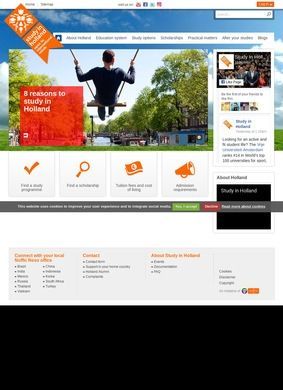
Study in Holland is the public information resource that Nuffic, the Dutch organisation for internationalisation in education, maintains for people abroad who are weighing a degree in the Netherlands. It describes itself as the official starting point to studying there, and the way the site is arranged backs that claim up. The visitor lands on a set of clearly separated sections that track the actual sequence of decisions a would-be international student runs into, from picking a course to working out what life looks like after graduation.
The spine of the whole thing is a program search sitting next to a plain description of how Dutch higher education is organised. That pairing is smarter than it first looks. Someone researching study abroad usually arrives with two questions tangled together, what can I study and how does this system even work, and the Dutch Education part of Study in Holland answers both in one place instead of scattering them.
Degrees, institution types, the split between a research university and a university of applied sciences: this is the groundwork most applicants skip and then regret skipping, and Study in Holland front-loads it.
Money comes next, and the site gives it a section of its own rather than burying it in fine print. Finances covers tuition levels and the scholarship routes open to international students. For most people looking at a foreign degree, cost is the factor that decides everything else, so putting tuition and funding under one clearly named heading is a sensible call. A student can shortlist courses and get a realistic sense of the bill without first losing weeks to an application that might never have been affordable.
The scholarship material matters most to applicants from outside the EU, for whom Dutch tuition runs higher, and giving those funding routes a clearly named home means the people who most need them are not left guessing whether any help exists at all.
Mapping the route into a Dutch degree
Read the sections in the order they are presented and they line up as a rough timeline. You choose what to study, work out what it costs, sort the practical business of moving, then look ahead to staying on. Plenty of official education portals dump everything into a flat menu and leave the visitor to assemble the order themselves. Study in Holland sequences its content around the applicant's real calendar, which is the single best decision behind the site.
That structure also keeps the tone measured. The material reads as guidance from a public body, informative and low-key, and the writing does not push the reader toward any one institution. For a government-affiliated initiative that could easily have tipped into promotion, the restraint counts for a lot.
Plan your stay and the practical move
Plan Your Stay is the logistics desk. Application steps, visa questions, and the perennial headache of finding somewhere to live all sit here. Dutch student housing is notoriously tight, and accommodation guidance belongs exactly where Study in Holland puts it, next to the visa and application material a new arrival needs at the same moment. This is the section that turns an abstract acceptance letter into a concrete to-do list, and it is the part a stressed applicant will come back to more than once.
Visas are the sort of thing people underestimate until a deadline is bearing down on them, and pulling the immigration questions into the same place as the housing hunt reflects how these tasks actually pile up. An applicant is rarely doing them one at a time. Study in Holland treating them as a single stage, instead of four scattered pages, is a quiet mercy for anyone juggling a move, a start date and a landlord in the same month.
Alongside it runs Life in NL, one of the calmer corners of Study in Holland, which handles the slower half of moving country. Integration, everyday routines, the texture of actually living somewhere new. One section gets you into the country; the other helps you settle once the paperwork is behind you.
Life after the degree and the voices of current students
After Your Studies looks past graduation to what a Dutch qualification is worth in the job market, which closes the loop the program search opens. An applicant weighing years and money on a degree wants to know where it leads, and Study in Holland treats that question as part of the decision instead of an afterthought bolted on at the end.
Student Stories does something the official copy cannot. It hands the microphone to international students already enrolled, and a current student describing a Dutch seminar or the reality of a shared house in a strange city carries a credibility no institutional summary can match. This is the part of Study in Holland most likely to move a wavering mind, precisely because the people speaking have nothing to sell.
Support in your home country and the formal channels
Study in Holland also carries a country-specific "Support in your home country" layer, so the guidance can be tailored to where an applicant is starting from rather than assuming everyone begins from the same place. Entry requirements, recognition of prior qualifications and local contacts differ enormously between countries, and building that difference into the site is a genuine strength that a lot of national study portals never bother with.
The operation goes further than an entry in a business directory ever would. There are formal complaint and objection procedures on Study in Holland, and a channel for reporting vulnerabilities. A newsletter keeps interested readers in the loop while they make up their minds. None of this is glamorous, and few visitors will ever use the complaint route, but its presence signals an operation run to a public-body standard.
What Study in Holland does well is coverage without clutter. Every stage of the journey has a named home within Study in Holland, the sequencing means a first-time visitor rarely has to guess what to read next, and the material stays honest about the fact that it is a starting point and not a shortcut. That is a hard balance for an official site to strike, and this one strikes it.
The limits are the ordinary limits of a signpost. Study in Holland points you toward programs, costs and procedures; it does not enrol you, and the depth on any single institution or course will always trail the university's own pages. Treat it as the map, not the destination. It does the job it sets out to do once someone has settled on the Netherlands but little else, and even for the earlier, foggier question of whether the country is worth considering at all, it remains a reasonable if unexciting place to begin.