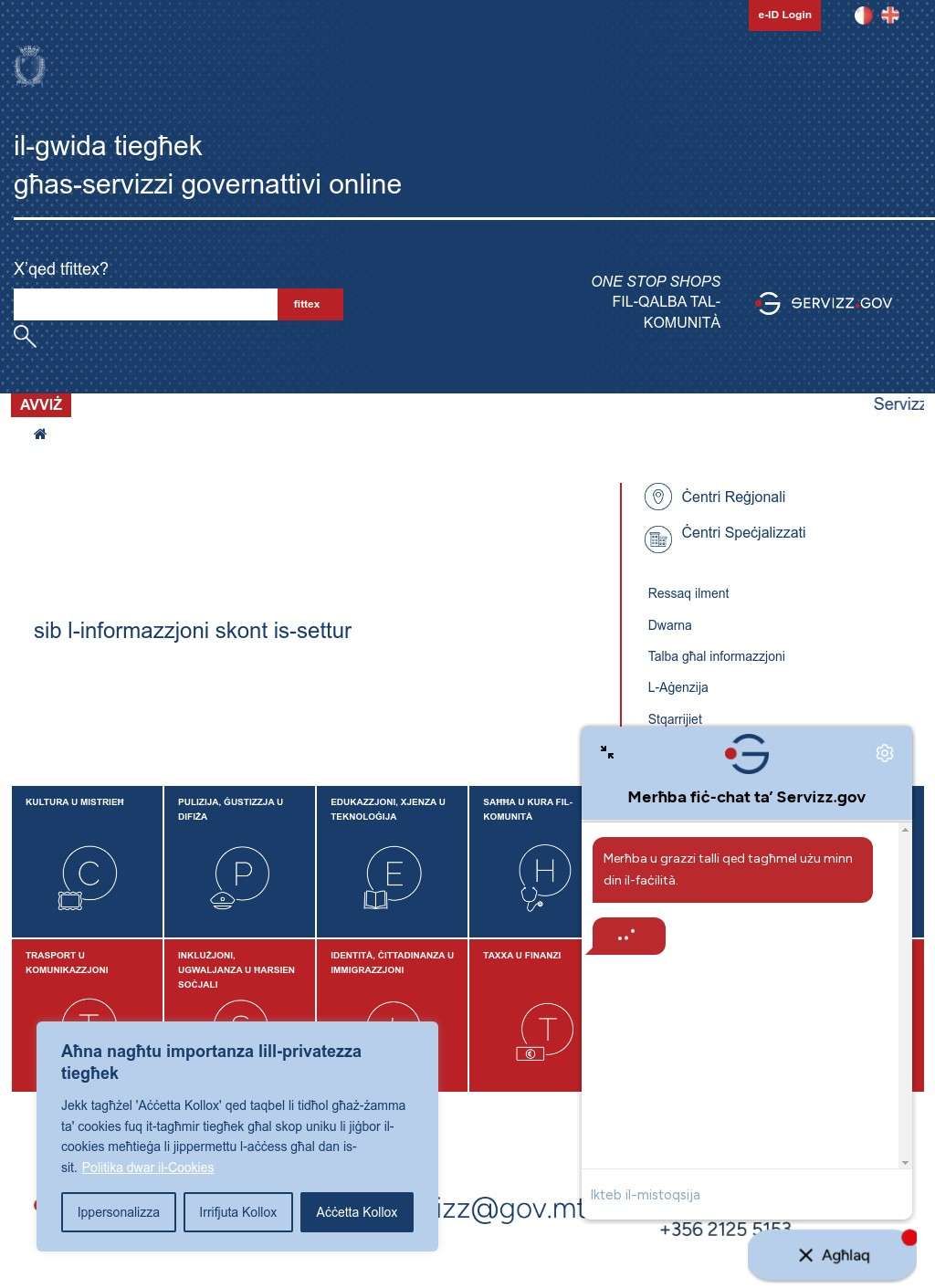
Type "starting a business" into the life-events menu on Servizz.gov.mt and the site does the sorting for you, pulling together the government steps that milestone actually requires instead of leaving you to guess which ministry owns which form. That is the whole idea behind Malta's official government services portal, which carries the tagline "Il-gwida tieghek ghas-servizzi tal-gvern online," your guide to online government services. It exists to be one door in front of a sprawling public administration.
The problem it solves is familiar to anyone who has dealt with a national bureaucracy: the service you need lives in some department you have to identify first, and half the effort is figuring out where to knock. Servizz.gov.mt tries to remove that first step entirely.
One gateway, many ministries
The portal acts as a single navigational layer sitting across every government ministry and agency in Malta. It does not replace those bodies; it points you into them. For a resident, a business owner, or a visitor, that means starting in one place regardless of which arm of government ultimately handles the request, and the site offers two different ways of finding your way in.
Sorted by sector
The first route is by subject. Servizz.gov.mt organizes government services into thirteen sector categories, and the labels are broad enough to catch most of what a person might need. Health and Community Care sits alongside Tax and Finance, Employment and Industrial Relations, Economy and Enterprise, Environment and Energy, Social Policy and Inclusion, Education, and Home Affairs, Justice and Security, among others reaching into transport, culture, agriculture, and foreign affairs.
Someone who already knows their question is a tax question, or a housing question, can head straight to the relevant sector and skip the rest. The categories are wide by design, which is the right call for a gateway whose job is to route rather than to answer, though a very specific query may still take a click or two past the sector page before it lands on the exact service.
Several of those sectors carry more inside them than their names let on. Economy and Enterprise folds together business support, tourism, and help for entrepreneurs, so a founder and a hotelier end up in overlapping territory. Social Policy and Inclusion gathers housing, social welfare, and inclusion programmes, the services people reach for at their most stretched. Science and Technology, Food and Resources with its agricultural remit, Arts, Culture and Sports, Human Rights and Civil Society, Foreign and European Affairs, and Public Administration and Local Government fill out the rest of the map.
It is a wide net, and the consistency of how each sector is laid out means a user who learns to navigate one has effectively learned them all.
Sorted by life event
The second route is the cleverer one, and I think it is the feature that most justifies the whole build. Instead of asking which department you need, the life-events navigation asks what is happening in your life: starting school, beginning work, changing residence, starting a business, reporting a crime. Each milestone bundles the government interactions it tends to trigger, so a person moving house or opening a company gets a guided path rather than a directory to comb through, since ordinary people do not think in ministries: they think in events.
A first job, a new address, a new business, these are the moments when someone suddenly needs several unrelated services at once, and Servizz.gov.mt lining them up by event is a genuinely user-shaped piece of design. It meets people where their actual questions start.
The finders and the extras
Beyond the two main routes, Servizz.gov.mt bolts on a set of practical tools. A benefits finder helps a user work out what support they might be entitled to, which is exactly the kind of thing people miss when they do not know it exists, and it quietly does the work of a caseworker by matching a person's circumstances to entitlements they may never have thought to claim. A service center locator points them to physical offices when an online step is not enough, closing the gap for anyone whose task cannot be finished on a screen.
Job vacancy listings surface public-sector openings for people looking to work for the state itself, and a news and updates section keeps the whole portal current, so the information a visitor acts on is the information that applies today. The site also keeps a presence on Facebook, Instagram, and TikTok, which extends its updates to where Maltese residents already spend their time, meeting them there instead of waiting for a visit to the portal.
None of these extras is revolutionary on its own, but together they turn Servizz.gov.mt from a static index into something closer to a working assistant for dealing with the state. A resident who drops in for one task often leaves having spotted a benefit or a vacancy they were not looking for, which is the quiet payoff of putting the tools in one place.
What holds all of this together is the promise of a single point of entry. The strength of Servizz.gov.mt is coordination: it takes a government made of many separate agencies and presents one coherent surface to the public, so a citizen does not have to hold a mental map of the entire administration just to renew something or claim something. The benefits finder and the life-events paths are the clearest expression of that ambition, because both start from the user's situation and work backward to the relevant office, which is the reverse of how most government sites are built.
For someone who has only ever dealt with government one department at a time, that reversal is the whole appeal of Servizz.gov.mt, and it is the reason the portal reads as built for the public first and the ministries second.
There is a natural limit to what a gateway like this can do, and it is worth stating plainly. Servizz.gov.mt is a navigational layer, so the quality of any given service still depends on the ministry that actually delivers it. A well-organized path to a slow or clunky underlying process only gets you to the door faster; it cannot fix what is behind it.
For most users that is a fair trade, since knowing where to go is genuinely half the battle, and Servizz.gov.mt handles that half well. The breadth is the point: whether the need is health, tax, employment, housing, education, or justice, Servizz.gov.mt claims a route to it, and the consistent structure across all those sectors means a user learns the pattern once and reuses it everywhere.
For a resident, the daily value is obvious. For a business, the Economy and Enterprise sector and the "starting a business" life event give a founder a running start on the paperwork. For a visitor, the same gateway logic applies to whatever official step brings them into contact with the Maltese state.
All three groups get the same organizing idea: one portal, many destinations, sorted either by sector or by the moment in life that sent them looking. Knowing which department to approach in advance is a shortcut Servizz.gov.mt is glad to skip past; not knowing is the ordinary case the whole portal exists to handle.