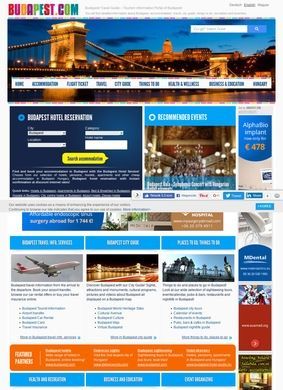
A Budapest TOP 10 attractions list sits right on the front page of the Budapest Travel Guide, next to seasonal coverage that swaps with the calendar: the Sziget Festival in summer, the Formula 1 Hungarian Grand Prix when the race comes to town. That homepage tells you what the Budapest Travel Guide is trying to be, a single planning hub for someone who has booked a trip and now has to figure out what to do with it.
Run by a company called BPONTKOM Kft. and billed as "Your Ultimate Guide to Budapest," the Budapest Travel Guide organizes the city into the categories a visitor actually thinks in. Attractions. Restaurants and cafes. Hotels. Thermal baths and spas. Nightlife. Shopping. Entertainment. Each has its own section, so the planning happens by topic instead of by endless scrolling through one long page.
What the guide puts in front of a visitor
The content splits along lines that match how a trip gets planned, and the Budapest Travel Guide keeps the practical and the aspirational in separate places. One part is for dreaming up an itinerary. The other is for the moment you are standing on a street corner and need an answer. The split is sensible, since trip inspiration and on-the-ground logistics are genuinely different needs, and folding them together tends to bury the useful bits under the pretty ones.
Beyond the category listings, the Budapest Travel Guide adds an events section covering concerts, exhibitions, sports, theater, and dance, plus a news area sorted by topic: art, gastronomy, culture, history, lifestyle, sports. Photo galleries run through the city's landmarks for anyone building a mental picture before arrival. The mix leans toward a reader who wants to browse and gather ideas, not simply confirm an address they already have.
The restaurant and cafe pages, the hotel section, and the thermal bath and spa listings are the parts a visitor is most likely to sit with, since eating, sleeping, and soaking are the daily rhythm of a trip to the city.
The FAQ that answers the awkward questions
The most quietly useful corner is the FAQ. It handles the things glossy guidebooks skip and travelers genuinely worry about: where to find a public restroom, which days are holidays, how tipping works in Hungary, how to get around the city, whether the boat tours on the Danube are worth booking. Practical, unglamorous, and exactly what someone opens a Budapest Travel Guide to settle before a trip.
For a first-time visitor who has never sorted out a foreign transit system or wondered how much to leave a waiter, that section does real work the pretty attraction pages cannot. Tipping and transport in particular are the two things that quietly trip up newcomers to a European capital, and having plain answers to both in one place is worth more than another glossy photo of the parliament building.
Where it hands you off
One honest feature is that the Budapest Travel Guide points outward. It links to official tourism sites, budapest.hu and budapestinfo.hu, instead of pretending to be the only source in town. For a commercial portal that is a small mark of good faith, since it sends a reader toward the municipal information when that is the better answer.
A site that only ever kept visitors on its own pages would be easier to distrust. The gesture also signals that the operators know their limits, which is reassuring in a category full of portals that overreach.
How far to trust it
Here is where the Budapest Travel Guide gets harder to judge. A search for outside opinion on the site itself comes back nearly empty. The reviews that surface are all about Budapest the city, on Tripadvisor, Expedia, U.S. News, and assorted travel blogs, none of them about budapest.com as a business. So there is no independent read on whether the recommendations are current, paid for, or genuinely useful to a stranger.
The absence is not proof of anything bad. It simply means the guide has to be judged on what is on the page, since no crowd of past users has left a verdict to lean on.
Contact on the Budapest Travel Guide is partial. A postal address for BPONTKOM Kft. in the city's seventh district is listed, along with an email and links to Facebook, Instagram, X, and YouTube, but no phone number appears on the page. For a trip-planning resource that is a minor thing, since most questions get answered by the content itself, though a traveler who wants to reach a person has only the slower routes.
An email and a registered company address at least establish that a real business stands behind the pages, which is more than some travel portals bother to show.
The freshness problem
The doubt that will not resolve is freshness. A city guide lives or dies on whether its restaurant picks, event dates, and opening details are current, and nothing on the Budapest Travel Guide, or in any outside review of it, tells a visitor how often the listings get updated. The seasonal homepage features suggest someone is tending the thing, but a suggestion is not a guarantee.
A reader planning around a specific concert or a particular thermal bath has no way to know from the site alone whether the detail they are reading was checked last month or three years ago, and that single unknown hangs over everything the guide otherwise gets right.