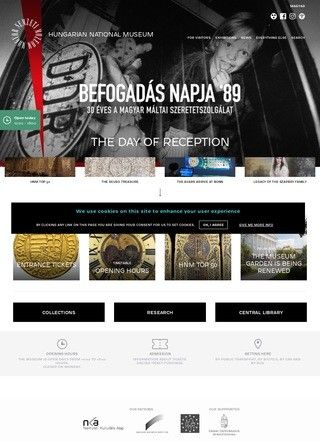
Someone planning a day around Hungarian history in Budapest usually arrives with a practical question: where is the actual stuff, the objects that anchor the story in physical form, and can the visit be arranged before leaving home. The Hungarian National Museum answers that on its English site without making a visitor dig. For a collection of this age and scope, that clarity is not automatic. The permanent collection is split across four departments, and the structure tells you what you are walking into before you buy a ticket.
Four departments spanning archaeology to photography
Archaeology covers the deep past. Early Modern History and Modern History carry the thread forward through the centuries that shaped the country. A Historical Photo Department sits alongside them, which is a quieter holding than the headline treasures but a genuine one, and a sign that the institution thinks about documentation as well as display.
Fifty artifacts including the Seuso Treasure
The objects do most of the talking. The site puts forward fifty highlighted artifacts, and a few of them carry significance well beyond Hungary. The Seuso Treasure is late Roman silver of a kind that few museums anywhere can show. The Coronation Mantle is tied directly to the crowning of Hungarian kings and is the sort of textile that historians cite in papers while tourists photograph it through glass. There is also Mozart's portable clavichord, an instrument that turns an abstract name into something you can stand in front of. These are not filler pieces chosen to pad a list. Each one is a reason on its own to make the trip, and the museum is right to lead with them.
Two centuries of collecting since 1802
What the museum was at its founding also shapes how you read the collection. It opened in 1802, which makes it one of the older national collections in Europe and explains the breadth: an institution that has been gathering for more than two centuries accumulates depth that a newer gallery simply cannot replicate. The Hungarian National Museum is not a single themed exhibition. It is the place where the national record was deliberately assembled and kept, and the four-department layout is the visible shape of that long project.
Temporary exhibitions with announced closing dates
Beyond the permanent holdings, the site lists temporary exhibitions with firm closing dates, and these are the kind of thing that decides whether a given week is worth the trip. One, built around Attila, runs through July 12. Another, on the treasures of King Louis I, stays open through December 31. Naming the end dates is a courtesy that planning visitors will appreciate, because it lets them line a trip up against a show that will not be there forever. A temporary exhibition is a different proposition from the standing collection, and the Hungarian National Museum keeps the two clearly separate so you know which you are coming for.
Programs designed for families
Family-oriented programming is also part of the offer, which broadens the audience past the specialist and the serious history reader. A national history collection can be a daunting place to bring children, and the presence of dedicated programming shows the institution has thought about that problem. It is one of the practical signs that the Hungarian National Museum treats visiting as something to be designed, not an inconvenience to be endured.
Affiliated archaeological sites beyond the main building
There is reach beyond the main building too. The Hungarian National Museum operates affiliated archaeological sites, so the institution is not confined to the rooms on Muzeum krt. That extends what a single ticket-holder might end up exploring, and it positions the museum as a network of places tied to the same record, not a single address. For anyone whose interest runs to the archaeology in particular, those affiliated sites are worth knowing about before a trip is planned.
Online booking, floor maps, collection access
The online side of the Hungarian National Museum's site is built for doing things, for booking and browsing as much as passive reading. There is online access to the collections, which lets a researcher or a curious traveller look before going. Tickets can be bought through the site, and guided tours can be booked the same way, so the visit can be assembled in advance without negotiating at a desk. A museum shop, a floor map, a news section, and a newsletter subscription round out the practical layer. The floor map in particular is the sort of thing people forget to value until they are lost on the second floor of an unfamiliar building.
Hours and closure information stated plainly
The hours are stated plainly: open Tuesday through Sunday, ten in the morning until six in the evening, closed Mondays. That Monday closure is common among major European museums, and stating it up front saves the wasted trip that catches out first-time visitors. The Hungarian National Museum gets it right by not burying it in a footnote.
On outside reputation, a search turns up no significant third-party review record for the Hungarian National Museum in the usual English-language travel databases, which is not unusual for a national institution of this standing. The museum's own publication history, the depth of the collection, and the weight of the specific pieces it holds are the more meaningful frame for assessing it.
Taking the whole offering together, the picture is of an institution that has organized two centuries of collecting into something a visitor can navigate. The departmental split gives the collection a backbone. The fifty highlighted artifacts give a first-time visitor a route through it. The temporary exhibitions give a reason to come now, before the Attila show closes in July. And the online tools mean the practical friction of a museum visit, tickets, tours, a map, the question of when the doors are open, is handled before anyone sets foot inside.
The Seuso Treasure and the Coronation Mantle are the pieces most people will travel for, and they are the kind of holding that determines where a serious history collection ranks in Europe. The Hungarian National Museum has them, shows them, and builds its highlighted list around them. Few institutions in Central Europe can make the same claim, and the Hungarian National Museum does not undersell it. A visitor who comes for those and stays for the Modern History rooms will have spent the day on the actual record of the country, which is what the institution set out in 1802 to preserve. That is not a modest achievement for a single afternoon.