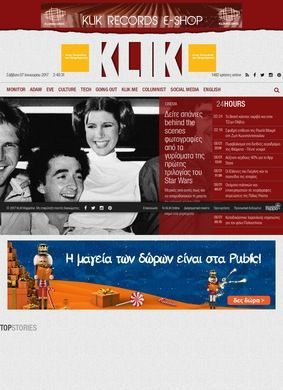
Someone chasing Greek pop culture, the music and film and television gossip and celebrity churn that a glossy title trades in, goes looking for Klik and hits an immediate snag: the website will not open. Two attempts on the homepage came back with a server refusing the request, and a second retrieval method, a scraping fallback, failed with an error of its own. The name a reader came for turns out to be real and long-established, yet the front door stayed shut for the entire time this review was assembled.
A listing is supposed to send a visitor somewhere, and this one did not. The destination failed to respond, and no amount of patience during the review changed that. A rate-limited response is not proof that Klik is gone for good, but for a visitor trying to read it on the day they visit, the practical result is the same: nothing loads.
The two failures were not even the same kind of problem. The homepage answered by turning requests away under load, while the separate scraping tool broke on its own end with a server error. Neither one points cleanly to a site that has been shut down, and neither one let a single page through either, which is the frustrating middle ground a reader is left standing in.
What can be reconstructed from elsewhere points to a Greek media brand with real mileage. Rendered KLIK in Greek, the publication has apparently been running since 1987. Its own YouTube channel boils the mission down to a line that translates as flexing pop culture since 1987, a phrase doing double duty as a founding date and a statement of intent.
The 1987 marker is the piece worth pausing on. A title old enough to predate the web, one that began in print and still carries a magazine identity, has lived through at least two complete upheavals in how pop culture gets made and covered: the arrival of the internet, then the migration of the whole conversation onto social feeds. Surviving both is no small thing for a publication in a market the size of Greece.
A Facebook presence still describes Klik as a magazine, which squares with that print lineage and suggests the brand never fully shed its origins even as it moved online.
A brand that files itself under pop culture is promising the churn of music, film, television, and celebrity, the sort of material that dates within a week and lives or dies on being current. That is what makes a homepage a reader cannot open a particularly poor look. The one thing this kind of publication cannot afford is to be hard to reach on the day someone wants it.
None of it, though, tells a visitor what the site itself holds today. That is the frustration sitting in the middle of this listing.
What can and cannot be verified about Klik
The honest read splits cleanly in two. Klik the brand is easy to trace. Klik the website is not, because the address a listing sends you to never loaded across repeated tries. Everything currently solid about Klik lives on social platforms, and the domain itself stayed dark.
That split is worth sitting with before moving past it. A reader who checks only the website would conclude Klik is inactive or gone. A reader who checks only social media would conclude Klik is thriving without reservation. Neither conclusion on its own is honest, since each one samples just half of what currently exists under the name.
The social footprint that does load
Where Klik reliably turns up is on the usual channels. There is an active Instagram account, a YouTube channel wearing that since-1987 tagline, and a Facebook group built around the magazine name. Those are the places where the brand is visibly still at work: posting, publishing, keeping its pop-culture thread going day to day.
For plenty of media names that has quietly become the real center of gravity, with the old website reduced to an archive nobody bothers to keep current.
If that is the case here, a reader loses less than it first seems, since the Instagram feed and the video channel carry the fresh material anyway and are the more natural home for celebrity and entertainment coverage in the first place. A print-era title that made it to the social age usually got there by leaning into exactly this kind of visual, short-form output, which fits the footprint on view: heavy on images and clips, light on a website anyone strictly needs to visit.
A feed is a window, not the whole house. It proves Klik is alive without revealing what klik.gr actually holds: which sections it runs, how far back the archive reaches, whether the writing has teeth or reads like filler. None of that could be confirmed, because the page never rendered even once.
So there are two versions of Klik in play. One is thriving on a phone screen. The other, judged only by its own domain, looks unreachable. Both were true at the same moment, which is a strange thing to report about a brand this established.
For anyone who arrives from a listing and meets a page that will not load, the workable move is to go where Klik plainly still lives. The Instagram account and the video channel are public, current, and easy to find, and between them they give a fair read on what the brand is putting out right now. It is a detour the listing should not force on a visitor, and it does not replace whatever the full site might hold, but it does get you to the living part of the operation while the domain sorts itself out.
The reputation that never turns up
Hunting for outside opinion on Klik leads straight into a thicket, and it ends empty in a telling way. The name is short and common, so search results crowd with unrelated companies that share it: technology and digital-services firms listed on business-review sites, an employer or two rated by their own staff, and camera, network, and event-software brands scattered across consumer rating platforms. Not one of them is the Greek publication.
Filter all of those out and nothing remains for Klik the magazine: no star rating, no customer reviews, no independent write-up from a third party. The only genuinely Klik-specific results are its own social accounts, which are not review platforms and post no scores at all. A common name is a real handicap here, since it drowns whatever reputation the actual title might have earned under a pile of namesakes doing entirely different things.
So a cautious reader who simply wants to confirm the site is the genuine article, and safe to open once it does, has no neutral source to lean on. The verification has to come from the brand's own feeds instead, which is a roundabout way to vouch for a homepage and asks more of those accounts than a reader might expect them to carry.
The upshot is plain. There is no third-party verdict on quality to borrow and nothing external on reliability, so a reader is left with the brand's own self-presentation and very little to check it against. It also means the ordinary tools someone would use to vet an unfamiliar site, a quick look at its rating or a scan of recent reviews, simply hand back other people's businesses instead.
Which leaves the doubt hanging over the rest. Klik carries a 1987 pedigree and a live social following, both of which mark it as a real going concern.
And yet the single address this listing points at would not answer across repeated attempts, with no outside source on hand to describe what Klik is like when the page does load. A visitor is left choosing between a name with decades of history and a homepage that, for the length of this review, behaved exactly like a site that was down, and from here there is no telling whether that was a passing stumble or the same wall the next person will run into.