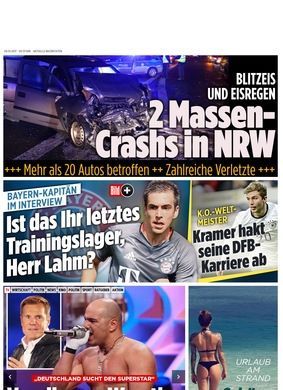
Running a live ticker through a Bundesliga match or a federal coalition crisis is what Bild.de is fundamentally about, more than any single article its editors produce. When a major verdict lands or a political resignation breaks, the site runs a rolling minute-by-minute feed with timestamps stacking up in real time, and that rhythm of constant updating is closer to the operation's core identity than the polished evening write-up. Built as the online arm of Bild, Germany's largest-circulation tabloid and a property of Axel Springer SE, Bild.de reads fast and loud, and it is engineered to keep a reader clicking from one headline to the next.
Live tickers for sports and breaking news
The German-language coverage spans the predictable big buckets. Politik handles government, parliament, and the back-and-forth of domestic and foreign affairs. Sport leans heavily into football, with Bundesliga matchday content front and centre, though the section reaches into other competitions. Unterhaltung covers celebrity news, television, and the gossip register that the print paper has traded on for decades. Around those sit Ratgeber, a consumer-advice and how-to section, plus Auto and Reise for cars and travel. Bild.de also runs regional editions tied to major German cities, so a reader in Hamburg or Munich sees local stories folded in alongside the national feed, which is something a purely national outlet would miss.
Content sections across politics, sport, entertainment
What gives Bild.de its shape is the freemium split. A large share of articles open freely, which is what keeps traffic numbers among the highest of any news site in the country. The deeper material sits behind BILDplus, the digital subscription. Pay for that, and the gate lifts on extended article versions, exclusive interviews, and the digital edition of the printed paper itself. The breaking, scannable stuff stays open to pull people in, and the reporting with more substance, plus the print replica, is what you are asked to fund.
Free articles with BILDplus subscription option
That model has real consequences for how the site feels to use. Casual readers can graze indefinitely without hitting a wall, while the more committed follower of a particular club or a running political story is steered toward the subscription. The premium interviews and the longer pieces are the carrot. Whether the gated content justifies the price is a personal calculation, and one that depends heavily on how much a given reader values the exclusives and the print access bundled into BILDplus.
Video, galleries, classified ads, WELT content
Beyond text, Bild.de carries a fair amount of video, photo galleries, and a TV-listings section, which fits the tabloid lineage. There is a classified advertising area, the kind of marketplace function that legacy papers have long maintained. The site also pulls in content from WELT, the sister title under the same Axel Springer roof, so a reader moving through Bild.de occasionally crosses into material originating from that more broadsheet-styled stablemate. The two operations sharing a corporate parent shows up in those crossovers.
Real-time match coverage and event feeds
The live-event coverage deserves attention because it is where Bild.de is at its most distinctive. During a match or a major news event, the ticker becomes the main event, and the rest of the page arranges itself around it. For sports in particular, this is a genuinely useful format: goals, cards, and substitutions land in near real time, and a reader who cannot watch the game can follow it closely through the feed. The same machinery covers elections, disasters, and breaking political developments, and it handles the load well enough that regular readers come back to it specifically for that function.
Speed and drama over measured analysis
The trade-off baked into that speed is the one any tabloid carries. Bild.de optimises for immediacy and emotional pull, and the headline writing reflects that. Stories arrive quickly and in volume, the framing tends toward the dramatic, and the line between hard reporting and entertainment is deliberately permeable. A reader who wants measured, slow analysis is in the wrong place; a reader who wants to know what just happened, right now, in plain German, is well served. The site knows exactly which of those two it is built for, and it does not try to be both.
Dense homepage designed for browsing
Navigation matches the content. The homepage is dense, headline after headline competing for attention, with the day's biggest story usually planted at the top and a long scroll of everything else beneath. It is busy by design. Someone arriving for one specific thing can find it through the section tabs, but the layout is plainly built to encourage drifting from story to story, which is the whole commercial logic of a high-traffic news outlet funded by a mix of advertising and subscriptions.
Outside reputation is worth noting. Bild.de draws substantial and long-running criticism from German media observers for how it frames people, particularly private individuals caught up in crime or scandal stories. The site's reach amplifies that effect in ways a smaller outlet would not. Press-council complaints about Bild and Bild.de are a recurring feature of the German media landscape rather than an isolated episode. None of that changes the practical usefulness of the football coverage or the breaking-news tickers, but it is relevant context for a first-time reader deciding how much interpretive weight to put on its framings.
For German speakers, Bild.de is hard to ignore simply because of its reach and the volume it puts out daily across politics, sport, and entertainment. The football coverage is thorough, the live tickers are quick, and the open portion of the site is generous enough that most readers will rarely feel pushed toward paying.
As a fast, high-volume source of what is happening in Germany, Bild.de does the job it sets out to do at a scale almost nothing else in the German market matches. The harder question is what a reader takes away after an hour on the site. The format rewards consumption over reflection, and the tabloid instinct that makes it gripping is the same one that draws consistent criticism of how it handles people and events. The volume-and-speed bargain is real, and so is the cost of it.