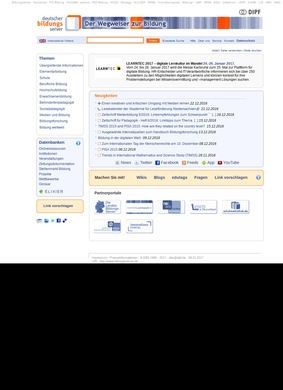
A secondary school teacher in Hamburg needs a vetted worksheet on cell biology by Monday, a parent three towns over is trying to work out how vocational tracks feed into apprenticeships, and a doctoral student is chasing one narrow strand of education research. Three different people, one recurring problem. German education spreads its material across thousands of ministries, universities, and regional bodies, and no single search box naturally covers all of it. The German Education Server: The Guide to Education sets out to be that box.
Run by the German education system for its own users, the portal gathers trustworthy websites across every learning stage, from kindergarten through to what it calls lifelong learning. Its audience is broad by design: educators, students, parents, and researchers, plus anyone in Germany who simply needs a reliable place to start. That plain framing is the honest description of what the German Education Server does. It does not teach; it points to where the credible material lives, which is a smaller promise and a more useful one.
From kindergarten to lifelong learning
The coverage is genuinely wide. Elementary education, higher education, vocational training, adult education, special education, educational research, and international perspectives each get their own gateway, so someone working in one sector does not have to wade through the rest to reach it. This is the part that justifies the name. A portal claiming to guide a whole national system has to hold the whole system, and the German Education Server carries the sectors a real map needs.
The international strand reaches past Germany's own borders, into global and comparative education, for readers whose questions do not stop at the national curriculum.
Access itself is treated as part of the work. Content comes in standard German, in sign language, and in plain language, a combination that helps parents with limited German, learners with disabilities, and anyone defeated by bureaucratic prose. The plain-language option is the piece I would point a newcomer to first. Plenty of official sites bolt accessibility on late; here it reads as a decision made early, and the German Education Server is steadier for it.
Tools built around the search
Search is the spine of the whole thing. The German Education Server offers both a plain box for quick lookups and an advanced mode for narrowing by sector or resource type, and around that core sit several features that push it past a static reference site. None of them is flashy.
Who it serves shapes what it stresses, so a trainee, a professor, and a parent each land on a different door from the same front page. A trainee wants worksheets ready for Monday, a professor wants the research strand, and a parent wants the plain-language explainer three clicks from the front page, and the same search box gets all three where they are going. Together, those features are the reason an educator keeps the tab open through a working week.
Events and the job marketplace
The portal lists education events and runs a job marketplace aimed squarely at the sector, which gives it a practical use well beyond research. A teacher can track a conference and scan vacancies in the same visit.
For a public resource that is a sensible pairing, and it keeps the German Education Server relevant to people already inside the profession, not students alone. Career listings rarely sit this close to teaching material, and the proximity is the point.
The innovations database and open resources
Two entries stand out here. An educational innovations database collects new approaches and projects, and an open educational resources portal points to material that can be reused and adapted without licensing headaches. For teachers building their own lessons, the open resources strand is the sort of thing that saves an evening of hunting.
Researchers get the innovations feed as a way to see what is being tried elsewhere. The German Education Server treats both as full sections with their own front doors, not links buried three clicks down.
Bildung + Innovation and the partner portals
Editorial content rounds it out. The magazine "Bildung + Innovation" and an accompanying podcast series give the German Education Server a voice of its own, covering developments in the field for readers who want analysis instead of a bare link list. Beyond its own walls the portal hands the reader on to specialists: ELIXIER for educational media, Fachportal Padagogik for pedagogy literature, edutags for teacher learning resources, and Schulmediothek for school libraries. A newsletter and feeds on Mastodon, BlueSky, and LinkedIn keep regular users current.
The German Education Server, put simply, works as a hub that trusts other good sites to do the specialist work rather than trying to duplicate it.
What the German Education Server: The Guide to Education will not do is decide for anyone. It hands over vetted sources and leaves the judgement of which one fits to the reader, which suits a researcher and can frustrate someone who wanted a single tidy answer. For the teacher facing a Monday deadline or the parent decoding the school system, that trade usually pays off, because a curated map beats a cold search most days of the week.
A national system this scattered rewards whoever starts from a checked guide rather than an empty search bar, and that is the whole case for keeping this one bookmarked.