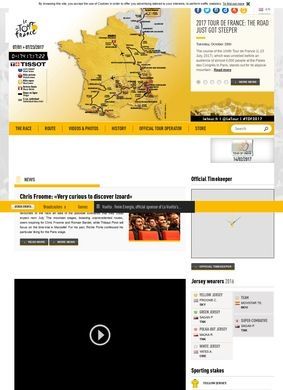
LeTour France runs a live map of the race that refreshes every three to five seconds, plotting the peloton's position and the time gaps between groups while a stage is still on the road. That single feature tells you what the site is for. This is the official home of the Tour de France, the annual professional road race, and it is built to put a spectator inside the event as it happens instead of leaving them to piece it together after the fact.
The site is run by ASO, the Amaury Sport Organisation that organizes the race itself. Worth being straight about one thing first: the page did not load when this review was put together, so what follows comes from how LeTour France is indexed and described elsewhere rather than from a clean walk through the live site. The picture that emerges is still reasonably clear, and the pieces line up with what an official race site would be expected to carry.
The route, stage by stage
The backbone of LeTour France is the race route. The site lays out the stages, the host cities, and the dates, and a recent edition it indexes covered seven regions and twenty-nine departments across twenty-one stages. Those stages break into flat days for the sprinters, hilly ones for the breakaway riders, and mountain stages with summit finishes where the race is usually won or lost. The dates and host cities matter for the same reason, letting a fan work out which stage to plan a day around and which town the race will actually pass through.
For a follower, that route section on LeTour France is the reference they will return to most. It is the difference between watching a stage cold and knowing in advance that a climb in the final ten kilometers is where the contenders will attack. A three-week race is really a set of very different days stitched together, and the route pages are what let a viewer tell a flat sprint stage from a mountain showdown before the flag drops.
Rankings, teams, and rider profiles
Alongside the route, LeTour France carries the competitive detail: team pages, rider profiles, and the rankings that shift every day of the race. A "Teams" section and a "Rank" section let a follower track who leads each classification and which squad a given rider belongs to. A "Required infos" page rounds out the practical side.
For anyone trying to follow a three-week race with well over a hundred riders spread across dozens of teams, having the standings and the rosters in one official place is the thing that keeps the story legible rather than a blur of unfamiliar names. Rider profiles fill in the human side, the background on the names that a first-time viewer would otherwise have no way to place.
Following the race live
The live tracking is where the site earns its keep during race season. Beyond that fast-refreshing map, LeTour France pairs the web experience with an official mobile app for iOS and Android, so the same position data and time gaps travel with a spectator who is away from a desk. During a mountain stage, that combination is the closest thing to a race radio a fan at home can get.
A "The race" overview page gives the newcomer the wider frame, explaining what the event is before they dive into a specific stage. That pairing does more real work than it looks like. The map is useless to someone who does not yet know what a general classification or a time gap means, so having a plain explainer sitting next to second-by-second tracking means LeTour France works for the once-a-year viewer and the obsessive alike.
Coming to the Tour in person
For the spectator who wants to stand at the roadside instead of watching a screen, LeTour France has a "Come to the Tour" section built around exactly that. Turning up to watch a stage in person involves logistics that a broadcast never has to think about: where the route passes, when the riders are expected, how to get there, and how to be in the right place safely on a road that will be closed for hours.
A dedicated spectator section is the sensible answer, and it sits within reach of the same route pages that tell you where the race is heading next. For a family planning a roadside picnic to catch thirty seconds of the peloton flashing past, that kind of practical detail is the whole point of the section.
Games, merchandise, and the amateur ride
Around the core race coverage sits a layer of tie-in products. LeTour France references official video games for PC, Xbox, and PS5, a "Fantasy by Tissot" game for followers who want to pick riders and score points against friends, and a "Cycling Legends" mobile game for iOS and Android. There is an official merchandise store as well, for the jerseys, caps, and souvenirs that trail any event this size. The games span consoles and phones alike, so a follower can pick whichever screen is nearest to hand.
These extras are aimed at the fan who wants to stay attached to the race between stages, or between editions. A fantasy game keeps someone checking results they might otherwise ignore, and the store turns fandom into something you can wear. None of it is essential to following the race, but it is the machinery that keeps a casual fan attached in the long months when no Tour is running.
One offering stands a little apart from the rest. L'Etape du Tour de France, a separate site, runs a version of the race open to amateur riders, letting non-professionals ride a genuine Tour stage on closed roads. It is a distinct thing from the coverage on LeTour France, aimed at people who want to feel the route under their own wheels instead of watching someone else ride it. The store, the games, and that amateur ride all hang off the same event, and each points back toward the race the site is built around.