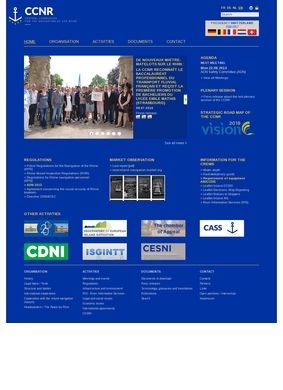
A barge operator moving cargo from Basel down to Rotterdam runs into a wall of practical questions before the vessel even casts off. Is the hull certified to current technical standards? Does the crew hold qualifications that the next country downstream will accept? Which police regulations apply on the stretch ahead, and what reporting is expected at each border crossing? The Central Commission for the Navigation of the Rhine sits at the source of those answers, because it is the body that writes and maintains the binding rules that govern the river. Its site is where the regulatory groundwork behind every Rhine voyage is set down and kept current.
What grounds the whole thing is age and mandate. Established in 1815, this is the oldest international organization in the world, and it exists for one river. That narrowness is a strength. The Central Commission for the Navigation of the Rhine does not try to cover every waterway in Europe; it concentrates on the Rhine and the corridor of trade that runs along it, and the depth of its work reflects that focus. The member states behind it, Switzerland, Germany, France, the Netherlands, and Belgium, are precisely the countries the river touches, so the legal agreements it manages carry force across every border a vessel crosses on a single trip.
Regulatory standards for vessels and crews
The regulatory core is the most substantive part of what the Central Commission for the Navigation of the Rhine provides. Vessel inspection requirements and technical standards are handled here. Crew qualification and certification rules sit alongside them, covering the people who run the vessel as well as the steel they stand on. Police regulations for the river complete the picture. Read together, these are the rules that decide whether a given craft and a given crew may legally work the Rhine, and they are issued by the institution with the authority to issue them. For a sector where a single non-compliant certificate can halt a shipment, having one source for all three is genuinely useful.
Real-time navigation data and traffic coordination
Beyond the rulebook, the Central Commission for the Navigation of the Rhine operates River Information Services, which feed real-time navigation data and reporting systems used to coordinate vessel traffic. This is the operational layer that sits underneath the regulations: rules tell you what is allowed, and the information services tell you what is happening on the water right now. A traffic coordinator or a master planning a passage gets something immediate and practical here, not a policy document to file away.
Market analysis for inland shipping
The economic reporting is a second strand worth knowing about. The organization publishes regular market observation reports and analyses on inland waterway transport across Europe. That reach extends the work of the Central Commission for the Navigation of the Rhine past the river itself and into the wider transport economy it helps move. Freight forwarders, port authorities, and analysts all need to understand where inland shipping volumes are heading, and the reports land with enough detail to be genuinely usable rather than decorative.
Those two functions, the live services and the market observation, show an institution that has not frozen in its founding century. It is publishing current data and current analysis for an audience that goes well beyond its five member states.
Preparing for autonomous vessel operations
Forward-looking work is visible too, and it is not window dressing. The Central Commission for the Navigation of the Rhine is developing regulatory frameworks for automated and autonomous vessel navigation, which puts it ahead of a problem the rest of the sector is only starting to confront. Writing rules for crewless or semi-crewed vessels before they become commonplace is the harder, slower kind of work, and it is exactly what a standards body should be doing while there is still time to get it right. The same applies to its environmental track: emissions reduction standards for inland vessels are part of its infrastructure and environmental initiatives, tying the river's commercial future to cleaner operation.
Crew welfare and working conditions
Crew welfare and social conditions in the inland navigation sector also fall within its remit, which is a reminder that the work is not purely technical. Behind the certificates and the emissions figures are people who live and work on these vessels, and the organization treats their conditions as part of its mandate. That breadth, from hull inspection to social policy to autonomous navigation, is unusual for a body tied to a single river, and it reflects how much one waterway can carry.
There is also an administrative side. A member extranet handles functions for the states involved, the kind of behind-the-login machinery that keeps an intergovernmental body running. Leadership for 2026 to 2027 rests with Swiss President Ambassador Roland Portmann, and the rotation of the presidency among member states is part of how the Central Commission for the Navigation of the Rhine maintains its balance across five countries. None of this is flashy, but it is the structure that lets binding decisions actually bind.
A search for independent reviews or ratings of the Central Commission for the Navigation of the Rhine on general platforms turns up nothing. That is not surprising for an intergovernmental regulatory body; its audience does not post on Trustpilot. The credibility here comes from the institutional record: over two centuries of continuous operation, five signatory governments, and a legal framework that ships depend on to move. That track record is more legible than any star rating would be.
For someone trying to make sense of how the Central Commission for the Navigation of the Rhine is set up, the pieces fit together clearly. There is a legal foundation reaching back to 1815, a living body of regulation covering vessels, crews, and conduct on the water, an operational information service, an economic research output, and a forward agenda on emissions and automation. Each part answers a different need, and the site keeps them in one place rather than scattering them across separate agencies. That consolidation is the practical payoff of dealing with one institution that owns the whole river.
Institutional authority from two centuries of operation
The long continuity from 1815 to the present is the through-line that makes decisions by the Central Commission for the Navigation of the Rhine credible to the states that follow them. An operator does not have to trust a new entrant or guess at which rule applies; the answers come from the body that has been governing this river for over two centuries. That quiet authority is hard to overstate in a sector where compliance is not optional.
Focus on Rhine navigation limits broader application
If there is a limit to what the Central Commission for the Navigation of the Rhine offers, it is the obvious one: this is not a general transport resource. Someone working the Danube or the Seine will find little here that applies directly, and the focus on the Rhine means technical depth comes at the cost of breadth. For its actual audience, that trade is the whole point. The people who need vessel standards, crew certification rules, real-time river data, and freight analysis for the Rhine corridor get a single authoritative home for all of it, maintained by the institution that wrote the rules in the first place.