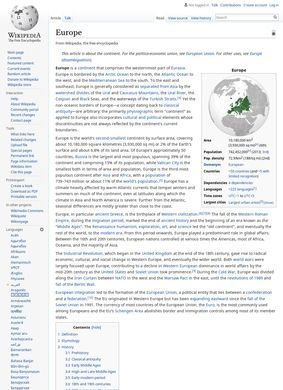
What does a single page need to give you before you trust it as a starting point on an entire continent? Wikipedia Europe answers that by packing the basics into one long, cross-linked reference: where the landmass begins and ends, how many people live there, which states sit inside it, and how the place got to where it is now. It opens with the grounding most readers want first. Europe covers roughly 10,186,000 square kilometres, its eastern edge drawn along the Ural Mountains, the Ural River, the Caucasus, and the Caspian and Black Seas, separating it from Asia along a boundary that has always been more convention than coastline.
Geography and population basics
From there the page settles into figures a reader can actually use. The population sits at about 745 million, which places Europe third among continental landmasses by headcount. Russia is named as both the largest and the most populous of the roughly fifty sovereign states described, and the article carries country-level breakdowns alongside its mention of major urban centres. Climate gets a clear, physical explanation: the Gulf Stream and Atlantic currents do much of the work in keeping the western half milder than its latitude would suggest. None of this is dressed up. It reads like reference material meant to be checked, and Wikipedia Europe delivers it in a register that respects the reader's time.
Historical coverage from prehistory onward
Deeper than a quick skim might suggest. The article walks the full span, from prehistory through to the present, and it does not treat the early stretch as a footnote. Neanderthals and Cro-Magnons get their place before the page moves into Classical antiquity, where Ancient Greece and Rome anchor the narrative. The Middle Ages and the Early Modern period follow in sequence, and the coverage carries through the upheavals of the twentieth and twenty-first centuries. A reader who arrives knowing only the broad shape of European history can leave with a working chronology, and one who wants more can follow the dense web of links into dedicated articles on each era.
Cross-references as encyclopedia hub
That linking is where Wikipedia Europe proves its value as a hub. It is less a closed essay than a junction. Almost every named country, region, war, and movement carries a cross-reference to its own fuller treatment, so the article functions as a map of the rest of the encyclopedia. Long survey pages like this work best as launch points, and Wikipedia Europe is built exactly for that use: read the section, click through when a detail pulls you in, come back to the spine. The structure rewards a reader who skims first and drills second.
Politics, economics, culture
The political coverage sits comfortably beside the history. Wikipedia Europe addresses the European Union's role and the wider question of European sovereignty structures, which is the sort of material that dates quickly and benefits from continuous editing. Because volunteer editors keep the page current under Wikimedia Foundation oversight, the political and demographic figures tend to track reasonably close to present reality, which is more than can be said for a printed reference left on a shelf for a decade.
Economic data in multiple framings
Economics get their own treatment too, and Wikipedia Europe does not flatten it into a single number. GDP appears in both purchasing-power-parity and nominal terms. Those two framings can tell quite different stories about the same set of countries, and pairing them on one page lets a reader see the gap instead of trusting whichever figure a headline happened to quote. For anyone comparing European economies against other regions, that side-by-side is genuinely useful.
How does Wikipedia present religion and language?
Culture and religion round out the substance. Wikipedia Europe notes Christianity at 76.2 percent of the population and sets that figure inside broader coverage of European philosophy, art, and science, along with the foundations of Western civilization. The treatment is descriptive rather than celebratory, which suits a reference page. Language data follows the same plain approach: Russian, German, French, English, Italian, and Spanish are identified among the major tongues, giving a reader a quick sense of the continent's linguistic spread without pretending to be exhaustive.
Visual elements and data tables
Wikipedia Europe is more than a wall of prose because of its data tables, statistical snapshots, and maps. A reader who prefers to scan numbers can pull what they need directly. The infobox style of presentation, with area, population, and density gathered in one block, is the kind of thing you reach for when you want a single figure fast. The maps anchor the geographic claims, which keeps the boundary discussion from staying abstract. These elements carry real information and shorten the path to it.
There are limits worth naming, and they are the ordinary limits of the format. A page edited by many hands can vary in depth from section to section, and a survey article on something as large as a continent will always compress more than a specialist would like. The figures are snapshots, accurate to the moment they were last revised, so a careful reader treats the population and economic numbers as close approximations, not fixed truths. Wikipedia Europe handles this honestly by sourcing its claims and pointing the reader onward to fuller articles, which is the right posture for a general reference. None of these caveats undercut the value of the page; they mark where its job ends and a more specialized source begins.
The fact that the whole thing costs nothing is easy to take for granted, and worth saying plainly: Wikipedia Europe is free. The article is openly editable and available in multiple languages through the wider platform, so a reader in one country can compare the framing in their own language against the English version. That multilingual reach is part of why the page works as a shared baseline: a student in Madrid, a journalist in Warsaw, and a researcher in London can all point to the same reference and argue from a common set of facts. The continuous volunteer maintenance means the page rarely goes stale in the way a static reference would.
Weighing it all together, Wikipedia Europe does the unglamorous work of a good encyclopedia entry well. It gives the geography, the numbers, the long history, the political and economic picture, and the cultural sweep, then hands the reader the links to go further. The writing stays measured, the data stays verifiable, and the cross-references turn one page into a doorway onto thousands. That combination is exactly what a general reference on a continent should be, and Wikipedia Europe meets the standard without padding or overreach. Read the lead section and the infobox for the shape of things, follow the in-text links into whichever specific country or period you actually care about, and use the cited references at the foot of each claim when the argument demands a primary source.