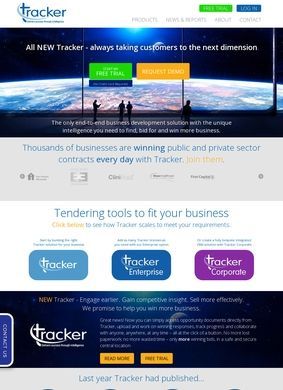
Eight and a half million contracts is the headline number on this site, and it tells you quickly what kind of operation Tracker Intelligence is. The company sells public sector procurement data to UK businesses that chase government and council work, and the scale of that database is the whole pitch. Sitting underneath it are award records and historical procurement data, so a sales team can see what is open now alongside who won past contracts and roughly what the market paid.
Database scale and procurement records
Tracker runs out of Glasgow and is incorporated in Scotland under BiP Solutions, a parent group that has been in the procurement information trade for a long time. For a product like this, that background is genuinely relevant: the value of a tender database depends entirely on how thoroughly someone is feeding it. A standalone startup promising 8.5 million records would invite skepticism. A long-running group with an established place in UK procurement is a more believable source for that volume, and it gives Tracker a foundation many rivals cannot claim.
Features for sales and business development
Around the core database sit the features you would expect a buyer to weigh. There is spend analysis and market analytics, a separate framework database, and a contact database listing 586,000 buyers and 85,000 named contacts, aimed squarely at sales and business development people who want a route to whoever signs off on a contract. The newer addition Tracker leans on is Aria Intelligence, an AI tool that matches contracts to a company profile, plus smart alerts that push relevant tenders out instead of making you go look. Customisable dashboards and API access round it out, the latter being the kind of thing a data team needs if it wants to pull procurement signals into its own systems. Taken together, this is a wide product, and Tracker clearly aims to be the single place a bidding operation checks each morning.
Pricing tiers without public costs
Tracker splits its pricing into four named tiers: ICONIQ, LOGIQ, dynamiq, and analytiq, scaled from micro-enterprises up to large organisations. The site is open about who each tier targets, with bid managers, sales and marketing teams, data teams, and strategic leadership all getting a mention. What the public pages do not appear to do is put actual figures next to those tiers, which is normal for B2B data subscriptions but does mean a prospective buyer has to make contact before knowing the cost. That is a friction point worth flagging for anyone trying to compare Tracker against cheaper or more transparent options quickly.
Building trust through market insight
The published procurement reports and market insight pieces are a sensible addition. They give a visitor something concrete to read before talking to sales, and they double as evidence that the company understands the sector it operates in. Free resources like that tend to do more to build trust than any amount of feature copy, because you can judge the quality yourself. They also show that Tracker treats public procurement as a subject it studies rather than a list it resells, which is reassuring when the whole proposition rests on the accuracy of the underlying data.
This is where the picture gets complicated. On Trustpilot the Tracker Intelligence presence amounts to just two reviews averaging 2.9 out of 5. That is far too small a sample to read anything into, good or bad. Two ratings tell you almost nothing about a platform serving businesses across the UK, and treating that score as a verdict would be a mistake in either direction.
Inside the review landscape
The search picture is muddied further by name collisions. Listings on G2 and Capterra that surface under "Tracker" turn out to be unrelated products, an applicant tracking system in one case and a fleet GPS tool in another. So the apparent review trail mostly leads somewhere else. The parent brand, BiP Solutions, carries its own Trustpilot footprint with passing references to this product inside individual reviews, but that is not a clean body of feedback on the platform itself. Anyone doing due diligence should know that the independent evidence is sparse and easy to confuse with namesakes.
Contact is handled through a web form, and the registered office in Glasgow is listed publicly alongside the company and VAT numbers. There is no phone line or direct email shown on the homepage, so the first move is the form. For a data subscription business that expects a sales conversation anyway, that approach is reasonable enough, though buyers who would rather phone a vendor will certainly notice it.
Tracker is a serious, well-sourced procurement intelligence product with real depth behind it, let down only by an outside reputation trail too sparse to confirm what the platform promises. The sensible comparison is Stotles, a newer UK procurement platform that competes directly on tender data and tends to be more upfront about pricing and self-serve access. Stotles may suit a smaller team testing the water. Tracker, with its larger contact database, deeper historical records, and BiP heritage, is the stronger fit for an organisation that lives and breathes public sector bidding and wants the fullest dataset available. The published evidence supports the trial; the verdict beyond that depends on the data.