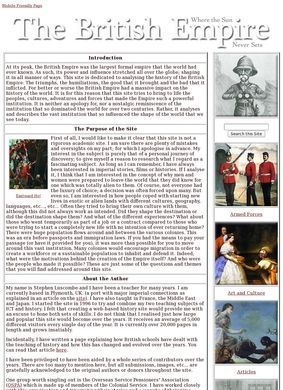
Running to something like 20,000 pages, The British Empire is held together by one person, Stephen Luscombe, who builds and maintains the whole thing out of Plymouth. That ratio of scale to staffing tells you most of what you are looking at: a decades-long personal undertaking, not an institutional product, pulling in more than 5,000 visitors a day. The material covers roughly five centuries, from 1497 to 1997. Few independent history sites reach that size, and fewer keep daily traffic at that level once they do; The British Empire manages both.
The period framing sets honest limits on the subject. The British Empire opens around the Cabot voyages and closes with the handover of Hong Kong, and inside that span the site tries to hold the entire story at once: the armed forces, the colonies, the people who ran them and the people who resisted, the maps that kept redrawing the world. It describes itself as neither apologetic nor nostalgic, which is a useful flag to plant on a topic that tends to drag writers toward one pole or the other. Whether a given article lives up to that is a question for the individual article, but the stance is stated in plain view from the first screen, and there is some value in a site declaring where it stands before you read a word of the history.
Content organization across fourteen sections
The British Empire splits its content across fourteen or more major sections, and the labels stay concrete rather than decorative: Armed Forces, Art and Culture, Articles, Biographies, Colonies, Discussion, Glossary, Hiking, Library, Links, Map Room, Sources and Media, Science and Technology, and Timelines. The breadth covers serious ground, arranged around the way someone actually researches a subject this big, by theme, by person, by place, by date. A glossary and a long run of timelines sit next to the heavier essays, so a casual browser and a student hunting one specific fact are both served by the same underlying structure.
Library resources with dual indexing
The Library is, of all the sections in The British Empire, the one a reader is likeliest to return to. It gathers book reviews of imperial and colonial history titles and indexes them two ways, by title and by author, the sort of double cross-referencing that takes real patience to build and quietly saves a reader hours. For anyone working out what to read next on a particular colony or campaign, a standing shelf of reviews sorted both ways is the kind of resource that justifies a bookmark on its own. The Map Room and the collections of photographs and artwork carry the visual side, and the biographies cover the figures who keep surfacing across the wider narrative, so a name you meet in one essay is rarely a dead end.
Search function enables navigation at scale
Beyond the reading there is a student zone with brainstorm boards, a set of reviews of television and film treatments of the period, and a body of multimedia sources. An integrated search function ties the pages together, which on a site this large counts as a necessity instead of a nicety. The British Empire would be close to unnavigable without it, since no menu could reasonably hold 20,000 entries; on something this size, search is what keeps The British Empire usable at all, and it is sensible that the search box, not the navigation bar, does the heavy lifting.
Discussion group and community interaction
Interaction on The British Empire runs through a linked Facebook discussion group instead of an on-site forum, which is a sensible call for a one-person operation. It shifts moderation and hosting onto someone else's infrastructure and meets readers where a good many of them already gather. The Discussion section points outward to that group. It is a lighter form of community than a full message board, but it exists, and it gives an audience of students, teachers, historians and general enthusiasts somewhere to compare notes and argue over the details.
Funding model and contact information
Upkeep is funded by PayPal donation, framed around maintenance instead of profit, and that fits the character of the whole project. A site of this size carries genuine hosting and time costs, and inviting readers to put something toward keeping The British Empire online is a clean arrangement with nothing bolted on. There is no shop, no membership wall, no course being pushed at the bottom of an article. The ask is small and the purpose behind it is stated, which is about as honest as a funding model gets.
Direct email access to the author
Contact goes through a direct author email, the owner's first name at the site's own domain, so a reader who catches a factual error or wants to suggest a source reaches the person actually responsible for The British Empire. There is no postal address and no phone number, and the email address sits a few clicks in instead of out front, so you have to go looking for it.
For a reference site maintained by a single named individual, that is a fair trade and not a real gap. The point of contact is the author himself, which is a good deal more direct than what plenty of larger operations put in front of you. He has named himself, attached his location, and put his address on the work, none of which is required and all of which makes the site easier to trust.
Assessing credibility through authorship and traffic
Independent commentary is scarce. A search surfaced the site's own pages plus a handful of unrelated reviews of other British Empire material from outlets such as the BBC and the Telegraph, but nothing that amounts to an independent assessment of The British Empire itself. The steady daily traffic points to a readership that arrives, uses the material and leaves again without filing a public rating, which is the ordinary pattern for reference sites people quietly lean on. Someone weighing it up has the size, the named authorship and the stated editorial line to go on, and on a thirty-year-old single-author archive of this scale, those are worth more than any ratings count would be.