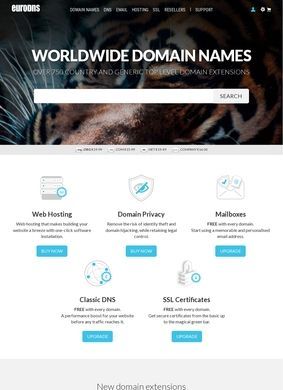
ICANN accreditation since 2002, Luxembourg registration, and a catalogue of more than a thousand top-level domains: that is the quick sketch of EuroDNS before you get into the specifics. The headline price points are competitive without chasing the bottom end of the market. A .com runs 10.99 euros a year, .eu is 12.99, and a .online can be had from 3.00 to start.
Domain registration with bundled services
The domain side is where EuroDNS feels most thought-through. Beyond plain registration and transfers, there is a bulk search with AI suggestions, a WHOIS lookup, and domain privacy protection from 5.00 euros a year. Every registration bundles free SSL, DNS, and branded email, the kind of inclusion that quietly saves money once you add up what other registrars charge for the same extras individually. EuroDNS also offers Trademark Clearinghouse and domain blocking options for brand protection, which points at a customer base that includes companies with names worth defending alongside hobbyists grabbing a first site.
Hosting options from shared to WordPress
Hosting fills out the rest of the menu. Plesk shared hosting opens at 1.99 euros a month for a single one-gigabyte site, and Managed WordPress Hosting starts at 5.99. EuroDNS lists an SSL line running from 15.99 a year up to an ACME automated certificate management service at 29.99, plus a Web Security Suite. Email comes either as a branded Email Cloud Suite from 1.36 a month or through Microsoft 365. Anycast DNS, the SiteJet website builder, and Jetpack for WordPress round it out. The spread is wide, and the named audience runs from individuals through small businesses, agencies, enterprises, and resellers.
Support channels in Luxembourg
Contact is direct. Two Luxembourg phone numbers sit on the EuroDNS site, one for support and one for sales. There is a contact form inside the customer portal at my.eurodns.com and a separate help portal at help.eurodns.com. Reaching a human does not look like a maze.
Customer ratings across review platforms
EuroDNS quotes a Google rating of 4.3 out of 5 across 452 reviews and a customer satisfaction score of 8.18 out of 10. The wider picture is more mixed once you step off the company's own site. Trustpilot carries 299 reviews with feedback described as mixed. HostAdvice shows 17 user reviews, also split. Smaller samples land lower: WHTop at 5.5 out of 10 from only two reviews and Knoji at 3.8 out of 5 across 43, while G2 has a single entry. That spread is normal for a registrar two decades old; the volume on Google and Trustpilot is the figure worth weighing, and it lands in respectable territory without tipping into glowing.
Transfer authorization codes raise concerns
One complaint recurs across more than one platform and is worth taking seriously. Several reviewers describe difficulty getting EPP or authorization codes when they tried to move a domain out to another registrar. That code is the key that lets you leave, and a registrar that makes it hard to obtain is friction at the exact moment a customer has decided to go elsewhere. I read that pattern as the single most useful data point in the whole reputation file, because transfer-out behaviour tells you how a provider treats customers who are no longer a paying win for them.
Comparing price against feature depth
Set against that, the EuroDNS offering itself is coherent. The company is not trying to be a discount bin. The free SSL, DNS, and branded email on every domain, the multilingual support across more than 20 years of operation, and the security tooling all read like a registrar aimed at people who want one provider to handle infrastructure properly. The 1,000-plus TLD count genuinely makes a difference if you need a niche extension that the giant registrars skip or bury. For straightforward .com ownership the price is fine; for the obscure extensions, the catalogue is the draw.
An agency or business wanting domains, hosting, email, and certificates under one login, from a provider with real phone support and a long track record, has a sensible case for EuroDNS. A solo user chasing the absolute lowest sticker price has cheaper options elsewhere, though they would lose the bundled extras in the trade. The enterprise brand-protection services are a clear differentiator that budget registrars do not offer.
Verify transfer policies before signing up
What keeps coming back is that exit door. The EuroDNS catalogue is deep, the pricing is reasonable, the contact routes are plain to find, and two decades of operation count for a great deal. None of that fully answers the concern that the moment you decide to move your domain, EuroDNS may turn the simple act of handing over an authorization code into the hardest part of the relationship. That doubt does not resolve itself anywhere in the public record, and it is the thing a prospective customer should ask about before going in.