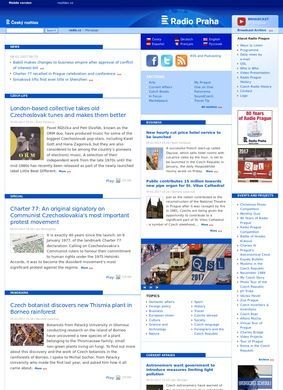
Where can a listener outside the Czech Republic follow Czech news, culture and history in a language they actually speak, straight from the country's own broadcaster? That is the question Radio Czechoslovakia answers. Listed here under that older name, the service is the official international broadcasting arm of the Czech Republic, known today as Radio Prague International and run by the state public broadcaster, Cesky rozhlas, or Czech Radio.
The name on this listing points to the past, the sort of holdover title a business directory entry keeps even after the service itself moved on. Radio Czechoslovakia recalls the era when Czechoslovakia was one country, and the station has been sending programmes out to the world for the better part of a century, from its early transmissions near Podebrady onward. That heritage has a practical payoff: the station has spent generations refining how to talk to an outside audience.
It is one of the older international broadcasters still going, and that longevity is part of what it offers: an institution with deep archives and a settled sense of its own purpose.
A national broadcaster speaking to the world
The purpose is straightforward. Radio Czechoslovakia exists to explain the Czech Republic to people who do not live in it, in their own tongue. That is a different task from domestic radio, which can assume its audience already knows the country. Here the whole effort is turned outward, toward listeners abroad, expatriates, and anyone curious about a nation that often gets only passing coverage in the wider world's news.
The audience it imagines is scattered across the globe, and the whole design follows from that simple fact. Reading about a country from its own public broadcaster gives you the national perspective directly, a useful counterweight to how such events get compressed elsewhere, and Radio Czechoslovakia delivers exactly that.
Public service is the frame to keep in mind. Radio Czechoslovakia is not a commercial outfit chasing clicks; it is funded as part of a national broadcaster, and that shapes the tone. The programming leans toward the informative and the considered, the measured coverage a state public service is built to produce, without the churn of an advertising-driven newsroom. For a listener that is a feature, not a bug; the absence of a commercial motive tends to show up as steadier, less breathless reporting.
News, culture, history and science
The content spread is wider than the word radio might suggest. Radio Czechoslovakia carries news from the Czech Republic, longer interviews, and features on culture, history and science. That mix matters, because the service reaches well past a bare news feed; a listener can move from a political update to a piece on Czech composers or a slice of the country's history in one sitting. The interviews in particular give the service a human texture that a wire feed never has.
For someone using it to understand the country rather than just track events, the cultural and historical material is where the real value sits.
History gets particular weight, and for good reason. A country with a turbulent modern history has a story worth telling in full, and Radio Czechoslovakia is positioned to tell it from the inside. The science and culture strands round the picture out, so the service works as a standing introduction to Czech life for anyone willing to spend time with it. It is the sort of material that rewards return visits, since the history and culture pieces stay relevant long after a news bulletin has gone stale.
Broadcasting in six or seven languages
The multilingual reach is the standout feature. Radio Czechoslovakia broadcasts internationally in several languages, with sources citing six or seven, among them English, Czech, French, German, Ukrainian and Spanish. Few small nations invest in speaking to the world in that many tongues, and it tells you the station is meant as a genuine bridge outward, not a token gesture. The inclusion of Ukrainian is worth noting on its own, a practical choice that says something about who the service is trying to reach now.
There is a reason a national broadcaster bothers with this. Speaking to the world in its own languages is a form of soft diplomacy, a way for a mid-sized country to be heard on its own terms instead of through others' framing. Radio Czechoslovakia is, in that sense, a small instrument of how the Czech Republic presents itself abroad, and the language list is the clearest evidence of the ambition behind it. It is a deliberate reach, and the breadth of it is part of what makes the station worth singling out.
Part of the Czech Radio network
Radio Czechoslovakia does not stand alone. It is one arm of Cesky rozhlas, the Czech Republic's public radio, a network that runs a dozen nationwide stations and fourteen regional ones. That backing is the quiet strength of the whole thing. A hobby project fizzles; a station embedded in a national public broadcaster has newsroom resources, a steady stream of material and institutional continuity behind it, which is why Radio Czechoslovakia can sustain the breadth of content it does. The international service is the outward-facing slice of a much larger operation.
The scale of Cesky rozhlas also explains the range of voices. Twelve nationwide and fourteen regional stations means a large pool of journalists and producers whose work can feed the international service, and Radio Czechoslovakia benefits from that depth without having to build a separate reporting operation from scratch. That institutional weight is the difference between a broadcaster and a mere website. It is the international storefront of a substantial national institution, and it sounds like one.
Who should tune in
Who is this actually for? The honest answer is a specific slice of listener, not the general public. Radio Czechoslovakia serves the Czech diaspora wanting news from home, learners of the language, researchers and journalists tracking Central Europe, and travellers or history buffs drawn to the country. For those people the appeal is obvious, because there is no substitute for a country explaining itself in its own words.
A casual reader with no particular tie to the Czech Republic will find less to hold them, and that is fine; a national international broadcaster is a specialist resource by design. None of this makes it a mass-market destination, and it was never meant to be one.
One practical wrinkle is worth flagging before you go looking. The name on this listing, Radio Czechoslovakia, is not the name on the door anymore; the live service calls itself Radio Prague International, and a visitor searching the old title may take a moment to land in the right place. Once there, though, what Radio Czechoslovakia offers is solid and clearly defined: an authoritative, multilingual, publicly funded window into the Czech Republic from the people who know it best.
It will never be a daily habit for most readers, and it does not try to be. Within that narrower audience, Radio Czechoslovakia comes close to being the definitive source, worth bookmarking whenever Czech news, culture or history is the subject at hand.