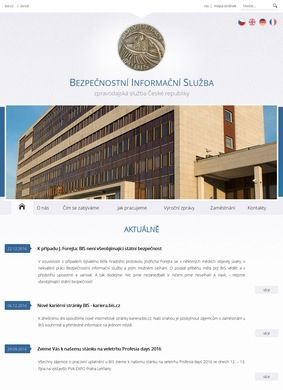
Czech Republic's civilian counterintelligence and domestic intelligence agency, the Security Information Service operates under Czech law with a mandate set out in statute. This site is its official public window. Most of what an intelligence service does stays classified, so what appears on a public portal like this is the deliberately chosen slice the agency is willing to explain. The Security Information Service uses the space to set out its remit in plain terms rather than leave the public uncertain about who watches what.
Four pillars of the agency's mandate
The core mandate is laid out without hedging. The Security Information Service handles counterintelligence, meaning the detection and countering of foreign espionage on Czech soil. It works on counter-terrorism. It tracks organized crime where there is a national security dimension, an important distinction because ordinary policing of organized crime sits elsewhere, and the site is careful to mark the boundary. It also follows the proliferation of weapons of mass destruction, the kind of dual-use technology and procurement networks that rarely surface in everyday news but occupy a real chunk of any modern service's attention. Four areas, each with a short explanation of why it falls inside the agency's lane. The presentation is sober throughout, and the Security Information Service comes across as an institution describing a job, not as a brand exercise.
Inside the About Us section
For anyone trying to understand the institution itself, the "About Us" material does the heavy lifting. It walks through the history of the service, the legal basis on which it operates, and the question of oversight, which is what most people actually care about when a secret agency publishes anything at all. A domestic intelligence body in a democracy lives or dies on whether it can be checked, and putting the legal framework and supervision arrangements out in the open is the Security Information Service answering that concern before it is asked.
How the service describes its methods
The "What We Do" and "How We Work" sections sit alongside this material, the first describing the substance of the mission and the second getting at method, at least to the degree method can be described without compromising operations. The legal grounding is spelled out enough that a reader can see which statute defines the Security Information Service and what limits sit on its activity, which is more than many comparable services bother to publish in clear language.
Annual reports as threat assessments
The single most useful thing on the site is the run of annual reports. These are publicly released, unclassified assessments of the threats facing Czech national security, and they are considerably more than a press summary. Over the years they have become a genuine source for journalists, researchers and security professionals following the situation in Central Europe, precisely because the Security Information Service names patterns and pressures that other governments tend to leave vague.
Reading the reports year to year
An annual report from an intelligence agency is an unusual document: it has to be candid enough to be credible and discreet enough to protect sources, and reading a few of them back to back gives a feel for how the Security Information Service weighs the risks it is mandated to watch. The tone shifts year to year as the threat picture moves, and that movement is itself informative. For research purposes, this is the part of the portal that earns repeated visits.
News updates and recruitment information
News updates fill in the gaps between those yearly assessments, carrying statements and shorter notices when the Security Information Service wants to put something on the record publicly. The Careers section is aimed at recruitment. An intelligence service has to hire analysts and officers somehow, and the Security Information Service uses the site to describe the kind of people it is looking for and what the work involves. An organization that needs to renew itself must do so from the ordinary population it serves, and a would-be analyst can get a realistic sense of the expectations here before ever making contact.
Absence from commercial review platforms
No commercial review platforms carry ratings for this type of site, which is entirely expected for a government intelligence agency. A search of common platforms turned up nothing, and that absence is unremarkable given the nature of the institution. The Security Information Service does not appear in any business directory either, and tracking it there would be beside the point.
Four language editions of the portal
One practical strength deserves mention: the portal runs in four languages. Czech is the obvious default, but the Security Information Service also publishes in English, German and French. For an agency whose work is bound up with foreign espionage and cross-border threats, that multilingual reach is not decoration. Foreign analysts, allied services, academics and journalists outside the Czech-speaking world can read the agency's own framing of its work in their own language instead of relying on second-hand translation. The English edition in particular makes the annual reports accessible to the international security community, and by publishing in four languages the Security Information Service makes clear it expects its assessments to be read well beyond its borders.
What the portal does not reveal
It is worth being direct about what the site is and is not. This is not a place to find operational detail, case studies with names, or anything resembling raw intelligence. An agency of this kind reveals what it has decided the public should see, and a visitor expecting exposure will leave disappointed. Judged on its own terms, the portal does exactly what it should. It explains a secretive institution to the citizens it answers to, documents the legal and oversight scaffolding that legitimizes its existence, and hands over a yearly threat assessment that genuinely informs public debate. The Security Information Service treats transparency as part of the job rather than a concession to critics, and the structure of the site reflects that priority in how material is ordered and how plainly it is written.
Where this resource proves most useful is as a primary source. Researchers studying Czech or Central European security, those tracking espionage and influence operations in the region, and those trying to understand how a post-communist democracy organizes and constrains its intelligence apparatus will find more here straight from the agency than in most secondary commentary.
The reports are written for non-specialists to read straight through, and the explanatory sections give enough context that a newcomer is not lost. The Security Information Service has clearly thought about who lands on this site and why, addressing both the curious Czech citizen and the foreign specialist without pretending to be something it cannot be. That dual address, accessible to a local reader and rigorous enough for a researcher, is harder to achieve than it looks, and the Security Information Service manages it across all four language editions.
Comparison with the Wikipedia entry
Set against an alternative a reader might reach for, the contrast clarifies the value. Going to Wikipedia for an overview of the BIS yields a tidy summary with basic facts and a timeline. What it cannot provide is the agency speaking in its own voice, the full text of each annual assessment, the precise legal language of the mandate, or the current recruitment picture. For a quick orientation, the encyclopedia entry is fine.
For anything that needs to rest on what the Security Information Service itself has said and published, this official portal is the better source, and it answers that demand without difficulty. The Security Information Service has built a public face that is restrained, honest about its limits, and genuinely useful, which is about the best anyone can ask of an intelligence agency that puts anything online at all.