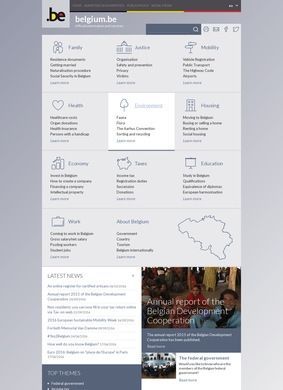
Moving to Brussels throws a tangle of questions at you immediately: which authority registers your address, how the eID card works, whether a foreign diploma counts, and who to call when none of the regional websites quite answer what you typed into a search bar. The Belgian Government portal at belgium.be was built for exactly that situation. The Belgian Government sits above the federal, regional, and community layers and routes you to the right one so you are not left guessing which of three governments owns your problem.
Life-based organisation of services
The structure follows the way life unfolds rather than the way ministries are organised. There are sections for living in Belgium, covering residence, housing, health, and social welfare; a working section that takes in employment rights, pensions, and labour law; and a path for people starting or running a company, from registration through permits and taxes. Education and youth get their own space, as do justice and safety, travel and tourism, and the distinct case of foreign nationals dealing with immigration, visas, and residence permits. A person rarely arrives at a government site curious about its org chart. They arrive needing one specific thing done, and the Belgian Government portal is organised around that reality. The distinction sounds minor; in practice it shapes every navigation decision the designers made.
Legislation search and official gazette
What I found genuinely useful is the legislation search tool sitting alongside a direct line to the official gazette, the Belgisch Staatsblad or Moniteur belge depending on which language you read it in. Plenty of state portals stop at friendly summaries and leave you stranded the moment you need the actual text of a law. Here you can move from a plain-language explanation of a rule to the published source it rests on. That path matters if you are a lawyer or accountant, but also if you are simply someone who does not want to take a paraphrase on faith.
Links to government agencies
That same instinct runs through the e-government links. The Belgian Government portal does not pretend to be the single application that handles every transaction; it points you toward the institutions and agencies that do. You reach tax filing, social security, and the various identity-document processes through it, including the eID card and passport. It is a hub more than a destination, and for a country with this many overlapping competences, a reliable hub is the more honest design choice.
Civic and family matters
The civic coverage is broad in a way that points to real obligations rather than content padded for show. Elections, identity documents, tax matters, and the registrations that bookend a life, birth, marriage, death, all have a place. Family matters are handled with the same matter-of-fact tone, which is the right register for content people read during stressful moments.
Expatriates, investors, tourists
Two audiences that are served more deliberately than expected are Belgians living abroad and international visitors or investors. The expatriate sections acknowledge that citizenship does not end at the border and that consular and administrative needs follow people overseas. The investor and tourist material widens the door further, so the Belgian Government is speaking to someone weighing a move, a holiday, or a business stake, and not solely to residents already inside the system. Everything appears in Dutch, French, German, and English, which respects the country's linguistic reality and quietly opens the whole thing to readers who command none of the national languages but can manage English.
Federal, regional, community content
The aggregation is the part that does the heavy lifting. Content is pulled from federal, regional, and community authorities into one coherent surface, with links out to the relevant government institutions when you need to go deeper. For anyone who has tried to work out, unaided, whether a given matter belongs to Flanders, Wallonia, Brussels, or the federal level, that consolidation saves a real amount of fruitless clicking.
The honest limit of a portal like this is that it can only be as current and as complete as the bodies feeding it, and the depth of any single topic depends on how engaged the underlying authority is. Some pages link through to departmental sites that have not been refreshed as recently as the main portal. That is a structural constraint, not a failing of the design itself. As a starting point, though, the Belgian Government has built something that respects how confusing its own federal structure can be from the outside. The Belgian Government does not oversell what it is: a well-organised gateway into a system that, by its constitutional design, will never be simple. Belgium.be is the reasonable first stop for anyone piecing together what Belgian law or administration requires of them.