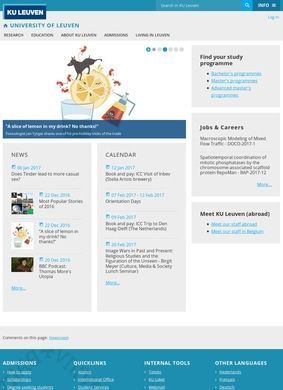
Most university homepages treat every visitor the same way. The English-language gateway to the University of Leuven does not: a prospective bachelor's student, a postdoc hunting for a position, and a retired graduate each get a genuinely different route through the same institution. That split personality is the first thing worth understanding about the site, because it explains both what makes it useful and where it gets confusing.
The University of Leuven is a research university based in Leuven, Belgium, and the site never lets you forget that research sits at the center of everything. Teaching, student life, and outreach all orbit it.
Walk through the academic offering and the scale becomes obvious. Bachelor's degrees, master's programs, doctoral tracks, and postdoctoral research each have their own space, spread across a wide set of faculties and disciplines. The English pages lean toward the audiences most likely to arrive in English: international master's candidates, researchers weighing a PhD or postdoc, and staff who need the institutional machinery in a language they share. A visitor looking for study abroad options finds them treated as a two-way street, both incoming exchange and outgoing mobility for enrolled students.
It is a lot of ground for one portal to cover, and the University of Leuven mostly covers it without collapsing into a single undifferentiated wall of links.
What the English portal opens up
The value here is less any single page and more the breadth of what one institution puts under a single roof, then documents in a second language. A university that publishes its PhD and postdoc vacancies, its library holdings, its housing arrangements, and its alumni programming in English expects a good share of its community to come from outside Belgium, and that expectation shapes the whole thing.
It also raises the bar. Once the University of Leuven presents itself in English to a global audience, orientation has to work for someone with no prior knowledge of how a Flemish research university is organized, and for the most part it does.
Research areas and the PhD and postdoc route
For anyone whose reason to visit is research, this is the strongest part of the site. Research areas are laid out by field, and open PhD and postdoc positions are presented as concrete opportunities to apply for, not abstract descriptions of what the university studies. The distance between reading about a research group and finding an actual vacancy attached to it is short, which is exactly what a researcher scanning for a next move needs.
There is real weight to seeing doctoral and postdoctoral tracks given equal footing with undergraduate recruitment. Many university sites bury the postdoc pathway. The University of Leuven puts it forward, and that choice tells you something about how the institution ranks its own priorities. Research first, and everything else arranged around it.
Toledo, My KU Leuven and the internal machinery
Two internal tools surface even on the public English pages: Toledo, the learning platform, and My KU Leuven, the personal portal. Neither is meant for a casual browser. They are the daily-use systems for enrolled students and staff, and their presence on the public site is really a set of doors that only open once you belong to the institution.
The same goes for the faculty and department "Who's Who" directory, which lets a visitor locate a specific academic or administrative contact within a large organization. It is a practical tool. For an outsider it also doubles as a map of how the University of Leuven is structured, faculty by faculty, department by department, which helps when you are trying to work out who does what across a spread-out institution before you have any formal connection to it.
Housing, libraries and student life across campuses
The University of Leuven does not operate from one building, and the site reflects that. Student housing, library access, and academic facilities are documented with the multi-campus reality in mind, so the support described is not tied to a single location. For an incoming student, the housing pages answer one of the most stressful practical questions early, before enrollment is even finalized.
Student life support is framed as something spread across campuses too, since its students are not all sitting in the same city. The University of Leuven treats that dispersion as a fact to plan around instead of a footnote.
The libraries deserve a specific mention. Academic facilities and library holdings are presented as a resource in their own right, which fits how the University of Leuven defines itself, by research output. A doctoral candidate reads those pages differently than a first-year would, and the site seems aware of that gap in who is reading.
Alumni and the public-facing side
Alumni programs round out the audience list, extending the relationship past graduation. The University of Leuven also reaches beyond its own community through outreach and charitable initiatives, which positions it as a public actor in the surrounding region and not purely an inward-facing academic body.
This section gives a browser the least to click through, but it is honest about existing. The outreach material tells the general public that the University of Leuven sees a role for itself past the campus gates, even if the pages themselves do not give an outsider much to act on. Whether any of it genuinely serves the wider public, or mostly serves people already inside the institution, is where the University of Leuven's English portal invites the most doubt.
The charitable and outreach initiatives are named without being fully opened up, so a curious member of the public learns that they exist and little about how to take part.
A search turns up no independent review platform rating the English portal itself, which is unsurprising for a university site rather than a business; what public commentary exists tends to concern the institution broadly, not this particular set of pages.
The honest tension running through these pages is between openness and enclosure. So much of the most substantive material, Toledo, My KU Leuven, the deeper reaches of the "Who's Who", sits behind a login or assumes you already have a stake in the place.
The public English pages of the University of Leuven are excellent at orientation and recruitment. What they are less clear about is how far a genuinely unaffiliated visitor can go before hitting a wall, and the site never quite resolves whether it wants to be a front door for the world or a staff room with a viewing window.
The University of Leuven's English portal cannot honestly be called fully open to the outsiders it works so hard to attract.