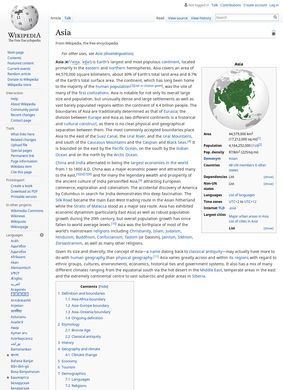
Asia is the largest and most populous continent on Earth, stretching from the Arctic reaches of Siberia down to the tropics of Southeast Asia, and the Wikipedia article carrying that name tries to hold the whole sprawling thing in one place. The numbers it leads with are the kind most people half-remember and get wrong: roughly 44 million square kilometres, close to 30 percent of the planet's land, and a population near 4.7 billion, which works out to about 60 percent of everyone alive. There is an economic figure too, a GDP in purchasing-power terms cited at $94.66 trillion on a 2025 estimate. Whether you trust that last one depends on how much faith you put in continent-scale aggregates, but the page at least tells you where the line is drawn and how the count was reached.
Six regions and their geographic variation
One of the more useful moves early on is the way the article splits the landmass into six working regions: North Asia, Central Asia, West Asia or the Middle East, South Asia, East Asia, and the southeast. That division does a lot of quiet work, because the single label hides enormous variation, and the page keeps returning to those buckets when it talks about climate, religion, or economy. It also accounts for 49 UN member states plus territories that do not fit neatly into that count, which is a reminder that the political map and the geographic one rarely agree. Cross-references run thick here, so a region that gets a paragraph in the overview usually has its own full article a click away, and the entry is built to hand you off rather than to be the last word.
Tracing the name back to Bronze Age Anatolia
The history runs deep and roughly chronological. There is an etymology section that traces the name back to a Bronze Age term, Assuwa, tied to northwestern Anatolia, which is a small detail but the sort that makes you realise the word predates almost everything we now attach to it. From there the article moves through prehistory: Homo erectus migrating into the region about 1.8 million years ago, modern humans reaching South Asia around 60,000 years ago. Then come the river-valley civilizations clustered around Mesopotamia, the Indus, and the Yellow River, the medieval stretch covering Islamic expansion and the Mongol Empire, and the modern arc of colonialism, industrialization, decolonization, and the economic surge that followed. It is a lot of ground, and the page paces it sensibly without pretending any one era can be summarised in a sentence.
Climate zones shape settlement patterns
It does, and the geography section is where that pays off. Climate gets real treatment, from Arctic Siberia to the tropical southeast, with the Himalayan range and the major river systems given their due as the features that shape where people can actually live. The religious breakdown is concrete rather than gestural: Islam at 28 percent, Hinduism at 22.8, Buddhism at 11.1, and Christianity at 8.4. Those figures sit better than a vague claim that the continent is "diverse," because you can do something with them.
Projecting extreme heat and water stress
The section with the most current bite is the one on climate change, which the article treats as present tense and not as a footnote. It carries a projection that by 2080 roughly one billion people in South and Southeast Asian cities could face extreme heat on a monthly basis. Around that sit shorter passages on coral reef loss, sea-level rise, and the risk to water supplies that depend on glacier melt. For a continent where so much settlement clusters along coasts and downstream of high mountains, that framing feels honest about stakes, and it is the part of the page a reader is most likely to come back to.
Historical economic dominance of China and India
On the economic side, the article gives proper weight to the long historical record: China and India spent centuries as the world's leading economies, a fact that often gets flattened by recent decades, and the page also walks through the East Asian "tiger economies" and the broader development story. It is not a forecasting document and does not pretend to be. The data is descriptive, sourced to estimates, and bounded by dates, which is about all you can ask of a reference entry covering something this size.
The same restraint shows in the prehistory: the Homo erectus migration of roughly 1.8 million years ago and the arrival of modern humans in South Asia near 60,000 years ago are given as figures with a range built in, not as settled fact, and that honesty about uncertainty is one of the quieter strengths of the page. A reader who wants the broad strokes of how the continent was peopled, traded across, and contested can get them here in an afternoon.
If there is a limit, it is the one built into the format. An article trying to cover 4.7 billion people and several thousand years has to generalise, and anyone wanting depth on, say, Central Asian water politics or the specific mechanics of a single tiger economy will treat this page as a doorway and follow the internal links outward. That is the intended use, so it is no real mark against the article. The page works as a map of where to go next as much as a destination, and it carries enough sourced detail to satisfy a reader who only needs the shape of things before deciding how far to dig.
Comparing with Britannica's encyclopedia entry
Set against a print encyclopedia entry like the one in Britannica, the comparison is closer than people assume. Britannica tends to read more tightly, with a single editorial voice and less clutter, and some readers will prefer that polish. This page wins on breadth, on the freshness of the 2025 economic estimate and the climate projections, and on the sheer density of links that let you keep digging. For a fast, current, well-segmented orientation to the continent, the Asia article is the one I would open first, with Britannica kept open in a second tab for the passages where tighter prose does the job better.