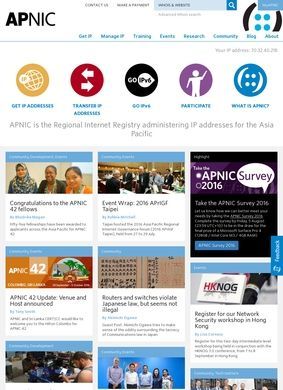
Every block of IP address space and every Autonomous System Number used by a network operator across 56 economies in the Asia-Pacific passes through one body: APNIC. It is the Regional Internet Registry for the region, the institution that decides which organisation holds which slice of the Internet's numbering system and keeps a public record of who holds what. That is a narrow remit on paper and an enormous one in practice, because without a single authoritative registry the routing of traffic between independent networks would not function at all.
IP address allocation and registration
The core of the work is allocation and registration. APNIC hands out IPv4 and IPv6 address space and registers ASNs to the parties that actually run networks: internet service providers, large enterprises, research bodies, and government networks. IPv4 has been scarce for years, so much of the present-day attention sits on IPv6 distribution and on the secondary market and transfer mechanics that keep older address ranges in productive hands. The registry function is not glamorous, but it is the load-bearing wall. Get the records wrong and disputes over address ownership become unresolvable; keep them clean and the rest of the system has a reference point it can trust. This is how APNIC appears in any serious business directory of technical infrastructure bodies: as a piece of plumbing too important to be optional.
Outside reputation: a search for APNIC on consumer review platforms turns up nothing of substance, which is exactly what you would expect from an organisation whose clients are network engineers and ISPs rather than individual consumers. The Trustpilot and Google review ecosystems are not the right frame for evaluating a regional registry, and the absence of ratings there says nothing useful about the organisation itself.
For organisations that hold resources, the day-to-day interface is MyAPNIC, a self-service portal where members manage their allocations, update routing registry entries, and handle the administrative side of their accounts. It is operational plumbing that most people outside a network operations team never see, but it is where the actual stewardship of resources happens once the initial allocation is made.
Public whois lookup tool
Anyone, member or not, can query the Advanced Whois database, which exposes who holds a given block of address space or a given ASN. This public lookup is one of the more genuinely useful things on the site for an outside visitor: if you are trying to identify the responsible party behind a network, abuse contact included, this is the authoritative starting point for the region. It is the visible face of all that registry work, and it is open without a login.
Two further tools sit alongside these. DASH is a network security monitoring platform aimed at helping members watch the health and threat exposure of their own networks, and REx offers routing and resource analysis. Both are operational instruments rather than reference material, and their value depends entirely on running a network worth monitoring. A casual visitor will get little from them; a network engineer responsible for a sizeable allocation may find them part of a regular workflow. APNIC wraps these around the core allocation service as part of the membership offering, not as standalone products.
Network monitoring tools for members
APNIC Labs is, to a technical reader, one of the most quietly valuable parts of the organisation. It runs Internet measurement work and publishes statistics and datasets on IPv6 adoption, DNSSEC deployment, routing security, and broad network health across the region. These figures get cited well beyond the membership, because measured data on how the Internet is actually behaving in a given country or economy is hard to source elsewhere with the same authority. If someone wants to know how far IPv6 has penetrated a particular national network, the Labs numbers are a credible reference.
On the education side, APNIC Academy delivers training courses and certifications on network operations, routing, and security, along with a community trainer program that extends that teaching across the region. This addresses a real gap: technical capacity in network engineering is uneven across 56 economies, and a registry that also trains the engineers who will use its resources is doing something concrete about the skills shortage, not deferring the problem to others.
Then there is governance. The allocation of address space is not a purely technical exercise; the rules that decide who gets what, and on what terms, are set through policy development forums that are open to the membership and the wider community. This is a defining feature of the RIR model. Policy is meant to be made by the people it affects, in the open, through a bottom-up process. Whether that process is as accessible in practice as it is in principle depends a great deal on how much time a participant can commit, since influence tends to follow sustained engagement at meetings, and a one-off attendee will not move much. For an organisation that controls a critical resource, the open process is a meaningful check, even if it favours the persistent.
Regional internet governance process
Orbit is the community news and blog platform, carrying technical writing and updates from the region's operator community. It is a reasonable place to track what people working on regional network issues are thinking about, though like any organisational blog the quality of individual posts varies with the contributor.
APNIC does not operate in isolation. It is one of five regional registries, working with ARIN, RIPE NCC, LACNIC, and AFRINIC, and coordinating with IANA at the top of the number resource hierarchy. The Internet's addressing system only holds together if the five registries apply consistent principles and hand off cleanly at the boundaries. APNIC's standing comes partly from being a recognised part of that global structure, not a self-appointed regional authority. It is a not-for-profit membership organisation headquartered in Brisbane, Australia, operating under ABN 42 081 528 010, which puts a concrete legal and financial frame around what could otherwise sound abstract. For an institution of this type, a real ABN is more grounding than any consumer rating would be.
So who is this entry useful to, and how useful? The honest answer is that it splits sharply by audience. For the people who run networks in the Asia-Pacific, dealing with APNIC is not optional; it is the registry, and the question is only how to work with it efficiently. The portal, the policy forums, and the training are all built for that group, and they are substantial. For a researcher or analyst, the Labs datasets and the Whois lookup are open, authoritative, and worth bookmarking on their own merits. For a general visitor with no network to manage, most of the site will read as specialist machinery they have no reason to touch, and that is simply the nature of the institution.
APNIC is exactly what it claims to be, and within its remit there is no real substitute. The work is foundational, the public tools are genuinely open, and the research output draws citations well outside the membership. What it is not is a destination for anyone outside the technical and policy world it serves. Judged against its actual job, keeping the regional numbering system together and the record straight, APNIC does it.