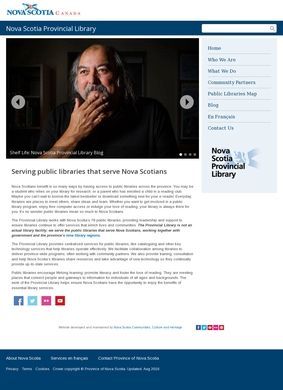
What does a provincial library actually run, if it does not lend books across a counter the way a neighbourhood branch does? The Nova Scotia Provincial Library sits one level above the buildings most residents picture when they think of a library, coordinating the province's regional public library system instead of operating a single reading room. That distinction shapes almost everything about what the service is for, and it is worth understanding before judging the site by the yardstick of a local branch.
How a provincial service sits above the branches
Nova Scotia runs its public libraries through regional boards, and a provincial body is what ties those regions into something that behaves like one system. The Nova Scotia Provincial Library is that connective layer. It is less a place you walk into and more the plumbing that lets dozens of separate branches share collections, standards, and access.
Most residents never think about this tier at all, and in a sense that is the measure of it working. When a title held only in Sydney reaches a reader in Yarmouth, or when a small rural branch quietly offers the same database as a large urban location, some central coordination made that possible. The provincial role is deliberately in the background.
That framing matters for anyone arriving at the Nova Scotia Provincial Library expecting event listings, storytime schedules, or a catalogue to browse for a Saturday read. Those belong to the individual regional libraries. What sits at the provincial level is the machinery that keeps the whole network coherent, which is a narrower and more administrative purpose.
Interlibrary loan and shared catalogues
Interlibrary loan is the clearest example of why a coordinating body exists in the first place. No single branch can hold everything, and the provincial layer is what lets a request travel from one collection to another, so a reader is not confined to whatever happens to sit on the nearest shelf.
A shared or linked catalogue underpins that movement, and it is precisely the kind of shared infrastructure the Nova Scotia Provincial Library is positioned to maintain on behalf of the regions. For students, researchers, and readers in smaller communities, that reach is the difference between a modest local collection and access to the holdings of the whole province.
Digital access and the library card
A large part of what a provincial service delivers now lives online, and this is where a central body genuinely changes what a small library can offer. Licensing e-books, audiobooks, research databases, and reference tools is expensive, and negotiating that access province-wide spreads the cost so a branch in a town of a few thousand can put the same digital collection in front of its members as a city location. Coordinating that kind of access is a core reason the Nova Scotia Provincial Library exists, and it is the part of the mandate with the widest reach into everyday use.
None of this is glamorous, and none of it announces itself to the person borrowing an e-book at home. The value shows up indirectly, in the fact that the borrowing works at all and that a card from one region unlocks the same shared resources everywhere else.
E-resources beyond the physical shelf
The digital side is arguably where the provincial tier earns the most trust, because it removes a real inequality between large and small communities. A resident does not need to know that the Nova Scotia Provincial Library brokered a database licence to benefit from it.
They simply find that their card opens research tools, language courses, or streaming collections that a single rural branch could never afford on its own. That levelling effect is a concrete, checkable reason the coordinating layer is worth having, and it is the part of the operation most likely to touch an ordinary member's day.
Cards, policy, and who it serves
Beyond lending and licensing, a provincial library service tends to hold the policy and standards side together: how a library card is issued and honoured across regions, what borrowing rules apply, and how the branches stay consistent enough to function as a single network. The Nova Scotia Provincial Library serves the branches and boards as much as it serves the public directly, which is an unusual dual audience.
A parent looking for a card, a librarian checking a shared policy, and a board coordinating with its neighbours are all, in different ways, users of what the provincial body maintains. That breadth rarely shows up on the front page of the Nova Scotia Provincial Library, but it is there in how the network runs day to day.
Reading the value of a coordinating body
Here honesty requires a caveat about the site itself. On the attempt made for this review, library.novascotia.ca returned an access error and would not load its content, so the current state of the pages, their navigation, and the specific tools on offer could not be examined firsthand. That may be a temporary block, a server hiccup, or a filter on automated access; a person visiting in a browser may well reach it without trouble. But a review should say what it could and could not verify, and the live pages were not among what could be checked.
What can be said with confidence is grounded in the domain and the role. This is the official provincial service on the government's own novascotia.ca system, which settles any question of legitimacy: it is the real coordinating body for Nova Scotia's public libraries, not a third-party imitation. For the functions a provincial service governs, interlibrary loan, shared digital collections, and the card and policy framework that binds the regions, the Nova Scotia Provincial Library is the correct and authoritative starting point.
So the verdict is a qualified one. As a destination, the Nova Scotia Provincial Library is not where a casual reader goes to find their next novel or a branch's opening hours; those live with the regional libraries, and someone arriving here for them will feel they landed a step removed. As the backbone of the system, though, it does what it should, and the value of the Nova Scotia Provincial Library is easiest to see once it is understood as infrastructure rather than a storefront.
A librarian checking policy, a researcher chasing an interlibrary loan, a resident curious how the branches connect: each finds the right door here. Everyone else does better starting at their own regional library, while the Nova Scotia Provincial Library keeps doing its quieter work underneath.