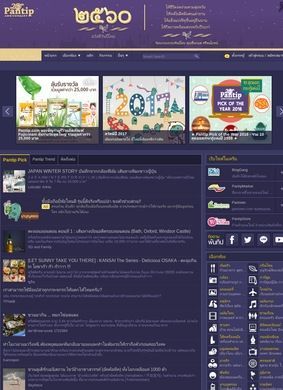
Someone in Bangkok wants to know whether a particular condo project is worth buying into, or which used pickup holds its value, or what really happened in last night's lakorn finale, and there is one Thai-language place where a real answer, argued over by dozens of strangers who have lived through the question, tends to surface within hours. That place is Pantip. The forum has been catching these everyday queries since 1996, and the format barely apologizes for its age: threads, replies, long stretches of reasoned Thai text, the occasional photo. What it lacks in gloss it makes up for in the sheer depth of accumulated argument, which is the thing people come back for.
Topic communities and lifestyle rooms
The structure underneath is broad on purpose. Posts are sorted into topic communities that cover entertainment, and here the categories run thick: Thai dramas, K-pop, manga, the kind of fandom chatter that fills a thread in minutes. Alongside that sit lifestyle rooms for food, travel and gardening, a personal finance corner where people trade notes on savings, loans and investments, plus career advice, automotive talk, sports and a section given over to broader questions about how to live. A first-time visitor who reads only English will hit a wall quickly, because the writing is almost entirely Thai, and that single fact shapes who this is for more than any feature does.
Trending and curated feeds
Navigation leans on a handful of curated and automated feeds, and they do different jobs worth separating out. Pantip Realtime pushes trending topics that refresh by the minute, so it reads like a live pulse of what the country is talking about. Pantip Hitz does something similar on a ten-minute cycle for posts gathering momentum. Then there is Pantip Pick, where staff surface the threads they judge to be the better contributions, which acts as a counterweight to raw popularity. My Feed, Explore and Communities round out the ways in, letting a regular tune the firehose down to the rooms they care about. The split between human-picked and algorithm-picked feeds is genuinely useful, because the two surface very different threads and a reader can choose which to trust on a given day.
When to use Pantip versus search
The honest answer depends on what someone needs. For a quick factual lookup, a search engine is faster. Pantip does better on the questions that resist a tidy answer: lived experience, local nuance, the comparison nobody publishes because there is no money in it. A thread asking whether a clinic is any good, or which neighbourhood floods, pulls in replies from people with nothing to sell, and that is hard to replicate on a polished review site. The age of the platform works in its favour here, because a search inside Pantip often turns up a discussion from years back that already chewed through the same problem.
User profiles, points, marketplace
Around the discussion core sit features that keep regulars invested. User profiles track what a member has posted and contributed. A points and rewards system lets active users redeem accumulated points, which nudges participation without turning the place into a game. There are activity features and community events, and a marketplace tie-in through Pantip MALL that connects the talk about products to somewhere to buy them. None of this is flashy, and the forum is better for not pretending to be a social network it is not.
Mobile apps for iOS and Android
Access is not locked to a browser, and for a Thai audience that lives on mobile that gap would cost reach. Pantip ships apps for iOS and Android, with a presence on HiCloud as well, so the realtime feeds and the rooms travel into a pocket without much friction. The mobile experience carries the same Thai-first content, so the language barrier follows you across every device rather than easing on the smaller screen.
Thailand's oldest online community
Some texture on scale helps put the thing in proportion. Pantip describes itself as Thailand's largest and oldest online community, and the founding date of 1996 backs the claim in a way few internet properties can match, since most forums from that era are long dead or hollowed out. It is run by Pantip.com Co., Ltd., and the continuity of a single operator over that span is part of why the archive holds together instead of scattering across abandoned platforms. For Southeast Asia specifically, a community that has stayed active and recognisable for this long is a rarity, and that longevity is itself a kind of credential.
The reach extends past the site into the usual social channels, all consolidated under the @pantip1996 handle across Facebook, Twitter, YouTube, Instagram and TikTok. That handle, with its founding year baked into the name, is a small signal of how much the brand leans on its history. The accounts mostly funnel attention back toward threads, which keeps the forum, rather than any feed elsewhere, as the centre of gravity.
A word of realism on who should bother. Anyone outside the Thai language will get limited value from Pantip even with browser translation, since the texture of slang, abbreviation and cultural reference that makes the discussions worth reading is exactly the thing machine translation flattens. For a Thai speaker, the calculus flips entirely. The forum becomes a place to vet a purchase, settle an argument, follow a drama beat by beat, or research a financial decision against the unvarnished opinions of people who have been there. The interface asks for patience and the reading asks for fluency.
What stays with me after clicking through is how unembarrassed Pantip is about being a forum in an era that mostly abandoned the format. Threads, replies, points, a search box pointed at three decades of Thai conversation. The realtime and Hitz feeds give it a current pulse, Pantip Pick gives it an editorial backbone, and the apps carry all of it onto a phone. It is dense, it is in Thai, and for the audience it was built for it remains one of the few places where a real question still gets a real crowd of answers.