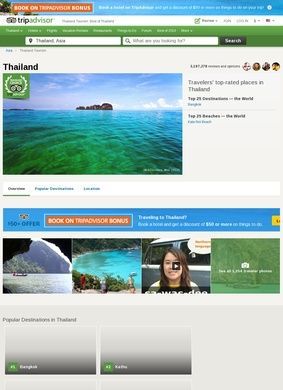
More than a billion reviews and contributions sit behind the platform this page opens into, and the Thailand section funnels that vast pile down to one country. Trip Advisor: Thailand is the national slice of a much larger travel engine, aggregating hotels, attractions, restaurants and things to do across the destinations a visitor to the country would actually search for. The scale is the point. Almost every temple, beach, night market or dive shop that a traveler might type into a search box has probably been rated by someone here already.
What you get, then, is less a curated guide and more a firehose with filters on it.
The Thailand pages inherit the full structure of the parent site. There is a Things to Do layer, a Hotels layer with search and booking, a Restaurants layer tied to reviews and reservations, and a Cruises layer for the coastal and river traffic. Trip Advisor: Thailand also surfaces Travelers' Choice awards and editorial travel stories, so the country gets both crowd-sourced rankings and written itineraries stacked on top of each other.
What the Thailand portal pulls together
The spread of content is genuinely wide. A person planning two weeks split between Bangkok, Chiang Mai and the southern islands can research where to sleep, what to eat and which tours to book without leaving the section. That breadth is the strongest thing Trip Advisor: Thailand has going for it, because most standalone travel blogs cover a handful of places well and everything else thinly.
Bookings do not all stay in-house. Tours and activities route through Viator, and restaurant reservations run through TheFork partnership, while cruise material draws on Cruise Critic. So when someone reserves a longtail boat trip around Phi Phi or a table in a Bangkok riverside restaurant, they are often transacting with a partner brand that Trip Advisor: Thailand sits on top of. The platform claims well over 400,000 bookable experiences globally, and Thailand, as one of the busiest tourism markets in Asia, is heavily represented in that catalogue.
Things to do and the Viator pipeline
The Things to Do category is where the Thailand section feels densest. Guided tours, outdoor activities, water sports and cultural experiences are all sorted, ranked and priced, and the volume of listed operators for places like Phuket or Krabi is large enough that the ranking itself becomes the main way to navigate. That is useful and also a little fraught, because the order you see is shaped by a mix of review scores, recency and commercial arrangements that a casual user cannot fully separate.
Someone comparing three snorkeling operators will find photos, itineraries, cancellation terms and a star average on each. The information Trip Advisor: Thailand shows is concrete enough to act on. Whether the top result is the top result on merit or on the strength of its Viator relationship is harder to read from the page.
Trip planning tools and the reservations layer
Trip Advisor: Thailand also pushes AI-assisted trip planning and a Tripadvisor Rewards loyalty scheme, both bolted onto the same review database. The trip planner will assemble a rough day-by-day outline for a Thailand visit from a few prompts, pulling attractions and restaurants from the existing listings. It is a reasonable starting scaffold, though it leans on the same rankings that already dominate the site, so it tends to recommend the heavily reviewed and the heavily visited.
Mobile apps exist for iOS and Android, and that counts for something here, since a lot of Thailand travel decisions get made on the ground, phone in hand, standing outside a restaurant deciding whether to go in. Offline-adjacent access to saved lists and reviews is the practical draw there.
Restaurants, hotels and the reservation flow
On the dining side, Trip Advisor: Thailand blends review browsing with TheFork booking, so a shortlist of Bangkok or Chiang Mai restaurants can move from reading to reserving in one flow. Coverage skews toward places that court foreign visitors, which is worth knowing: the street stall that a local rates highest may not appear at all, while a mid-tier tourist-facing spot with hundreds of reviews sits near the top.
Hotels work the same way, with search, filtering by price and area, and booking handoffs. For a traveler who wants everything in one comparison view, Trip Advisor: Thailand does consolidate a scattered market. The reviews attached to each property are the real currency, and they range from detailed and photo-backed to terse and unhelpful, as any large open review pool does.
There is also a business-facing side that colors how the whole thing reads. Restaurant owners, hotel operators and tour companies can claim listings, advertise and sponsor placement. Trip Advisor: Thailand is a marketplace as much as a guide, and the two roles are not always cleanly separated on the page.
For a first pass at a Thailand trip, the depth here is hard to match. The Travelers' Choice lists give a quick read on what large numbers of visitors rated highly, the destination guides fill in context, and the booking integrations mean research and reservation happen in one place. A traveler willing to read past the top few results and cross-check will get real value out of Trip Advisor: Thailand.
The nagging problem is trust in the very thing the platform is built on. A billion contributions is a strength and a weakness at once, because open review systems attract incentivized posts, and Thailand's tourism operators have every reason to shape their standing. The ranking that Trip Advisor: Thailand presents so cleanly is the product of scores, commercial ties and moderation that the user never sees the inside of.
Whether the tour sitting at the top of the Phuket list is genuinely the best, or simply the best positioned, is a question the page cannot answer for you, and it is the one that decides how much the whole edifice is really worth.