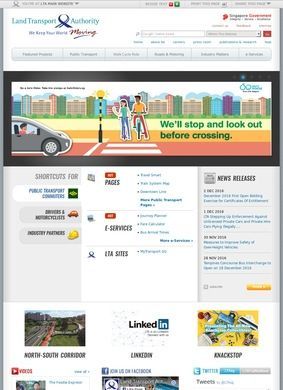
One website handles both jobs, telling a commuter which bus to catch and publishing the tender documents a contractor bids on. That spread is the first thing worth registering about the Land Transport Authority site, Singapore's official government portal for everything that moves on land. It is a single .gov.sg address, served over secure HTTPS and marked clearly as an official Singapore government agency site, and it tries to hold four very different audiences at once.
Those audiences are the general public who ride buses and trains, motorists behind the wheel, cyclists and personal mobility device users, and the businesses that build and run the transport system. A site answering to all four could easily turn into a maze. The Land Transport Authority instead splits the material by who needs it, which is the single decision that keeps the whole thing usable.
The government framing is doing quiet work here. Because this is the agency's own site instead of a third-party aggregator, the information on it is the information, the primary source a resident can trust over a search result of uncertain age. A national transport network throws off a constant stream of changes, new fares, altered routes, closures for works, and a single official home for all of it is worth more than any number of unofficial summaries.
Planning a trip before you take it
The most immediately useful part of the Land Transport Authority site, for an ordinary resident, is the cluster of planning tools. These are the features a person reaches for before leaving the house, and they answer the practical questions any journey raises: which service, which line, how long, how much.
The Land Transport Authority puts public transport at the centre. The site carries bus service maps, information on the MRT and LRT rail networks, and the reference material a rider needs to work out how the system connects across the island. It reads as something the public is expected to return to often, which is the right instinct for a national transport body that most people touch every single day.
Fare calculators and network maps
The fare calculators are the quiet workhorse here. Anyone weighing whether to take the train or the bus, or wondering what a particular trip will cost, can settle the question before tapping in, and for daily commuters those small sums add up over a month. Paired with the bus service maps and the MRT and LRT network information, the tools let a rider plan a route and price it in the same sitting, without bouncing between apps or guessing.
The network information is not frozen at today's layout. Because the Land Transport Authority both plans and builds the rail lines, the maps and service details are kept in step with the actual state of the network, which is more than a great many transport sites manage. That alignment between the agency that builds the system and the agency that documents it is the reason this counts as an authoritative reference rather than a best guess.
It is also what justifies the Land Transport Authority running a full website of its own instead of leaving the details scattered across unofficial pages.
Cycling routes and active mobility
Beyond public transport, the Land Transport Authority site covers active mobility, the walking-and-wheeling side of getting around. It publishes cycling route information and material aimed at personal mobility device users, treating bikes and their riders as a real part of the transport mix, not an afterthought bolted on at the end. For a dense city working to move people off congested roads, giving cyclists their own dedicated corner of the official site is a substantive choice, not a cosmetic one.
Motorists get their own share as well. Driving regulations and information on taxi services sit alongside the public-transport and cycling material, so a household that drives, rides the MRT, and cycles in the same week can find all three covered under one roof. The breadth is genuine. Whether any single visitor needs all of it is another matter, and the site makes no pretence that everyone will.
The agency behind the network
The Land Transport Authority does more than let visitors look things up. It plans, builds, and regulates Singapore's land transport, and the website doubles as the public record of that work. This is where the site stops being a commuter tool and becomes the front door of a working agency with a construction programme to answer for.
The project updates are the clearest example. The Land Transport Authority publishes progress on major rail construction, and those pages let a resident follow the works that will reshape their own commute, sometimes for years, well before a single new station opens its gates.
Rail expansion and system renewal
Three rail projects anchor this section: the Thomson-East Coast Line, the Cross Island Line, and the Jurong Region Line. The Land Transport Authority uses the site to report on how each is progressing, which matters directly to anyone living along a route or planning a home purchase around a future station. Alongside the new lines, the agency documents system renewal work, the less visible business of replacing and upgrading ageing rail infrastructure so the existing network keeps running smoothly while the new one is being dug and laid.
Reporting on renewal as well as expansion is a telling choice. New lines are the announcements a transport authority likes to make; the slow, unglamorous work of renewing what already exists is the part that keeps trains on time, and the Land Transport Authority gives it room on the same site as the headline projects. A resident who wants to understand why a stretch of line closes for maintenance can find the reasoning rather than just the disruption.
Resources for the transport industry
The other audience the Land Transport Authority serves is the transport sector itself. The site hosts a body of industry material aimed at partners and businesses, and this is the corner an ordinary commuter will almost never open.
Here sit tenders, the regulations that govern operators and contractors, training programmes for the workforce, and development funds meant to support the sector. Putting all of that on the same public site as the fare calculator is a deliberate move toward one authoritative source; a contractor, an operator, and a passenger are meant to read from the same agency instead of from three disconnected channels.
It makes the Land Transport Authority site do double duty as both a public service and a professional reference, and the training and funding material signals an agency thinking about the pipeline of people and companies that will run transport a decade out.
The two jobs do not always sit comfortably together. A page dense with tender and regulatory language speaks differently from a bus map, and a first-time visitor can land in the industry material expecting a timetable and meet procurement documents instead. The Land Transport Authority accepts that tension as the price of being the single source for land transport in Singapore, and its answer is the by-audience structure that runs through the whole site.
What the site amounts to is a working index of an entire country's land transport, from the cost of one bus ride to the funding of the companies that build the railways. The fare calculator and the tender notice live on the same domain, under the same Land Transport Authority, which makes no attempt to separate the commuter's Singapore from the contractor's.