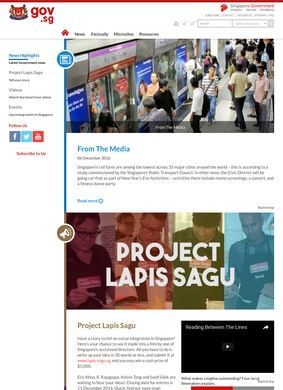
At the top of what gov.sg pushes hardest sits the anti-scam helpline at 1799, and that one number tells you a lot about how the Singapore government uses this portal. It is not a place to file taxes or check a CPF balance. It is the channel where the state explains itself: why a Budget measure exists, how to spot a fake government website, what a new piece of legislation will change. Singapore Government Information reads as a communications hub first, and the editorial choices reflect that purpose at almost every turn.
Scam prevention and public safety messaging
Take the scam coverage, which runs deeper than a single warning page. ScamShield, the 1799 line, and step-by-step guidance on identifying legitimate official sites are bundled together because impersonation of government services is a live problem, and Singapore Government Information treats it as one connected concern. The same instinct shows up in the health campaigns. The Stop Vaping push and the QuitVape Programme are framed as practical cessation help, with the messaging aimed squarely at residents who might actually pick up the habit. Public education here has a target audience and a concrete ask, which is more than a lot of official sites manage.
ScamShield and impersonation awareness
Budget coverage is where the portal does its heaviest lifting. The Budget 2026 material breaks down cost-of-living support and financial assistance into explainers that try to answer the question most people have, which is whether any of it applies to them. I find this genuinely useful, because the underlying policy documents tend to be dense and the version on Singapore Government Information translates them without dumbing them down past the point of accuracy. Alongside the Budget sit the Economic Strategy Review pieces and the longer feature articles on social and governance topics, giving the economic story both a headline layer and a slower, more analytical one.
Budget explainers for cost-of-living support
Parliament updates track sitting schedules, legislative news, and ministerial statements, so a reader following a specific bill can see where it stands without piecing the timeline together from news reports. The National Day Rally addresses are archived here too. Those speeches often set the policy direction that the rest of the year's announcements flow from, so having them in one place on Singapore Government Information is genuinely useful for anyone trying to follow a policy thread over time.
Parliamentary updates and National Day Rally archives
Then there is Factually, the fact-checking resource that debunks misinformation about government policy and public affairs. It is a pointed feature for a state portal to run, and Singapore Government Information leans on it to correct specific false claims about programmes and decisions. Whether a reader trusts a government correcting the record about itself is a fair question, but the section is transparent about what it is doing, and it gives a single reference point when a rumour about a policy is circulating. That kind of named, standing resource is harder to dismiss than scattered rebuttals.
Factually fact-checking resource
One structural point is worth being clear about. Singapore Government Information does not process transactions. When the content touches CPF, HDB, MOM, or the SingPass ecosystem, it hands you off to the relevant agency e-service rather than trying to host the form itself. That keeps the portal focused on explanation and announcement, and it means anyone arriving expecting to renew something or check an account will need to follow the outbound link to the right agency. Knowing that before you start saves a few minutes of hunting.
Transaction processing through agency e-services
Distribution is the other thing Singapore Government Information takes seriously. The same material flows out through Facebook, YouTube, Instagram, LinkedIn, Telegram, WhatsApp, TikTok, and Threads, which is a wide net for official communications and a sign that the government wants these explainers to reach people where they already are. For policy announcements and public health campaigns, that reach is part of the point. The portal works as the canonical source, and the social channels carry the same message outward in formats suited to each platform.
Social media distribution channels
English is the primary language, and the breadth of coverage is the headline strength. Across ministries and agencies, the policy explainers, official announcements, and campaigns are gathered in one place, sparing a reader the work of chasing each agency separately. Singapore Government Information is most useful to residents and citizens who want the authoritative version of a current policy story, whether that is a Budget measure, a parliamentary development, or a scam warning. If you are trying to confirm what a new support scheme actually offers, or you want to verify a circulating claim, start with the relevant explainer here and use the Factually section to check anything that smells like rumour.