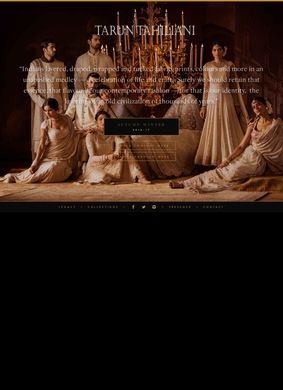
A lehenga here is not a starting point so much as a statement of budget. Tarun Tahiliani leads its site with seasonal collections carrying names like Ever Bloom Spring Summer '26, Quintessence, and SOL, each a run of handcrafted garments pitched squarely at brides, wedding guests, and buyers shopping for the most expensive occasion in their calendar. The label describes its work as traditional Indian craftsmanship crossed with contemporary global cut, and the merchandise backs that up: this is couture, priced and positioned for people who already know they are spending a lot.
The name does a lot of the selling on its own. Tarun Tahiliani the founder is one of the more established figures in Indian fashion, and the house trades on that recognition without spelling it out on every page. What follows is a look at what Tarun Tahiliani puts in front of a shopper, how the collections are organised, and what the scattered outside commentary suggests about buying from it.
The womenswear and menswear ranges
The catalogue is broad without being sprawling. Most of the attention, and most of the floor space judging by how the site is arranged, goes to womenswear, where the traditional and the modern sit side by side under one roof.
Lehengas, sarees, and gowns
On the women's side the range runs through lehengas, sarees, suit sets, gowns, dresses, jumpsuits, and capes. That mix tells you something useful about who Tarun Tahiliani is trying to dress. A bride looking for a heavily worked lehenga is served, but so is a guest who wants a gown or a jumpsuit that reads as evening wear anywhere in the world. The inclusion of capes and dresses alongside classic drapes is a genuine signal that Tarun Tahiliani wants to be worn beyond the wedding mandap, and it keeps the womenswear from feeling like a one-note bridal shop.
For a customer weighing a single very expensive purchase, a piece that only works at one type of event is a harder cost to justify, and this range avoids that trap.
The craftsmanship claim is worth taking at face value, since the pieces are described as handcrafted and the pricing follows. A saree in this range is a considered purchase, and the suit sets give a buyer a middle option between the full bridal lehenga and a plain gown.
Sherwanis, bandhgala, and the accessories
Menswear is narrower but coherent: kurtas, sherwanis, waistcoats, and bandhgala suits. It is the expected vocabulary for Indian occasion dressing, and the presence of the bandhgala in particular points at a grooms-and-guests audience that wants formality without a Western tuxedo. I found the Tarun Tahiliani menswear reads as a deliberate companion to the bridal womenswear, sized to a couple shopping for the same event, which is a sensible way to run a couture house of this kind.
Accessories round it out. Bags, jewelry, and belts are stocked, which lets a shopper assemble a full look from one source instead of hunting for pieces elsewhere. It is a small thing on paper and a real convenience in practice when the outfit itself already costs what it does.
Seasonal collections and ready-to-ship
The site does not dump every garment into flat category pages. It leans on named, time-bound collections, and that choice shapes the whole browsing experience.
Collections built around a season
Ever Bloom Spring Summer '26, Quintessence, and SOL are the anchors, and organising merchandise this way does two jobs at once. It gives the house a way to present fresh design language on a schedule, and it lets a buyer shop a mood instead of a product type. There is a cost to it, though.
Collection-led navigation can bury someone who knows exactly what they want and has to click through several seasonal edits to find, say, a plain saree. The counterweight is the Ready-to-Ship section, which collects pre-made pieces that can go out without the wait of a made-to-order timeline. For anyone whose event is close, that section is the part of Tarun Tahiliani worth opening first, since couture ordering usually assumes months of lead time the calendar may not allow.
Taken together the structure suits the brand's own logic. A couture label wants you browsing its point of view, and the seasonal framing does that job while Ready-to-Ship quietly handles the shoppers who cannot afford to wait. It is a reasonable compromise between how Tarun Tahiliani wants to present itself and how a buyer under deadline actually needs to shop.
Reputation and reaching the stores
This is where a would-be buyer has to read between the lines, because the outside record on Tarun Tahiliani is uneven and skewed toward the wrong audience. Plenty of the visible ratings measure what it is like to work at Tarun Tahiliani, not what it is like to buy from it.
What the review sites show
The heaviest presence sits on employer platforms. AmbitionBox carries an overall 3.8 out of 5 across more than thirty employee reviews, with a stronger 4.8 from seventeen reviews for the Gurgaon location and 4.5 from a small handful for the fashion designer role. Glassdoor adds a couple of employee reviews. None of that tells a customer much about the garment that turns up at their door.
There is less of it on the customer-facing side, but what exists is more relevant. Justdial shows real volume, 241 ratings for the Mumbai store at Apollo Bunder and 103 for the Delhi store in Mehrauli, described as generally positive though without a stated average. On the bridal side, Wedmegood carries customer reviews of Tarun Tahiliani that praise garment quality, alongside at least one complaint about communication and customs on an international order. Wanderlog echoes both notes: warm words for the Mumbai collection and staff, and grumbling about the online ordering experience.
The pattern is consistent enough to act on. In person, at the physical stores, buyers sound happy with the clothes and the service. At a distance, the friction shows up, and the recurring complaint is process rather than product: how an order is communicated, how it clears customs, how the site handles a remote purchase. A shopper near a store gets a very different experience from one ordering across a border, and the reviews say as much.
Reaching Tarun Tahiliani is straightforward. A phone and WhatsApp line is published, a separate WhatsApp number handles appointments, and there is a contact page along with a store locator, worth using first given how much better the in-person feedback runs. Physical stores in Mumbai near the Taj Mahal Hotel and in Delhi's Mehrauli are named outright, so a serious buyer can walk into a Tarun Tahiliani store and see the work in hand.
No public email surfaced, but the messaging and appointment channels cover that. For a purchase at this level, the ability to book a fitting and inspect the beadwork in person is not a small perk.
Against a rival like Sabyasachi, which occupies the same rarefied bridal tier and pulls the same kind of aspirational attention, Tarun Tahiliani makes a strong case on breadth: the womenswear reaches past bridal into gowns and jumpsuits, the menswear is a proper companion range, and Ready-to-Ship gives the impatient a real door in. Where Sabyasachi leans hard on a single signature look, Tarun Tahiliani spreads its bets across more of the wardrobe.
The honest caveat is the distance-selling record. A buyer within reach of the Apollo Bunder or Mehrauli stores gets the version of Tarun Tahiliani the reviews actually praise; a buyer ordering internationally is relying on the same communication and customs process that generated the complaints on Wedmegood and Wanderlog.