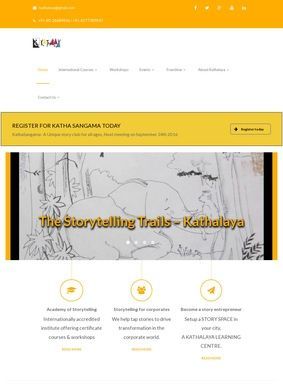
What does an outfit that calls itself "The House of Stories" actually teach? At Kathalaya the answer is concrete and a little unexpected: a graded, certified curriculum that treats oral storytelling as a trainable craft, run out of Bengaluru by a group founded in 1998 by Geeta Ramanujam. This is a training body, not a bookshop and not a touring act. The whole site is sorted by who wants to learn and how far they mean to take it, which is a sensible way to organize something as slippery as narration.
That framing matters, because storytelling instruction drifts easily into vague inspiration and motivational fluff. Here Kathalaya keeps things specific: named courses, fixed durations, fieldwork requirements, and separate tracks for individuals, schools, companies, and NGOs. A visitor can see quickly whether they want a weekend taster or a commitment measured in months, and that clarity does the site a lot of good. The organisation has been at this for a long time, and the catalogue reads like something built up over years of running real sessions, not assembled overnight for a launch.
Courses that certify a storyteller
The spine of Kathalaya is a two-level certification path, and it is the part of the site that reads as most carefully built. Everything else, the school visits and the corporate bookings, hangs off this core of trained, certified storytellers.
Three named courses make up that spine: the Intensive Beginner's Course, the Diploma Course, and a separate workshop called Anthardhwani. Each carries a stated duration and a stated audience, which is more structure than a lot of storytelling training bothers with, and it lets the site speak in levels instead of pushing one generic package at everyone who lands on it.
The beginner intensive and the diploma
Level 1 is a three-day Intensive Beginner's Course, a short doorway for people who want the fundamentals without signing away half a year. Level 2 is where it turns serious: a four-day Diploma Course backed by six months of fieldwork. That fieldwork clause is the detail I'd point to first, because it separates a certificate you collect after a long weekend from one Kathalaya makes you earn through half a year of supervised practice.
Plenty of short courses hand out paper on the last afternoon. A diploma tied to six months in the field asks for something closer to real competence, and it is the strongest signal on the whole site that the training is meant to stick. The two-tier shape also lets people self-select honestly.
Someone merely curious can pay for three days and stop there, while a would-be professional can go the full distance and come out with something a school or an employer might actually recognise.
Anthardhwani and the turn toward silence
The third named course, "Anthardhwani," is a three-day workshop built around silence and the inner voice, which is an odd and interesting thing for a storytelling school to teach. Most narration training pushes outward, toward projection, gesture, and holding a room. A workshop about listening inward points the other way and suggests the people behind Kathalaya think of storytelling as reflective, interior work, closer to meditation than to the performance techniques most communication courses default to.
Whether the three days deliver on that promise is impossible to judge from a listing, but the intent is at least specific and a shade braver than the usual public-speaking fare. A course that asks a would-be storyteller to sit with silence first is doing something more considered than teaching stagecraft.
Work beyond the certificate courses
Around that certified core, Kathalaya runs a spread of programs aimed at institutions rather than lone hobbyists. This is where the organization does most of its actual reach, and presumably where the large numbers it likes to quote come from.
The range is wide and pitched squarely at buyers who purchase training in bulk: schools, companies, and NGOs each get a dedicated track instead of one generic package. That segmentation suggests the catalogue grew out of actual client requests over the years, not something drafted in a single afternoon.
School programs and Stories on Wheels
For schools there is a "Mini Storytellers Program" pitched at grades 1 through 10, along with themed and event storytelling performances a school can book directly for assemblies or festivals.
The most charming item in the catalogue is "Stories on Wheels," described as experiential trips, the sort of get-the-children-out-of-their-seats idea that tends to win over teachers and parents alike. Teacher-training modules round out the Kathalaya school offering, so a school can send its own staff to be trained instead of forever hiring outside performers. That last point is smart. It turns a one-time booking into a lasting capability inside the school.
Corporate and teacher training
The Kathalaya corporate arm carries the faintly groan-worthy tagline "Stories that work at work!" and pitches storytelling as a plain communication tool for companies and their teams. Alongside it sit workshops tailored to NGOs, which fits a Bengaluru outfit working across the education and development sectors. None of this is unusual for a storytelling consultancy, and the corporate line reads a little like every other soft-skills vendor, but it is a sensible engine for funding the more idealistic school and community work.
Podcasts and media features fill out the public side and give a browser a way to sample the actual storytelling before paying for any of it.
Reach, numbers, and how it presents itself
Kathalaya is fond of big, round figures. The site claims 11,04,800 lives impacted, more than 500,000 children reached, a footprint across 48 countries, 32 certified courses, and 220 franchisee units. Those are all self-reported, and self-reported impact numbers always deserve a pinch of salt, especially one as oddly exact as 11,04,800.
Still, the franchisee count and the spread of countries do square with a group that has been training trainers for decades, so the scale is at least plausible even if the precision is for show. The 220 franchisee units are the most telling figure, because a franchise network is harder to invent than a headline count of lives touched; it implies people willing to run the model under the Kathalaya name in their own towns.
Contact is refreshingly easy. Kathalaya lists a full Bengaluru street address, a working phone number, and an email, plus links to its YouTube, Instagram, Facebook, and LinkedIn accounts under the handle @kathalayastoryhouse. For a training body that wants schools and companies to book it directly, that openness is the right instinct and a clear mark in its favor. A school administrator can pick up the phone or send an email without hunting, and the active social accounts give a cautious buyer somewhere to check that the outfit is still running and still performing.
Independent reputation falls well short of the impact numbers Kathalaya quotes. Kathalaya's own Facebook page shows a 96 percent recommendation rate across 30 reviews and roughly 7,435 page likes, which is warm but comes from its own channel. No Trustpilot, Google Business, or independent review-platform listing surfaced, and a ZoomInfo entry files it as a low-activity company profile with no rating shown.
The praise looks genuine, then, but lightly evidenced: thirty Facebook reviews is a small sample for an organization that claims to have reached half a million children. A 96 percent recommendation rate sounds glowing until you notice it rests on those thirty voices, all gathered on a page the organisation controls. It counts in favour, but softly, and a prospective client would do well to ask for references beyond the site itself.
Set the diploma against the obvious cheaper option, a one-off storytelling or public-speaking course on Udemy, and the difference comes down to structure and accountability. Udemy sells you a video library for the price of a lunch and asks nothing of you afterward. The Bengaluru programme gives you fixed contact days, six months of fieldwork, and a certificate from a group that has been at this for decades.
For a casual dabble, the video course wins on price and convenience. The diploma costs more in time and money, but it is built for people planning to carry storytelling into a classroom or a career rather than sample it over one weekend.