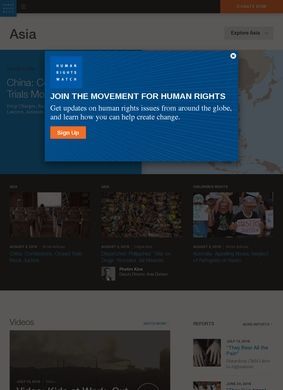
Twenty-eight countries sit under the Asia banner here, from Afghanistan and Myanmar to China, India, Indonesia and Vietnam, and the page treats each of them as a live file rather than a settled chapter. That breadth is the first thing worth registering. Human Rights Watch built its Asia section to track abuses across a region where political conditions shift quickly and where the people best placed to document those abuses are often the ones most at risk. The result is a steady output of investigative reporting that names specific practices in specific places, and it does not soften its subjects to make them easier to read.
Investigative reports on forced labor and coerced confessions
The investigative reports are where the Asia section earns close attention. These are not summaries clipped from wire copy. A piece on Uyghur forced labor traces the supply chain into aluminum production. Another documents coerced confessions in Cambodia. A third examines China's policy of integrating Tibetan children into a preschool system designed to pull them away from their own language and community. Each report rests on interviews, document review and field research, and each comes from an organization that journalists, lawyers and policymakers cite when they cannot afford to be wrong. For a reader trying to understand what is happening across the Asia region, this material does the heavy lifting that a headline never can.
News dispatches alongside longer analysis
Alongside the long reports, the Asia section runs news dispatches, commentary, policy letters and formal statements, which together give it two speeds. The reports go deep and slow. The dispatches move fast and flag an arrest, a court ruling or a new piece of legislation as it happens. Anyone following a single country, say Pakistan or the Philippines, can read both the immediate development and the deeper pattern it belongs to. The country-by-country structure makes that navigation straightforward, and it keeps places like Bangladesh and Tibet from being folded into a vague regional blur. A reader who wants only one government's record can get it without first reading the entire Asia caseload.
Thematic coverage across human rights issues
Cutting across the geography is a set of thematic threads that show how wide the brief runs. Coverage takes in arms and weapons, children's rights, disability rights, economic justice, environmental harm, free speech and press freedom, health, LGBTQ rights, refugees and migrants, technology and digital rights, counterterrorism accountability, women's rights, and international justice. The breadth reflects how the organization reads human rights as something that runs through a factory's labor practices, a government's surveillance tools and a court's treatment of a refugee, well past the familiar frame of prisoners and protests. The Asia material connects those threads where the evidence connects them, which is part of why the Asia pages reward a slow read instead of a quick scan.
Staff accountability through named reporters
The reporting is also led by people who put their names to it. Elaine Pearson runs the Asia division as director, with Maya Wang as deputy, supported by country and thematic specialists who track particular nations and particular issues. Naming the people behind the work is a small thing on the page and a large thing for credibility, because it tells a reader that the Asia analysis has authors who can be held to it. That accountability is easy to miss and hard to overstate.
Video transcripts, photos and interactive features
The section does not rely on text alone. It carries video documentaries with full transcripts, photo galleries, and interactive features that let a reader move through evidence at their own pace. The transcripts deserve a specific mention: they make the video usable for someone who cannot watch it, quotable for someone writing about it, and searchable for someone hunting a particular claim. That is a practical editorial decision, one that shows the material was built to be used as a source rather than merely viewed. The photo galleries and interactive features serve the same end: a reader gets more than one way into a story whose details can be difficult to absorb in plain prose alone.
No third-party ratings for this page were found in a general search, which is unsurprising for a documentation resource of this kind. The organization's standing in international reporting circles is well-established, though that reputation sits outside what any single section page can prove on its own terms.
As a reference, the Asia output is hard to match: detailed, sourced, and organized so that a single country or a single theme can be followed without wading through everything else. As reading, it is demanding and frequently grim, because the subject matter is forced labor, coerced confessions and the erasure of a language.
Reaching audiences through newsletters and social media
Nobody arrives at the Asia files looking for comfort, and the section does not pretend otherwise. A student, a reporter or a researcher will find the depth they need; a casual visitor may find the volume and the tone heavy going. Newsletter subscriptions push new reporting out as it lands, and the organization maintains a presence across BlueSky, X, Facebook, YouTube, Instagram, LinkedIn and TikTok, so the same documentation reaches very different audiences in very different formats. Donation channels run alongside all of this, with options for one-time gifts, monthly giving, legacy bequests and stock transfers; the Asia reporting is funded by readers and supporters, not by the governments it scrutinizes.
Documentation without guaranteed remedy
One question the section cannot fully answer for the reader sits underneath the entire enterprise. Documentation is not the same as remedy. The Asia files can prove that Uyghur labor sits inside an aluminum supply chain, that confessions in Cambodia were coerced, that Tibetan preschoolers are being pulled from their language, and the proof can be detailed, careful and damning. What the page cannot show is whether any of it changes the behavior of the governments named in it.
The reports accumulate, the abuses they describe often continue, and a reader who finishes a piece on China or Myanmar is left holding evidence with no guarantee it leads anywhere. That gap between what the work documents and what it can compel runs through everything the section publishes, and the Asia output, across all its breadth, does not resolve it. The evidence is here in abundance; whether anyone with power chooses to act on it stays outside the reach of any report, however careful.