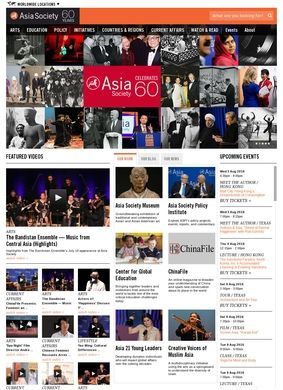
What does an organization founded in 1956 to bridge the United States and Asia actually do almost seventy years later? Quite a lot, and the site lays it out without much fuss. Asia Society runs along three tracks that rarely overlap in one place: policy research, an art museum, and education resources, all tied to a network of centers that stretches from New York to Hong Kong, Mumbai, Manila, Seoul, Sydney, Tokyo, and beyond.
Policy research and economic analysis
The policy work is the part that gives the institution its public profile. Global and pan-Asian research, briefings, and forums sit here, the kind of analysis aimed at people who follow trade, diplomacy, and economic shifts across the region for a living. It reads as serious and current. John D. Rockefeller 3rd set the thing up as a nonpartisan, nonprofit body, and the policy output still carries that even-handed framing, leaning toward explaining rather than advocating. Business and economy coverage threads through the same area, so a reader tracking supply-chain news or cross-border investment will find material pitched well above a quick news summary.
Nonpartisan framing on trade and diplomacy
The arts and culture program centers on Asia Society Museum in New York. It mounts exhibitions of both traditional and contemporary work, including Asian American art, and it holds a permanent collection built around the Rockefeller Collection of Asian Art. That collection is the through-line back to the founder, and it gives the museum a spine that a lot of contemporary-only spaces lack. Traditional bronzes and ceramics share the institution with living artists, which is a harder balance to strike than it sounds, and I find the willingness to hold both ends honestly appealing.
Museum exhibitions and permanent collection
The museum facility also rents out space for events, which is worth knowing if you are organizing something and want a venue with genuine cultural weight behind it. It is a practical detail buried under the bigger programs, but a real one.
Event space with cultural significance
Public lectures and events run alongside the exhibitions, and the calendar pulls in the AAPI community programming Asia Society has built over the years. The events listing is one of the more active corners of the whole operation, so the site rewards a regular check more than a single visit.
Public lectures alongside AAPI programming
Education is the third leg, and it may be the most quietly useful. The resources are split between K-12 and higher education, with free webinars, guidebooks for setting up Chinese-language programs, and curriculum tools written for teachers. A district trying to launch a Mandarin track, or a teacher who wants vetted material on contemporary Asia, can pull real documents here without paying for them. That the webinars are free matters: it widens who can use the material well past the institutions that can afford consultants.
Free educational resources for teachers
A few things are easy to misread, so the site is upfront about them. Asia Society is not a grant-making organization, and the fellowship opportunities it does offer are limited in number. Anyone arriving in search of funding will leave disappointed, and it is to the institution's credit that this is stated plainly instead of left as a hopeful gray area. Job listings, internships, and volunteer openings are posted directly on the site, which keeps the career side from getting buried.
What Asia Society does not offer?
The geographic spread deserves a second look. Offices in Hong Kong, Houston, Los Angeles, Manila, Mumbai, New York, San Francisco, Seoul, Sydney, Tokyo, Washington DC, and Zurich mean the programming is not filtered solely through a single American viewpoint. Each center runs its own events and brings its own regional emphasis, so the Manila calendar will not mirror the one in Zurich. Anyone who found Asia Society through a business directory entry might underestimate the scope: this is an institution with genuine programmatic weight in more than a dozen cities, not a listing that happens to have international offices.
From New York to Zurich and beyond
What holds Asia Society together is purpose rather than polish. The site is large and a little sprawling, the inevitable result of one organization carrying a think tank, a museum, and a teacher-resource library under the same roof. Navigation takes patience. But the substance is there in every section, and almost none of it is gated behind a paywall, which is rarer than it should be for material of this depth.
One honest caveat: the breadth can work against a first-time visitor. If you land looking for a specific exhibition or a particular policy brief, the homepage will not necessarily point you straight to it, and you may need to dig through the program menus before landing where you want to be. That is a navigation cost, not a content one. Asia Society publishes a large amount of freely accessible, substantive material for an institution of this kind, and the friction of finding it is a fair trade for what Asia Society puts on the other side of the search.