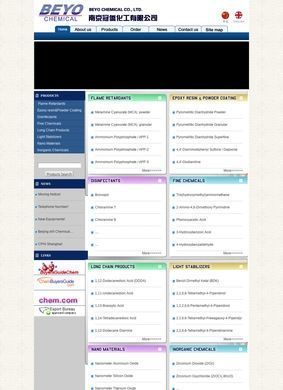
Nanjing-based chemical manufacturer BEYO Chemical operates as a private joint-stock company registered at the TianFeng Building on HongWu Road in Jiangsu province. BEYO Chemical sells into the B2B industrial chemicals market, positioning itself as both a producer and a trade supplier, which is the model most buyers in this space deal with regularly.
Product categories from flame retardants to specialty polymers
The product range is the most concrete thing to go on. Flame retardants are one pillar, with melamine cyanurate named as a representative line. Epoxy resin and powder coating inputs sit in another category, where pyromellitic dianhydride is the listed example, a curing agent that anyone formulating high-performance coatings will recognise. There is a disinfectant category built around bronopol (2-bromo-2-nitropropane-1,3-diol), a preservative used across cosmetics, industrial water treatment and household formulations. The range extends into long-chain products: dodecanedioic acid, undecanedioic acid and brassylic acid, the kind of diacids that feed nylon, lubricants and specialty polymer chemistry.
Fine chemicals and pharmaceutical intermediates
Where the listing gets genuinely specific is the fine chemicals section. Named compounds include 2,4-dihydroxybenzoic acid, 2-amino-4,6-dimethoxy pyrimidine, 2-ethoxybenzoic acid and 2-ethoxybenzoyl chloride. These are intermediates that tend to appear in pharmaceutical and agrochemical synthesis, and listing them by exact name implies BEYO Chemical is comfortable supplying defined synthesis inputs rather than only large-tonnage staples. The catalogue also covers light stabilizers, nano materials, inorganic chemicals, and a grouping of organic intermediates and cosmetic raw materials. That is a wide sweep for one supplier, common among Chinese exporters that function as a window onto a network of manufacturing partners as much as a single production site.
One claim worth weighing is that BEYO Chemical has taken products from R&D stage through to industrial output measured in hundreds of metric tons. If accurate, that scale-up capability is directly relevant to a buyer, because it points to a supplier who can carry a compound from a small trial order to committed volume without forcing a source change midway. BEYO Chemical's listing offers no independent confirmation of that figure, so it remains a company statement, useful as an indication of intent but not something an outside buyer should accept as verified without requesting batch records or references.
Online presence and buyer verification
BEYO Chemical appears on Made-in-China.com and ECHEMI, two of the larger B2B chemical marketplaces, and also turns up on ChemicalRegister.com and ChemExper. Being indexed across several of these platforms is normal for an active exporter and at least confirms the company is a known, listed supplier rather than a name that exists only on its own pages.
What those listings do not provide is any aggregated buyer feedback. No star ratings or review counts turned up on Google, Trustpilot or comparable platforms, and the trade directories carry BEYO Chemical without attached buyer scores. For a B2B chemical supplier that absence is not unusual: procurement in this field runs on samples, certificates of analysis and direct negotiation more than on public ratings. Even so, a prospective customer has no crowd-sourced reputation to draw on and would be relying entirely on direct due diligence.
Website offline blocks direct contact routes
The sticking point is beyochem.com. At the time of this review the site shows a maintenance notice reading "WE ARE COMING BACK SOON." With the primary domain down, none of the contact routes a buyer would normally reach through the company's own pages are accessible, and the detailed product catalogue cannot be inspected directly. Chemical directories fill part of the gap by carrying two Nanjing phone numbers and the registered street address, so a determined buyer can still locate a way to make contact through secondary sources.
A supplier whose own domain is dark is a fair thing to flag. It may be a routine redesign, and the presence across trade platforms suggests BEYO Chemical is still operating. But a first-time visitor arriving at a maintenance screen has no way to verify the catalogue, request a quote or judge response times. The site being down blocks the very verification a cautious buyer wants to do early in a sourcing conversation.
On the evidence, BEYO Chemical reads as a broadly capable chemical supplier with a credible product spread, a registered corporate identity in Nanjing, and a real footprint on the main B2B trade platforms buyers in this sector already use. The named intermediates and the stated R&D-to-tonnage scaling are the details a serious procurement contact would want to follow up. Against that, the live site being offline is more than a minor inconvenience, and without any independent rating there is no outside view of how the company actually performs.
A buyer sourcing one of the listed compounds, say bronopol or a long-chain diacid, has enough here to justify reaching out through the Made-in-China or ECHEMI profiles or the published Nanjing numbers, then asking for documentation and a sample. Until beyochem.com returns and the catalogue can be checked at source, BEYO Chemical is best treated as a credible lead to be verified through direct contact, not a confirmed supplier to take on the basis of directory listings alone. The bones of a legitimate operation are visible in the public record; the fuller picture requires getting a response from the company itself.