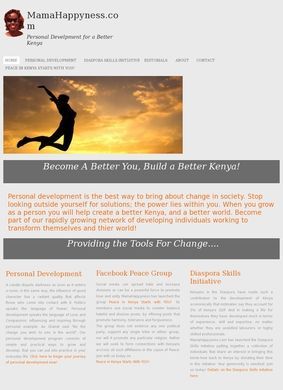
A Kenyan reader worn down by the political, tribal, and religious noise online, who suspects the fix has to start closer to home than the next election, arrives at MamaHappyness with a fairly specific hunger. They want a calmer way of thinking about their country and their own part in it. The site answers that hunger directly, and its premise is unusually plain for a self-improvement project: change your own character first, and the wider change in society follows from there. Everything else on MamaHappyness grows out of that single conviction.
Character development as civic action
The core of the offering is practical guidance on character development and self-improvement. This is the part that does the heavy lifting, and it sets the tone for the rest. The framing is deliberate. Personal growth here is treated as a civic act, not a private hobby, so the reader is asked to see better habits and a steadier temperament as something they owe the people around them. Whether that argument lands depends a lot on the reader, but it is a coherent and honest position, and MamaHappyness states it without dressing it up.
Peace in Kenya Starts with YOU Facebook group
From that base, the project branches into two more concrete efforts. One is a Facebook community group with the blunt name "Peace in Kenya Starts with YOU!" The group asks members to push back, in their own feeds and conversations, against the divisive content that floods Kenyan social media along political, tribal, and religious lines, and to answer it with messages of harmony and tolerance instead. It is a modest mechanism, and I find the modesty refreshing, because the goal is something an ordinary person can attempt today without waiting for permission or funding. Anyone joining should know the activity lives on Facebook, so the experience depends on that platform as much as on MamaHappyness itself.
Diaspora Skills program for professional volunteers
The second initiative is the more distinctive one. MamaHappyness runs a Diaspora Skills program built for Kenyans living abroad who want to put their professional expertise to work for the country they left. It connects those volunteers with development needs back home, turning a doctor, an engineer, or an accountant in London or Atlanta into a contributor rather than a spectator. This is a sharper idea than the general inspiration that fills a lot of personal-growth sites, because it names a real group of people, a real resource they hold, and a real channel for using it. A Kenyan abroad who has often wondered how to help without simply sending money will find a clearer route here.
Focus on Kenya and personal contribution
Taken together, those three pieces give MamaHappyness a recognizable shape. The audience is Kenyans, in the country and in the diaspora, and the thread running through the character guidance, the peace group, and the skills program is the same belief that individual conduct scales up into national outcomes. It is a focused proposition. MamaHappyness is not trying to be a general lifestyle portal; it stays close to Kenya and close to the question of how one person contributes to a less fractured society. That focus keeps the content from drifting into the vague uplift that sinks similar projects.
Limited external verification available
What could not be found is the kind of outside confirmation that would tell a newcomer how much traction any of this has earned. A search for independent reviews or ratings of MamaHappyness turned up nothing tied to the site. The results that surfaced belonged to unrelated outfits with similar names, boutiques and shops with no connection to this Kenyan platform.
No independent reviews or ratings found
So there is no third-party verdict to rely on, positive or negative. A reader weighing whether to join the Facebook group or sign up for the diaspora program is doing so largely on the strength of the site's own presentation and the appeal of the idea, without a chorus of past participants to vouch for the experience. That is worth knowing going in, though it is a common position for a grassroots civic effort that has grown through community channels rather than press coverage.
Single email contact for inquiries
The spare part of the picture is how to reach anyone. MamaHappyness lists a single email address, presented for advertising inquiries, which tells you the site carries ads and is partly funded that way. There is no phone number, no physical address, and no dedicated route for a member or a curious volunteer to reach the organizers about the work itself.
For a project whose entire pitch is participation, that gap is a little awkward. Someone in the diaspora ready to offer their skills would reasonably want a clear, named channel to start that conversation, and right now the advertiser-facing email is the only visible door. It does not sink the project, since the Facebook group gives an alternative way to engage and to gauge whether the community is active, but a careful visitor should set expectations accordingly. The bare contact setup fits a small, mission-driven operation, yet it does leave a person guessing about who is behind the effort and how responsive they will be.
Engage through Facebook group first
That mix of a strong idea and modest institutional scaffolding is the honest summary of MamaHappyness. The concept is clear, the focus on Kenya is consistent, and the Diaspora Skills program in particular fills a need that many emigrants feel but rarely find a structured outlet for. Set against that, the absence of any outside reviews and the spare contact details mean a visitor cannot easily verify the organization's reach or track record. These are not reasons to dismiss MamaHappyness; they are reasons to engage with eyes open. Joining the Facebook group first costs nothing and shows immediately whether an active, like-minded community is actually there.
Business address
Scolar Nginya
United Kingdom