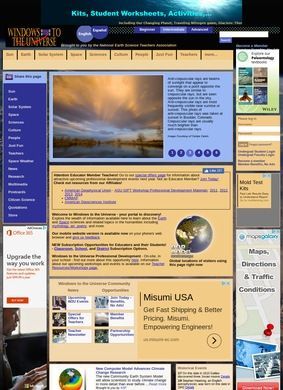
Windows to the Universe is a free Earth and space science education website run by the National Earth Science Teachers Association, or NESTA. It gathers explanatory content across the physical world, from the planet's core to the outer edges of space missions, and organises it for students, teachers and curious general readers. The material is broad, cross-referenced, and built to be read online without a paywall.
The site is old-school in the best sense: a deep library of interlinked reference pages, not a slick app. Windows to the Universe grew up inside the university atmospheric-science world, developed with support from UCAR and NCAR, where the project previously resided, and sponsored in part through federal agency grants. That lineage shows in the seriousness of the content. Material that grew inside NCAR and UCAR, two heavyweight names in atmospheric and climate research, tends to be written by people who know the science first-hand, and it reads that way: careful, factual, more interested in explaining than dazzling.
The trade-off is a presentation that can feel dated next to a modern, animation-heavy education site. This is not the sort of listing a person would find in a business directory, an address and a phone number and nothing else; it exists to be read and returned to, not glanced at once.
The science it covers
The subject range is the main event. Windows to the Universe splits its material into a few large territories, and each one goes surprisingly deep for a free resource.
The organising logic is by domain, so a reader can follow one thread from the planet outward. That structure suits a curriculum. A teacher building a unit on, say, the atmosphere can find the relevant pages grouped together instead of scattered, and a self-directed student can wander from one linked topic to the next the way the old web was built to let you.
Earth, from the interior to the poles
The Earth section of Windows to the Universe is the largest, covering the interior and surface, the atmosphere, the ocean, the magnetosphere, the moon, the poles, climate, and life. It reaches past hard science into the cultural side too, with pages on myth and on the history of exploration, which is a nice touch for a science site and gives a teacher a way into a topic through story. A pupil researching the magnetosphere or the polar regions can find a dedicated, readable page instead of a single thin paragraph.
The inclusion of myth and exploration alongside the physics is the quietly clever part. Science education often strips out the human story, and setting the folklore of the poles or the history of who first mapped them next to the hard data gives a teacher a hook that a bare diagram never will.
Space missions and physical science
Beyond Earth, Windows to the Universe carries a "Space Missions to Earth" section and a Physical Science area that explains geology, physics, chemistry and biology together rather than siloing them off from each other. Treating the physical sciences as connected is a sensible pedagogical choice, since that is closer to how the real world behaves.
The coverage sits at an accessible level, aimed at learners meeting these ideas for the first time. That accessibility is deliberate and, for the intended audience, correct. This is reference material for a school-age reader or a general adult, not a research portal, and it does not pretend otherwise.
Someone wanting graduate-level depth will outgrow it fast; someone wanting a clear first explanation of plate tectonics or the water cycle is well placed.
Built for the classroom
Windows to the Universe is aimed squarely at teachers as much as students, and the extras reflect that. The teacher-facing side is where the NESTA connection pays off, going past reading material into professional development.
For educators there are web seminars and webinars, the kind of continuing-development sessions science teachers are often required to log. The content is free to read, but the Windows to the Universe teacher tools sit behind a light membership layer. Web seminars are the kind of continuing professional development many science teachers have to accumulate hours of anyway, so bundling them with a trusted content library is a sensible fit. It also gives the project a modest revenue line that does not compromise the free-to-read core.
Membership and partnership programs
A "Basic Educator Membership" opens up the teacher resources, and NESTA members get it at a 50 percent discount, roughly fifteen dollars off.
Windows to the Universe also runs a "Partnership Opportunities for Education and Outreach" program that invites geoscience organisations to join its community, which is how a site like this keeps its content current without a large commercial budget. Neither is a hard sell; both read as ways to sustain a public-good resource.
Reach and where it stands
By its own account the reach is considerable. Windows to the Universe reports roughly 14 million visits a year and more than 15,000 educators subscribed to its monthly e-newsletter, and it describes itself as one of the most popular Earth and space science education sites in the world.
Those are the site's own figures, so treat the superlative with the usual caution. For a free resource run largely on grants and volunteer educators, Windows to the Universe carries an unusually large audience, and a science reference at that scale is clearly doing real work for a lot of classrooms. Longevity counts too. A site that has survived from the earlier days of educational web content, moved between host institutions, and kept its material current has proven something a flashier newcomer has not.
Set against NASA's own education pages, such as NASA's Space Place, Windows to the Universe makes a different trade. NASA has slicker graphics, first-party mission data and a far bigger budget behind it. It answers with breadth and a genuinely teacher-built structure, tying Earth science, physical science and space together in one interlinked place, plus classroom tools NASA does not really bother with.
For a student chasing polished visuals on a single mission, NASA is the better first stop. For a teacher planning a unit that has to span the planet's interior, its climate, and the space around it, Windows to the Universe is the more complete workbench. The two are less rivals than different tools; a well-built lesson could easily pull a striking image from NASA and the connective explanation from here. If only one had to be bookmarked, the teacher-built breadth is what keeps this one open in a tab.