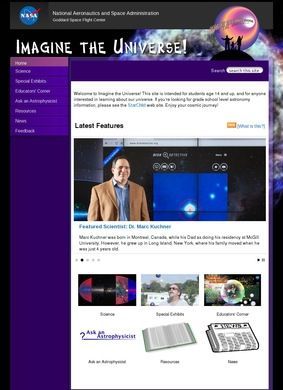
You can send an astronomy question to a working NASA scientist and get a real answer back, then read through thousands of questions other people already asked. That feature, called Ask an Astrophysicist, sits inside Nasa's Imagine The Universe, a public education site run out of Goddard Space Flight Center and aimed squarely at the high-energy end of astronomy: black holes, pulsars, quasars, dark matter, active galactic nuclei, and the Sun. It is built for students from about age 14 upward and for any curious adult who wants the physics explained without being talked down to. Unlike a general space portal or a business directory of science resources, this is a curated, deep resource with a clear scope.
The scope is narrower than a general space portal, and that focus is the point. Nasa's Imagine The Universe is not trying to cover every planet, rocket, and mission. It concentrates on how astronomers study the most energetic objects in the universe and on the satellites that gather the data. Knowing that going in helps, because the content rewards readers who want depth on a specific corner of the field rather than a shallow tour of everything.
Structure and scope of the science section
The Science section is split into four parts, and the split is sensible. Astronomer's Toolbox explains the methods and instruments used to observe the high-energy sky, which is the part most general sites skip entirely. Objects of Interest walks through cosmic phenomena across a wide span of scales, from the Sun out to extragalactic sources. Big Questions takes on the open problems that astronomers have not yet solved, and Featured Science collects highlighted discoveries and imagery.
Astronomer's Toolbox explains observational methods
High-energy astrophysics is hard to approach cold, so putting the tools and methods on equal footing with the objects themselves means a reader can grasp what a quasar is and also understand how anyone could possibly know. A student who reads the Toolbox pages before the Objects pages comes away with a much firmer grasp than someone who only memorises facts. That sequencing is baked into how Nasa's Imagine The Universe is laid out, and it is one of the better structural decisions on the site.
Observatories section covers NASA satellite missions
The Observatories section carries this further by covering actual NASA satellite missions, how they acquire data, and the detection technology behind them: X-ray, gamma-ray, and multiwavelength instruments, plus history on older observatories. Pairing the science with the hardware that produced it turns a fact into something a reader actually understands. It also quietly teaches that astronomy at these energies happens above the atmosphere, which is worth grasping early. Newer material has been added around recent NASA video releases, including pieces on black hole safety and travel near the speed of light. Those are exactly the questions a teenager tends to ask first, and meeting that curiosity head-on is a smart way to pull someone into the harder material that surrounds it.
Special Exhibits with interactive activities
Beyond the core reading, the Special Exhibits area is where Nasa's Imagine The Universe gets playful without losing depth. There are scientist biographies, a cosmic distance scale module, coloring pages, and two interactive pieces worth singling out: "Be an Astrophysicist," which puts the reader in the role, and a Space Forensics game. These are not filler. Interactive activities tend to be where younger users actually stay on a site, and an exhibit that lets someone work a problem the way a researcher would is more memorable than a wall of text.
Educational resources for teachers and students
For teachers, the Educators section of Nasa's Imagine The Universe is the most substantial part of the whole project, and it is genuinely built for a classroom. It holds structured curriculum materials: lesson plans, the Afterschool Universe program designed specifically for middle-school after-school settings, and Cosmic Times, a curriculum presented in newspaper format that traces astrophysics discoveries across decades. That last one is a clever device. Reading the history of a field as if it were breaking news gives students a sense of how scientific understanding shifts over time, which is harder to convey through a static timeline.
Curriculum materials for classroom use
The Educators material has a practical weight that sets Nasa's Imagine The Universe apart. A middle-school instructor running an after-school club can pick up Afterschool Universe and have something usable, not a vague suggestion to "explore." Ready-to-run lesson plans make clear that real educators were involved in building this, and it shows. On the reference side, an Astronomer's Dictionary and supporting pages cover the vocabulary problem that trips up beginners. High-energy astrophysics is dense with terms, and having a plain-language dictionary one click away means a reader does not have to leave the site every time a new word appears.
HEASARC expertise ensures accurate explanations
Nasa's Imagine The Universe is produced under the High Energy Astrophysics Science Archive Research Center, HEASARC, at Goddard. That provenance is the quiet backbone of the whole site. The same group that maintains the data archives professional astronomers use is writing the explanations for fourteen-year-olds, which means the simplifications are made by people who know precisely what they are simplifying. That is rarer than it sounds, and it is the difference between accurate popularisation and confident error.
Beyond that, Nasa's Imagine The Universe is free and openly accessible, with no gate of any kind. A student in a school with no astronomy program has the same access as anyone else, which removes the main friction that keeps science education from reaching the people who would benefit most.
If there is a fair caution, it is that the high-energy focus means Nasa's Imagine The Universe will not answer every space question a casual visitor brings. Someone hunting for material on Mars rovers, exoplanet hunting, or crewed flight history will need to look elsewhere; this is a place for the physics of energetic objects and the instruments that detect them. Treated as a specialist library and not a general encyclopedia, the depth it offers within its lane is hard to match.
Multiple entry points for different audiences
One more thing worth noting is the range of entry points Nasa's Imagine The Universe keeps open. A coloring page and a working answer from an astrophysicist live under the same roof, which means a family, a curious adult, and a classroom can each find a sensible starting place. Few education sites manage to serve a ten-year-old and a self-directed high-schooler from the same set of pages, yet Nasa's Imagine The Universe does it by sorting content rather than diluting it. The recent black hole and near-light-speed pieces are a good doorway in for anyone who has been putting off the harder material, and the depth waiting on the other side is real.