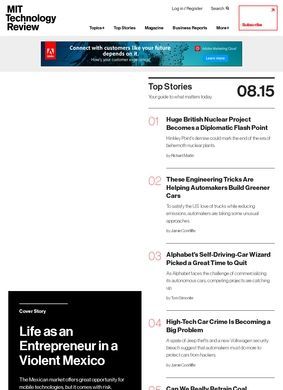
Running since 1899, Technology Review is older than most of what it covers. The Massachusetts Institute of Technology launched it to document the work coming out of its labs, and more than a century later the publication still carries the MIT name, but it operates as an independent media company that funds itself commercially. That distinction matters when you read it: the editorial side runs free of MIT's direct control, so the coverage is not a university press office in disguise.
News coverage by beat
What you get when you open the site is a working newsroom organized around a handful of beats. Artificial intelligence gets the heaviest rotation, which is unsurprising, but the climate-technology and biotechnology desks are substantial in their own right, and there is steady reporting on computing and on space. The mix runs from quick news hits to long-form investigations that take a subject apart over several thousand words. Opinion and analysis sit alongside the straight reporting, clearly labeled as such. The climate coverage is the most consistently useful of the lot, because it tends to put numbers and engineering reality first instead of the breathless framing that topic usually attracts elsewhere.
Biotech reporting without hype
The biotech reporting deserves its own mention. It covers the territory where genetics, medicine, and money collide, and it does so without either credulous wonder or reflexive alarm. The computing coverage is steadier and quieter, less driven by the news cycle, and the space desk fills in the gaps that bigger general-interest outlets leave when a launch is not happening. Taken together, the beats give a reader a fairly complete map of where applied technology is heading. None of it is dumbed down, and none of it is written for an audience that already knows everything either. Technology Review keeps this breadth well beyond the AI moment that dominates its homepage.
Products beyond the homepage
Beyond the article stream, Technology Review has built out a set of products that extend past the homepage. There are podcasts, including "Deep Tech," and a roster of email newsletters that slice the coverage by subject: The Algorithm for AI, The Download as a daily catch-up, Chain Letter, The Spark, and others. The newsletters are a reasonable way to follow a single beat without committing to the full volume. There is also a digital magazine behind a subscription, where the deeper special reports and the most ambitious feature work tend to land. Those special reports are where Technology Review does some of its best work, pulling a single emerging field into focus across a structured package instead of a scattering of separate stories.
It is worth being clear about the structure of all this, because Technology Review is not one thing. There is the free news operation, the paid magazine, the newsletter network, the podcast slate, the events arm, and the recurring franchises like the "35 Innovators Under 35" list. Each draws a slightly different audience and serves a slightly different purpose, and they reinforce one another. A reader who comes in through a free AI article might end up on a newsletter, then at a conference, then as a subscriber. That funnel is deliberate, and Technology Review has assembled it with more coherence than legacy outlets that bolted these pieces on as an afterthought.
How the revenue model works
The events arm is its own thing. The EmTech conference series runs in several locations around the world and pulls in researchers, founders, and executives to discuss whatever is cresting at the moment. These are paid professional gatherings, and they function partly as a revenue stream that keeps the journalism self-sustaining. That commercial independence shapes what Technology Review can afford to cover and how long it can spend on a single story. A magazine that funds itself through subscriptions and conferences answers to a different set of pressures than one propped up by an endowment or a billionaire owner.
Who reads Technology Review
Technology Review clearly aims at people who work in or near technology: researchers, business leaders, policymakers, and professionals who need to understand a development before it shows up in a board meeting or a regulatory filing. The writing assumes a reader who is comfortable with technical substance and impatient with hand-holding. That is a strength when the subject demands it, and a limiting factor when it does not.
Free access versus paid content
A general reader who wanders in for a single AI explainer will find plenty that is accessible, but the rhythm of the site, the assumption of prior context, and especially the subscription wall around the magazine all point toward a committed audience. The free article stream gives a real sense of the place, yet the work that justifies the reputation Technology Review enjoys, the long investigations and the special reports, is mostly on the paid tier. Whether the gap between the free taste and the paid substance feels fair depends on how much you already lean on this kind of coverage.
The international footprint backs up the seriousness of the project. Technology Review maintains bureaus and correspondents abroad, which means the reporting is not filtered entirely through a single coast of a single country. For climate and biotech in particular, where the important work happens across many borders, that reach shows up in the stories. The EmTech events follow a similar logic, landing in multiple regions instead of clustering in one tech capital, and the effect over time is a publication that reads less parochially than its peers.
Independence and institutional ties
There is a tension running underneath all of this that Technology Review never fully resolves. The publication is editorially independent of MIT, yet it trades on the MIT name in everything from its masthead to the credibility readers extend to its judgments. That borrowed authority is genuine and mostly earned. The "35 Innovators Under 35" list has the weight it does precisely because of the institution behind it, and the deep reporting is strong on its own terms. But the same arrangement that funds the independence, the conferences, the subscriptions, the commercial machinery, also gives Technology Review a stake in the technology economy it covers.
The people who appear on its innovator lists and its conference stages are often the same people whose companies it reports on as news. None of this reads as corruption, and the editorial work is genuinely strong. The unresolved part is whether a reader can always tell where the journalism ends and the prestige-and-access business begins. On that question Technology Review asks for a trust it has mostly, though not entirely, demonstrated it deserves.
Credibility in academic circles
On outside reputation: Technology Review is widely referenced across academic and professional circles, and searching for reader criticism turns up more debate about its paywall and conference pricing than about the accuracy of its journalism. No aggregate rating from a single review platform defines it, which is fitting for a publication whose audience tends to cite it rather than score it.