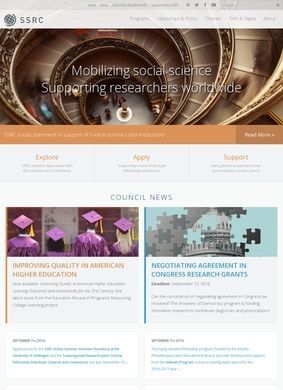
A doctoral student finishing a dissertation, or a postdoc trying to turn a defended thesis into peer-reviewed articles and a book, runs into the same wall: the work is done or nearly done, but the money, the time, and the structured support to carry it across the line are missing. The Social Science Research Council exists for exactly that stretch of an academic career, and it has been doing this kind of work since 1923. It is an independent nonprofit based in New York that designs and runs competitive fellowship and grant programs across the social sciences, and its catalogue of programs maps closely onto the moments where researchers tend to get stuck.
Career stages and fellowship programs
The clearest way to understand what the organization does is to look at the career stages it covers. There are programs aimed at the pre-dissertation phase, others at the dissertation phase itself, and others built for postdoctoral researchers. The needs at each stage differ considerably. Someone scoping a project that will take years wants different help than someone who has a finished draft and needs it published. The Social Science Research Council runs annual competitions across that whole arc, which means a researcher can plausibly engage with it more than once over a career as their work matures, and the timing of an application against where the work stands becomes part of the calculation.
Named initiatives with funding
The named initiatives give a concrete sense of the priorities. The Just Tech Fellowship is built around researchers working where technology meets society, and it comes with a $60,000 unrestricted award. The word unrestricted does real work there: the recipient decides how to spend it, which is a meaningfully different proposition from a grant tied to specific line items. The Next Generation Social Science Fellowships target a problem that quietly stalls a lot of early careers, namely the gap between having defensible research and having it appear as peer-reviewed articles and book manuscripts.
Data access for accountability research
The Social Data Research and Dissertation Fellowships go after a harder bottleneck still: access to proprietary data that holds socially relevant information, with an emphasis on journalistic and academic accountability work. Getting at data that companies and institutions hold privately is a genuine obstacle for accountability research, and a program organized around easing that access is solving something real instead of something cosmetic.
Partnership model with major foundations
Most of these programs run in partnership with major funders. The MacArthur Foundation and the Ford Foundation are named among the collaborators, and the model is consistent: the Social Science Research Council brings the design and administration of a fellowship while a foundation supplies the backing. That arrangement is worth understanding before applying, because it shapes what each program funds and who it is looking for. The organization is acting as the intermediary that turns philanthropic money into structured, competitive research support, and it has a long history of doing precisely that. The Social Science Research Council managed the Ford Foundation's Foreign Area Fellowship Program from 1972 onward, which is the kind of multi-decade administrative track record that tells you the grant-running machinery is not improvised.
Networks, working groups, conferences
Fellowships are the most visible output, but they are not the whole picture. Beyond the grant competitions, the Social Science Research Council also builds research capacity through networks, working groups, conferences, and publications. This distinction is worth weighing for anyone deciding whether the Social Science Research Council is relevant to them. A working group or a research network is a slower, more collaborative form of support than a one-time grant, aimed at sustaining a field or a question over time instead of funding a single project. So a scholar who is not currently in the application window for a fellowship might still find a reason to pay attention, whether through a network in their subfield or a conference where the relevant conversations are happening.
Items publication platform
On the publishing side, the organization runs Items, an online platform at items.ssrc.org that puts out research findings and program news. For anyone evaluating whether to apply, Items is a useful read. It shows what the Social Science Research Council considers worth circulating, the questions its programs gravitate toward, and how it talks about its own work. That is a more honest signal of fit than any program summary, since it reveals substance rather than pitch.
The audience is deliberately broad. The Social Science Research Council describes serving researchers, academics, practitioners, creatives, and institutions worldwide, across the range of social science disciplines. The inclusion of practitioners and creatives alongside academics is a meaningful choice. The Just Tech Fellowship's framing around technology and society, and the accountability emphasis of the data fellowships, both point to an interest in work that travels beyond the university and touches policy and public life. The recurring phrase in how the Social Science Research Council positions itself is policy-relevant knowledge, and the program design bears that out rather than merely asserting it.
Evaluating program fit and competitiveness
It is worth being honest about what this means for an individual applicant. These are competitive annual programs, and competitive is the operative word. The structure favors researchers whose work already aligns with a program's specific theme, whether that is the technology-and-society lens of Just Tech or the data-access focus of the dissertation fellowships. A researcher whose project sits squarely in one of those lanes has a clear path to consider. Someone whose work is only loosely adjacent will likely find the fit harder, and the breadth of the audience description should not be mistaken for breadth of any single program. The right move is to read the individual program requirements closely, because each one is narrower than the organization's overall mission statement suggests.
Institutional track record in social sciences
For the social sciences specifically, the long institutional memory is part of the value. An organization that has been running research programs for a century, and administering large named initiatives for decades, has accumulated a sense of how the funding and publishing pipeline actually works. That experience shows in how the programs are structured: staged support across career phases, partnerships that bring real money, a publication outlet that keeps the work visible. None of that guarantees any one application succeeds, but the infrastructure is clearly the result of deliberate design.
The verdict is favorable with a clear condition attached. The Social Science Research Council is a serious, long-running institution with concrete programs, real funding partners, and a coherent focus on policy-relevant research across the social sciences. For a graduate student, postdoc, or independent researcher whose work matches one of its program themes, it is plainly worth the time to investigate, and the unrestricted nature of awards like the Just Tech Fellowship gives the support unusual flexibility. The qualification is straightforward: the value depends heavily on fit. The programs are specific and competitive, so the payoff is substantial for researchers in the right lane and limited for those who are not. Read the program pages and the writing on Items before deciding, and the picture of whether the Social Science Research Council fits a given project becomes clear quickly.