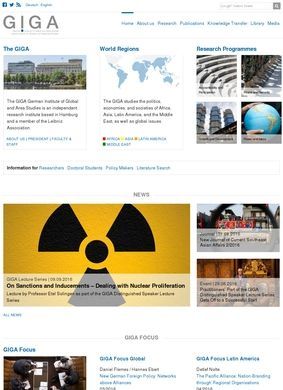
Hamburg-based and Leibniz-funded, the German Institute of Global and Area Studies is a social science research institute that studies political, economic, and social developments across Africa, Asia, Latin America, and the Middle East. It runs as an independent body within the Leibniz Association, the German network of publicly funded research institutes, and it is jointly financed by the German Federal Foreign Office and the country's federal states. That funding arrangement tells you something about the work before you read a single paper: the analysis here is built for use by people who make foreign policy decisions, not purely for the academic archive.
Four regional institutes under one structure
The structure is what gives the place its weight. Four regional research institutes sit under one roof, each covering one of those world regions, and the German Institute of Global and Area Studies pulls their findings together into comparative work that looks across regions instead of treating each one in isolation. Comparative area studies is the term the institute uses for this, and it is the part that separates it from a single-country think tank or a desk that only watches one continent. A researcher tracking, say, how migration policy plays out differently in West Africa and Southeast Asia can find both halves of that comparison coming out of the same organisation.
Comparative area studies across regions
What the German Institute of Global and Area Studies actually puts out covers the full academic range. There are peer-reviewed journal articles, working papers, and policy briefs, the last of these being the shorter, sharper documents aimed at people who need a position laid out quickly. The research topics named on the site are specific enough to be useful: governance of global value chains, sustainability, development, migration and refugee policy, and the broader geopolitical shifts reshaping how regions relate to one another. These are not vague banners. Someone studying refugee policy or supply chain governance can go straight to the relevant output and find scholarship that has been through proper review.
Research outputs and publication formats
Events form a second strand. The institute hosts seminars, webinars, and longer academic series, and one of those is worth singling out because it shows how the German Institute of Global and Area Studies works with partners abroad. The Franco-German Observatory of the Indo-Pacific is a collaborative series that brings German and French perspectives to bear on a region that has become central to current geopolitical argument. Running a standing series like that, with a named foreign partner, puts it inside international academic networks rather than publishing in a national vacuum.
Franco-German Observatory of the Indo-Pacific
The audience is broader than the academic core, and the institute is open about that. Scholars and students are the obvious users, drawing on the publications and the comparative framework for their own work. But the German Institute of Global and Area Studies also writes for policymakers, government bodies, NGOs, and international organisations, the readers who need regional expertise translated into something they can act on. The policy briefs exist precisely for that crowd, and the foreign ministry funding makes the connection to government work explicit.
Audiences beyond academic circles
The general public is named too, which is easy to dismiss as a courtesy line, though I think it holds up here. Anyone trying to follow why a particular region is moving the way it is, without a subscription to a paywalled academic press, has a genuine route in through the freely published briefs and papers. The reading level is academic, so this is not light explainer content, yet the door is open in a way that a lot of specialist research bodies do not bother with.
Public access to research findings
Scale matters when judging a research institute, because depth of coverage depends on having enough people to cover the ground. With roughly 160 staff, the German Institute of Global and Area Studies is the largest area studies institute in Germany and one of the largest in Europe. That headcount is what lets it run four regional institutes at once and still maintain the comparative layer on top. A smaller outfit would have to pick a region and stay there; this one holds all four and asks how they compare.
Scale and staffing in European context
There is a clear logic to how the German Institute of Global and Area Studies divides the world. Four regions, each with its own institute, all feeding a comparative centre, gives the output a consistency that ad hoc commentary lacks. The work on geopolitical dynamics gains from being grounded in the same teams that track development and migration in those regions, so the big-picture pieces rest on regional detail instead of floating above it. That internal feedback loop is hard to build and harder to sustain, and the German Institute of Global and Area Studies has had the size and the funding to do both.
Internal feedback loop between regional teams
It is worth saying plainly what the German Institute of Global and Area Studies is not. It is not a news service and not a consultancy selling forecasts. It is a research institute whose value lies in considered, reviewed analysis that takes the time scholarship requires. For a reader who wants a quick headline take on a crisis, that may feel slow. For a reader who wants to understand the structural forces behind a region's trajectory, the patience is the point, and the published record is there to be checked.
On outside reputation, a search turns up no aggregated user ratings or review-platform listings for the German Institute of Global and Area Studies, which is exactly what you would expect from an academic body of this kind. The standing of the German Institute of Global and Area Studies comes from citation records, Leibniz membership, and the fact that its funding chain runs through the German Foreign Office. None of that is quantified on a five-star scale, but the institutional track record is publicly checkable in a way that review scores are not.
The breadth on offer is the standout. Few research bodies cover four world regions plus global affairs with comparable depth, and the German Institute of Global and Area Studies pairs that reach with formats running from full journal articles down to brief policy notes. A student, a ministry analyst, and a curious general reader can each find a way in at the level they need, and the published output gives each of them something concrete to work with.