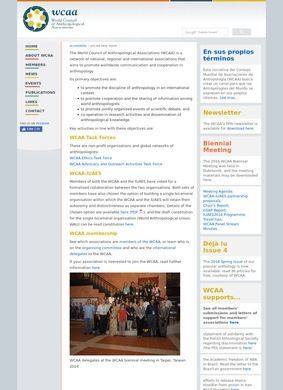
Arriving at the World Council of Anthropological Associations site expecting a learned society in the usual sense, you quickly realize you are looking at something structurally different: an umbrella body whose members are national, regional, and international anthropological associations, not individual scholars. The council coordinates between organizations, not people. That distinction is easy to miss on first glance, and the site does not flag it prominently, but it shapes what the resource is actually for.
Publications spanning magazines and working papers
The publishing output is where the site earns attention. DejaLu, a magazine that republishes and circulates anthropological writing across language barriers, sits alongside a run of newsletters and the series titled En sus propios terminos, whose Spanish title reflects the council's habit of not defaulting to English. Working papers and online repositories extend the range further, so the output covers both the quick and topical and the slower, archived material. For anyone tracking how anthropology is practiced and argued outside the dominant Anglo-American centers, this spread of formats is a reason to keep the page open.
Delegate meetings and international symposiums
The World Council of Anthropological Associations also functions as a convener. The site documents delegates meetings and international symposiums, with sessions organized around themes such as the sustainable development goals and the public role of anthropology. These are not minor side events. They are the moments when association leaders from different continents sit at one table, and the council keeps a record of what came out of them. That kind of cross-association coordination usually leaves no public trace, so the archive has real documentary value.
Task forces and official statements
Task forces fill the other half of the picture. These are specialized working groups assigned to particular problems inside the discipline, and they reflect an organization doing more than circulating other people's writing. There is also a body of official statements, issued by both the World Council of Anthropological Associations and its member organizations, on professional and political questions. A federated group makes its collective position legible through statements like these, and having them in one place means a researcher or journalist can cite what the global community of anthropologists actually said, rather than reconstructing it from scattered press releases.
Video archive of recorded webinars
A video section rounds out the offerings, hosting recorded webinars, interviews, and seminars. Recorded discussion often carries disciplinary debates that never make it into a published paper, so this is not a section to skim past. Whether the archive is deep or merely a handful of clips is something the page does not advertise up front; clicking through is the only way to find out.
Governance structure across member associations
Governance gets its own treatment here, which is more consequential for an umbrella body than for a single institution. The site lays out the council's structure and lists member associations by region, so a visitor can see which national bodies are inside the network and which parts of the world are represented. That regional listing is genuinely informative. It is, in effect, a map of organized anthropology worldwide, and the World Council of Anthropological Associations is one of the few places where such a map exists in consolidated form. News updates keep the sections current rather than letting them go stale.
Relationship with the World Anthropological Union
There is a structural wrinkle worth understanding. The World Council of Anthropological Associations describes itself as the coordinating body of a larger entity, the World Anthropological Union, and that relationship is not spelled out in a way a newcomer will instantly grasp. The WAU appears as the broader network, with the council doing the day-to-day coordination across the global community. For a reader who lands expecting one tidy organization, the layered arrangement can be disorienting, and the site assumes you already know roughly how the pieces fit together.
Checking for public ratings
A search across public review platforms turns up no user ratings or comment threads for the World Council of Anthropological Associations. This is entirely expected. The World Council of Anthropological Associations operates at the policy and governance level for inter-association coordination, not as a service provider seeking public endorsements, so the absence of ratings says nothing useful about quality.
Who benefits from this resource
Who benefits most from all this is fairly clear: association officers and discipline-builders, since the resources are pitched at the level of policy, coordination, and collective voice. A working researcher will find the publications and recorded talks of practical use, especially the multilingual material that pulls in scholarship the English-language journals tend to overlook. The World Council of Anthropological Associations is strongest as a connective layer, the thing that lets a Brazilian, an Indian, and a Norwegian anthropological association recognize each other as part of one field and act together when they choose to.
Judging the current pace of activity
What the site cannot settle on its own is how much of this infrastructure is active versus archived. A council that exists to coordinate is only as good as the frequency of its meetings, the freshness of its statements, and the pace of its task forces, and the World Council of Anthropological Associations presents the apparatus without making the current tempo obvious. The publications and meeting records prove serious work has happened. The open question is whether a visitor arriving now finds an organization mid-stride or one whose most consequential gatherings are already behind it. Nothing on the page resolves that doubt, which is itself a finding worth noting before putting the site to professional use.