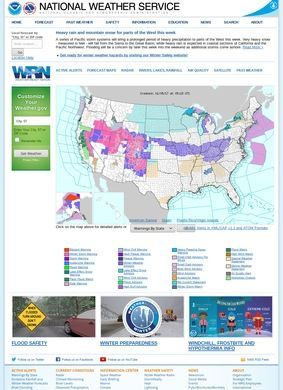
Weather forecasts and warnings for the United States come from one authoritative source: the National Weather Service, a federal agency inside NOAA and the Department of Commerce. Its website is the public front end of that operational system, and it reads less like a simple forecast page and more like the entrance to a large technical infrastructure. Type in a ZIP code or city name and you land on a local forecast with a graphical display, an hourly breakdown, and an extended outlook stretching several days out. That is what most visitors come for, and the National Weather Service delivers it without registration, payment, or any of the friction that private weather apps have layered on over the years.
Specialized forecasts for aviation and marine users
Underneath the everyday local forecast sits a far deeper catalog of specialized products. Aviation users get terminal aerodrome forecasts. Mariners can pull coastal and offshore zone forecasts from the National Weather Service directly. Anyone near a river or lake can check flood stage data and hydrograph predictions, which can be critical during a wet spring. Fire-prone regions have red flag fire weather conditions, and a space weather section tracks solar storms and the alerts that accompany them. The breadth is the point: a single agency covers domains that elsewhere would be split across half a dozen commercial vendors, and the National Weather Service does so as the authoritative source the rest of the industry feeds from.
Inside the real-time monitoring tools
Real-time monitoring is where the National Weather Service shows its operational character. National radar is available in both standard reflectivity and velocity modes, the latter being the one storm chasers and serious hobbyists want for spotting rotation. Satellite imagery comes from GOES-East and GOES-West. There is a nationwide map of active alerts, an air quality index layer, and river gauge readings that update as conditions change. During a severe event, having all of this in one place is the difference between piecing together a picture from scattered sources and seeing it whole. Warnings and watches for tornadoes, hurricanes, winter storms, and thunderstorms are issued with county-level precision, which is the granularity that determines whether a particular town needs to take cover or can carry on.
Checking historical records and long-range outlooks
For people who need the record after the fact, the National Weather Service publishes historical weather records and certified past-weather datasets searchable by ZIP code. That certified piece is easy to overlook and genuinely useful, since insurance claims, legal disputes, and research projects all sometimes hinge on proving what the weather did on a specific date in a specific place. Long-range planning is served through 6 to 10 day and 8 to 14 day outlooks, monthly and seasonal projections, and the broader suite of Climate Prediction Center products that come out on a regular cadence. A farmer, an event planner, or a utility company can each find a planning horizon that fits their needs inside the National Weather Service's published products.
Building community safety readiness
The agency does more than publish numbers. It runs the Weather-Ready Nation initiative, which pushes community preparedness, and the SKYWARN program that trains volunteer storm spotters to feed ground-truth observations back into the warning process. There are also the StormReady and TsunamiReady certification programs, which give towns and counties a framework for measuring their own readiness against a national standard. These efforts turn a forecasting body into something closer to a public safety partner, which explains why the National Weather Service shows up in emergency planning conversations far from any radar screen.
Data resources for technical users
Builders and analysts are not left out. The National Weather Service offers GIS data, documentation for the forecast models themselves, and cooperative observer network data gathered by thousands of volunteers across the country, some of whom have been logging readings for generations. Educational materials and brochures cover students, teachers, and the merely curious. A developer wiring forecasts into an application, a journalist checking a climate claim, and a schoolteacher building a lesson on hurricanes can all draw from the same well, which is unusual for a resource of this scale.
Why does the site feel overwhelming?
The sheer volume can overwhelm a first-time visitor. The navigation reflects the structure of a large technical agency, and someone arriving only to check whether it will rain tomorrow may find themselves a few clicks deeper than expected before reaching a clean answer. The National Weather Service design favors completeness and accuracy over the polish of a consumer app. That is a defensible trade for an organization whose primary obligation is to be correct and comprehensive, but it is worth knowing going in. The information is all there; finding the precise corner you want occasionally takes patience.
Accuracy in forecasting is never absolute, and the National Weather Service is candid about uncertainty in a way that consumer products often are not, presenting probabilities and confidence levels rather than false precision. That honesty is part of what makes it trustworthy. The seasonal and long-range outlooks are framed as tendencies and odds, which is the correct way to communicate that kind of prediction even if it is less satisfying than a single confident number. Readers who understand that distinction will get considerably more out of the site than those expecting certainty on a 10-day outlook.
What separates the National Weather Service from the many private services that repackage its output is that this is the origin. The watches, the warnings, the model runs, the radar feeds: commercial apps are largely reselling and reformatting data that begins here. For aviation operators, maritime professionals, broadcasters, and emergency management personnel, going straight to the National Weather Service removes a layer of interpretation and delivers the unfiltered product. For the general public, it costs nothing and carries no advertising, which is a refreshing thing to be able to say about a tool this capable.
Taken as a whole, the National Weather Service site is one of the most substantive public resources of its kind anywhere, a working tool for professionals and a free safety net for everyone else. The local forecast is fast, the warning system precise, and the specialized products go far beyond what any single visitor will ever use. The depth is the real strength, and the only mild drawback on a quiet day is that the depth is obvious to navigate only once you know where you are going.