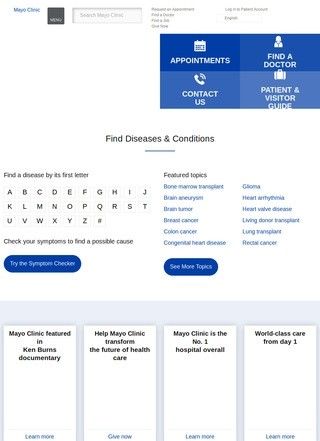
Type "magnesium" or "metformin" into the search bar at mayoclinic.org and you land on a Drugs and Supplements entry that lays out dosage ranges, what the medication treats, the interactions worth knowing, and the side effects that send people to a pharmacist. That single page is a fair sample of what the whole site does well: it takes a narrow medical question and answers it in plain language, sourced from the staff of an academic medical center, without trying to sell anything along the way. MayoClinic runs one of the deepest free health libraries on the open web, and most visitors arrive there by accident, chasing a symptom or a prescription label that worried them.
Diseases and conditions library
The backbone is the Diseases and Conditions library, which covers thousands of entries from the common to the rare. Each one follows a steady shape: overview, symptoms, causes, risk factors, when to see a doctor, diagnosis, and treatment. That consistency is the quiet strength of MayoClinic. Once a reader learns how one article is laid out, every other article reads the same way, so finding the "when to see a doctor" line on a page about migraines takes the same two seconds it takes on a page about kidney stones. Sitting alongside it is a Symptoms directory built for self-triage, the kind of tool someone reaches for at eleven at night before deciding whether the morning can wait.
Wellness content by life stage
Beyond the reference material, MayoClinic carries a large bank of wellness and health-topic articles sorted by body system and by life stage, so content meant for a new parent sits apart from content aimed at someone managing arthritis in their seventies. There is also Mayo Clinic Press, which publishes books and a newsletter, extending the same editorial voice into longer formats. None of this strays into miracle-cure territory, and that restraint is worth naming, because plenty of health sites that rank well do not show it.
Patient care and appointment services
It is easy to treat MayoClinic as an encyclopedia and stop there, but the encyclopedia is really the front door to a working hospital system. The Care at Mayo Clinic section handles the practical side of becoming a patient: appointment requests, second opinions for people who already have a diagnosis they want re-examined, and a dedicated track for international patients who travel to the United States for treatment. MayoClinic is a nonprofit academic medical center based in Rochester, Minnesota, with major campuses in Phoenix and Scottsdale, Arizona, and in Jacksonville, Florida, and the site threads all of those together without making the navigation feel crowded.
Online scheduling and insurance information
There is also the broader Mayo Clinic Health System, a network of regional community hospitals and clinics spread across several states, which MayoClinic folds into the same navigation. Established and new patients can use online scheduling and patient portals, and a Find a Doctor tool lets people search the clinical staff before they commit to an appointment. I find the second-opinion pathway the most genuinely useful piece, since it answers a real situation (a patient holding a diagnosis they do not fully trust) in a way a generic search engine cannot. Insurance is addressed too: the system accepts most plans and publishes financial assistance information, which spares people one round of phone calls before they even start.
Resources for healthcare professionals
MayoClinic is not built only for patients. A section for healthcare professionals carries clinical updates and continuing medical education resources, and the institution's research and clinical trials information lives here as well, alongside its medical education and graduate programs. That dual audience explains a lot about why the writing stays careful. The same organization producing the public-facing symptom guides is also training physicians and running trials, so the reference content has to satisfy a clinician glancing over a patient's shoulder.
If there is a fair caution, it is the obvious one that the site itself repeats: this is information, not a substitute for being examined. A reader can talk themselves into the worst entry in any symptom list, and a thorough medical library makes that easier, not harder. MayoClinic handles this honestly by leading most articles toward "see a doctor" instead of toward a self-administered fix, which is the responsible call even if it occasionally frustrates someone who wanted a definitive answer at midnight.
What keeps the whole thing coherent is that everything points back to one clinical reality. The drug database, the conditions library, the clinical trials, the graduate programs, the regional clinics: these are facets of a single institution rather than a content farm assembling pages for traffic. That shows in small ways, like dosage figures that match prescribing practice and treatment sections that mention surgical options a community blog would skip. The breadth of MayoClinic is genuine, and the depth stays consistent even when a reader pushes past the overview into the specifics of a less common diagnosis.
Why medical libraries require careful writing?
The audience splits into a few clear groups. There is the worried searcher who needs a plain answer about a symptom or a pill. There is the prospective patient weighing a trip to Rochester or a second opinion on a serious diagnosis. There is the clinician or trainee using the professional section and the CME material. MayoClinic addresses all three from the same domain without the patient-facing pages feeling dumbed down or the professional pages feeling walled off, and that balance is harder to strike than it appears.
Outside reputation is limited in searchable form: no large pool of public reviews exists for an institution like this in the way one might find for a local clinic. The site's standing comes from its clinical output and decades of academic publishing rather than aggregated star ratings. On that basis, MayoClinic is a reliable starting point for almost any health question, with the understanding that the site is unusually explicit about where its information ends and a doctor's judgment must begin.
Set against a reader's other obvious option, WebMD, the contrast is instructive. WebMD covers similar ground and is often quicker to surface, but its pages lean harder on advertising and sponsored content, and the editorial voice can feel built for clicks. MayoClinic reads like reference material written by the people who actually treat the condition, and for anyone deciding whether a symptom warrants a real appointment, that difference in tone is the reason to start here. The library is free, the clinical pathways are documented, and the writing earns the trust the name already carries.