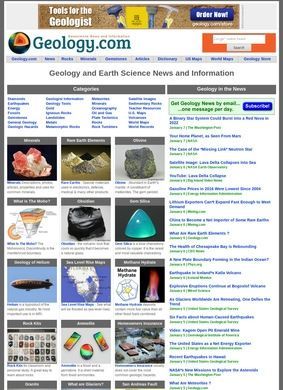
Running since 2005, Geology.com is a free earth science reference site built as a general encyclopedia for anyone trying to make sense of rocks, minerals, and the processes that shape the planet. The range of subject matter is the first thing worth noting. It covers diamonds, earthquakes, fossils, gemstones, geologic hazards, gold, landslides, meteorites, minerals, oil and gas, plate tectonics, rocks, and volcanoes, each treated as its own area instead of being crammed into a single survey article. That breadth means a curious reader can land on the site for one question and stay for three more.
Explanatory articles and dictionary tool
Most of the value sits in the explanatory articles. A person who wants to understand why a landslide happens, or what distinguishes one gemstone from another, gets plain writing aimed at people without a degree in the field. The geology dictionary backs this up for anyone who hits a term they do not recognise, which happens often once you start reading about plate boundaries or igneous classification. Pairing readable articles with a quick lookup tool is a sensible arrangement, and it keeps the encyclopedia from assuming too much prior knowledge. The writing on Geology.com tends toward explanation over jargon, which is the right instinct for a resource whose visitors arrive with wildly different levels of background. A high school student and a weekend rockhound can both get something out of the same page.
Through photo galleries and maps
The photo galleries do a lot of teaching on their own. Geology.com hosts galleries of rocks, minerals, gemstones, and even sand varieties, the last of which tells you the people behind the site genuinely care about the subject. Sand under magnification looks nothing like what most people picture, and having a gallery devoted to it is a telling detail. The site also offers satellite imagery alongside interactive maps covering both the United States and the wider world. For a topic that is fundamentally spatial, maps and imagery do more than paragraphs can. Plate tectonics, the distribution of volcanoes along boundaries, where major oil and gas fields sit: these only make sense when you can see them placed on a map. Geology.com clearly understands that, and the interactive maps are a working part of how the material is delivered.
The audience is broad but identifiable. Educators and students form a clear part of it, and Geology.com supports them directly with teacher resources meant for classroom use. A teacher planning a unit on volcanoes or fossils has a starting point that does not require sifting through dense academic papers first. Students working on assignments get material pitched at a level they can absorb and cite.
Field course directory
Beyond the classroom, the site speaks to rock and mineral collectors and to gemstone enthusiasts, two groups that overlap with each other and with the general earth science reader. A collector wanting to confirm what a specimen is, or a hobbyist deciding whether a stone is worth acquiring, finds reference material aimed squarely at those questions. The field course directory deserves a mention on its own. With more than ninety undergraduate geology field courses listed, it serves a narrower but important need: students choosing where to get hands-on training, which is the part of geology you cannot learn from a screen. Geology.com curating that list is a quiet service to a real decision, since picking a field course shapes how a student spends a summer and what they walk away knowing.
That directory is the sort of feature that separates a maintained resource from a static set of articles. Compiling and keeping a list of ninety-plus programs current takes ongoing effort, and it points to a site that treats itself as a working reference for people moving through the discipline, well beyond what a casual reader stopping by once would need.
Explore the online store
There is a commercial side too, and Geology.com is open about it. The site runs an online store, and the selection lines up closely with the editorial content. Rock and mineral specimen kits, gold panning kits, and hardness testing tools are the practical companions to the identification articles. Someone who reads about the Mohs scale and then wants to test a stone can buy the tools to do it in the same place they learned the concept.
The store stretches further than that. It carries geology books on gems, minerals, and fossils, topographic atlases from DeLorme, wall maps, and rock tumblers with the supplies that go with them. The DeLorme atlases and wall maps are a natural fit given how much the site leans on maps for teaching, and the rock tumblers point back to the collector audience: tumbling rough material into polished stones is one of the entry points into the hobby. The merchandise reads as an extension of the subject matter, which is a more honest model than a reference site bolting on an unrelated shop. For a parent buying a first specimen kit for a curious child, or a hobbyist upgrading from a basic tumbler, the store on Geology.com removes a step: the explanation and the product sit side by side.
Focus across two decades
What stands out across all of this is consistency of focus. Geology.com does not wander into adjacent sciences or pad itself with general-interest filler. Every section, the dictionary, the galleries, the maps, the field course list, the store, points back to the same core subject. A site running for two decades could easily have sprawled or gone stale, and the breadth of current offerings indicates it has kept being tended to instead.
If there is a limitation, it is one of depth versus specialisation. Geology.com is built to introduce and explain, so a working geologist looking for peer-reviewed detail on a specific mineral assemblage will outgrow it quickly. That is not a flaw so much as a definition of scope. The site aims to be the well-organised front door to earth science, and it fills that role with coverage that keeps people clicking from one topic to the next.
The pairing of free reference content with a topical store also means the site has a sustainable reason to keep its lights on, and that is a credible foundation for longevity. Resources that depend entirely on goodwill tend to fade. Geology.com has a revenue stream tied directly to the audience it educates, and that alignment likely explains how it has stayed comprehensive across so many years.
How does it compare?
Set against a resource like the Mineralogical Society of America's mineral database or a university extension page, Geology.com plays a different game. Those sources go deeper on narrow questions and back their findings with the authority of formal institutions, but they ask more of the reader and rarely cover the full spread from earthquakes to gold panning in one place. Geology.com wins on breadth, readability, and the sheer number of entry points it gives a non-specialist. Twenty years of steady upkeep have given it enough depth across topics to keep each visit opening a door to the next one.