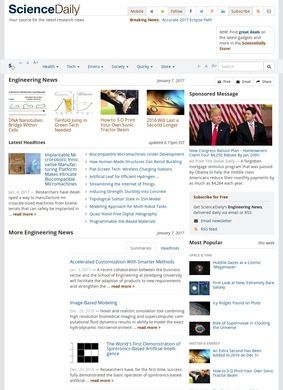
A student reading about a new battery chemistry or a self-healing polymer usually hits the same wall: the original journal paper sits behind a login, runs forty pages, and assumes you already speak the field's dialect. Science Daily Engineering News exists to bridge that gap. It takes the press release a university issues when its lab publishes something, rewrites it into a few hundred plain words, names the institution and the journal, and points you to the source if you want the full study. For someone who needs the gist of a robotics or nanotechnology result without spending an afternoon on it, that is a fair trade.
How the site bridges research and readers
The engineering coverage on Science Daily Engineering News is not a standalone section so much as a slice cut across several of the site's broader divisions. Material that touches engineering surfaces mostly from Matter and Energy and from Computers and Math, with a regular feed coming out of Business and Industry as well. In practice that means stories about materials science, robotics, electronics, energy systems, applied physics, and the kind of nanotechnology work that turns up first in a lab announcement and only later in the trade press. The articles are short by design. Each one summarizes a peer-reviewed finding, credits the source institution or journal, and links back to the original press release or paper.
Engineering coverage across multiple topics
That sourcing habit is the part worth dwelling on. A lot of science writing on the open web floats free of any citation, leaving you to guess where a claim came from. Science Daily Engineering News does the opposite: the provenance is attached to nearly every item, so a researcher can click through and judge the primary work directly. That single discipline does more for the site's usefulness than any amount of polish on the summaries themselves. The summaries are a starting point, and the platform treats them that way.
Citation and sourcing practices
The audience is wider than the engineering label suggests. Students use Science Daily Engineering News to keep current without a library subscription. Working researchers and professionals skim it to catch developments adjacent to their own field, the way you notice what is happening two doors down the corridor. Educators pull from it for class material, and general readers who simply like keeping up with applied science get a steady stream they can follow. None of these groups is asked to pay. The whole site is free to read, with no paywall standing between you and an article, which matters more in science publishing than in most other corners of the web.
Who uses Science Daily Engineering News
The format suits casual and habitual reading equally. If you want the firehose, the front sections refresh constantly. If you want only the engineering-adjacent material, the topic structure on Science Daily Engineering News lets you filter down to Matter and Energy or Computers and Math and ignore the rest. The Strange and Offbeat corner sits off to the side for anyone who reads science news partly for the oddities, and it tends to be the section people share.
Reading formats and topic filtering
One thing to set expectations on: Science Daily Engineering News produces no original reporting. Nobody here is running experiments, interviewing the lead author, or fact-checking the institution's framing against an outside source. Every item is aggregated and rewritten from a press release, which means it inherits whatever enthusiasm the issuing university built into its own announcement. A press office wants its research to sound important. The summary carries that tone forward. Read across enough articles and you learn to discount the gloss and focus on the underlying finding, which is the right way to use a service like this anyway.
No original reporting, sourced from press releases
The breadth is genuinely large. Beyond the engineering slice, Science Daily Engineering News spans twelve topic categories grouped under health, the physical and technical sciences, the environment, and society, covering everything from mind and brain research to fossils, earth and climate, science and society, and education. An engineer who wandered in for a robotics story might leave having also read about a materials breakthrough filed under a different heading, because the categories overlap at the edges the way real research does.
Twelve topic categories beyond engineering
Delivery is flexible without being overbuilt. There is an email newsletter run through Substack for people who want the day's items pushed to them. There are topic-specific RSS feeds, which is the channel to point a researcher toward, since it lets you subscribe to exactly the engineering streams you care about and skip everything else. Science Daily Engineering News also maintains social channels on Facebook and on X, formerly Twitter, for anyone who prefers to catch headlines in a feed they already check. Pick whichever fits how you already read, and the content arrives the same way.
Outside reputation is limited. A search turns up no substantial third-party reviews or ratings on consumer platforms, which is typical for a science aggregator rather than a consumer service. The name carries recognition in science-literate circles, and the Substack following adds a layer of ongoing readership, but there is no star rating to point to. That absence is worth noting without making too much of it.
What you are getting from Science Daily Engineering News, then, is a fast, free, well-cited filter on the daily output of the world's research institutions, narrowed toward the engineering disciplines when you want it narrowed. The summaries are brief and inherit a promotional tilt from their sources, but the link back to the original is always there, which keeps the whole thing honest for anyone willing to click. Science Daily Engineering News will not replace reading the actual paper, and it does not pretend to.
It tells you the paper exists, roughly what it claims, and where to find it. For staying aware of materials science, robotics, energy, and applied physics work as it breaks, that is a reasonable use of ten minutes a day. Treat Science Daily Engineering News as a tip sheet rather than a final word and you get the most out of it, since the constant feed means there is nearly always something new in the Matter and Energy column by the time you check again.