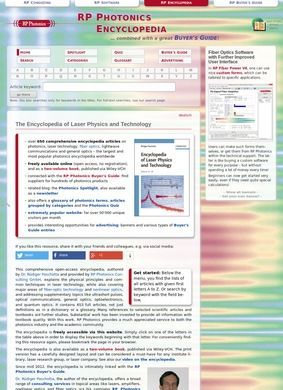
RP Photonics runs a photonics-focused technical encyclopedia at rp-photonics.com, and the encyclopedia is what most people arrive for. It holds 1,138 articles covering optics, lasers, fiber optics, nonlinear optics, and quantum photonics. You can move through it two ways: an A-to-Z index that treats the whole thing like a dictionary, or a topical grouping that clusters related entries when you are reading toward a subject rather than chasing one term. Both routes lead to the same body of writing, which is dense, technical, and clearly aimed at people who already speak the language of the field.
Inside the photonics encyclopedia
The depth is the selling point. These are not stub definitions padded to look substantial. Articles on fiber amplifiers and passive fiber optics extend into proper tutorials, and RP Photonics backs them with case studies on fiber design and amplifier optimization, the sort of worked example that an engineer can compare against their own problem. That separates this resource from the many glossaries that explain a term in two sentences and leave you no closer to using it. Someone trying to understand why an amplifier is underperforming gets material written by a person who has clearly done the work, not a summary scraped from elsewhere.
Comparing articles to typical glossaries
Authorship explains much of that consistency. The encyclopedia is written and maintained by Dr. Rudiger Paschotta, a recognised figure in laser and fiber technology, and the single-author model shows in how entries cross-reference and build on one another. There is none of the tonal drift you get when a hundred contributors each define their corner differently. The flip side is worth naming: a reference standing on one expert reflects that expert's priorities and reading of the field, and a topic he weights lightly will be covered lightly. For most working questions in lasers and fiber optics that is a fair trade, since the coverage sits squarely where his expertise is deepest.
Commercial services alongside free content
RP Photonics publishes proprietary simulation and design software for laser development and fiber optics, the kind of tooling that turns a concept into numbers you can iterate on. It also offers fee-based technical consulting and tailored training courses pitched at organisations, so the reference content sits alongside paid services that draw on the same knowledge base. A Buyer's Guide connects engineers and researchers with photonics product suppliers, and a "Photonics Spotlight" blog adds periodic commentary on technical matters as they come up. The intended audience is consistent across all of it: photonics professionals, R&D engineers, researchers, and educators who need more than a general-purpose business directory can offer.
That mix is where a careful reader should pause, because the commercial layer and the educational layer share one roof. The Buyer's Guide carries advertising and supplier-marketing opportunities, and the consulting and software businesses give the author a direct stake in the topics he also explains for free. None of that is hidden, and a single expert funding a serious reference through related services is a legitimate model that has kept RP Photonics alive and growing for years. But someone leaning on an article to choose between approaches should keep in mind that the person writing the explanation also sells software and advice in that space. The articles reviewed here read as genuinely educational, yet the structural overlap is real.
Assessing the paid offerings
The training courses and consulting sit a step removed from the open content and are harder to assess from the outside, since their value depends on the specific engagement and what an organisation needs. The software is similar: powerful in description, but its fit is something a team has to test against its own design problems. RP Photonics presents these as serious professional tools, and the encyclopedia gives reason to take that framing at face value, yet the public pages can only tell you so much about how the paid offerings perform in practice. There is no meaningful third-party review record for RP Photonics on the platforms a general web search turns up, so the paid services rest largely on the reputation the free encyclopedia has built.
What RP Photonics does not offer is breadth outside photonics, and that is by design. This is a specialist reference, so anyone working at the edges of optics where the subject touches other disciplines will find those neighbouring fields handled only as far as they bear on the photonics question. Within its declared scope the 1,138 articles are unusually thorough, and the organisation makes them easy to reach whether you know the exact term or are feeling your way toward it. As an entry point for learning a laser or fiber concept properly, it is hard to point to a freely available equivalent with this combination of depth and coherence.
The question that lingers is one of concentration. RP Photonics has built a reference that an entire corner of optics quietly relies on, and that reliance rests almost entirely on one person continuing to write, update, and steward it. The encyclopedia is excellent in its current state. What is harder to gauge is how a resource this concentrated in a single expert maintains its currency and completeness over time, and whether the surrounding business that sustains RP Photonics keeps pulling in the same direction as the open knowledge it sits beside. For now the evidence on the page points toward a genuinely serious resource, and the depth of RP Photonics's free content is sufficient reason to take its paid services seriously too.