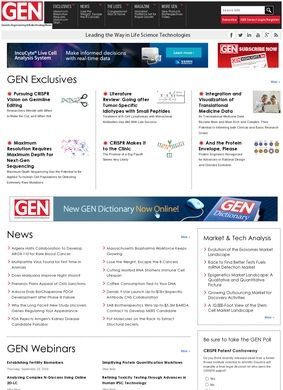
Genetic Engineering and Biotechnology News is a US science media outlet published by Mary Ann Liebert Inc., covering biotechnology and the life sciences for a professional audience. It goes by GEN for short, and the abbreviation appears across its own pages and in third-party listings. The remit is wide without being vague: news and analysis on AI in biotech, bioprocessing, cancer research, drug discovery, genome editing, infectious diseases, OMICs, and translational medicine. That spread tells you who the intended reader is, namely someone already working in or near the field who wants developments tracked rather than explained from scratch. The tie to Mary Ann Liebert Inc. places Genetic Engineering and Biotechnology News inside an established scientific publishing house, not a standalone news startup with no institutional backing.
Magazine and journal lineup
The output is more varied than a typical news site. There is a monthly digital magazine, GEN Magazine, which gives the publication a print-style cadence on top of the rolling web coverage. Alongside that sit two open-access peer-reviewed journals, GEN Biotechnology and Re:Gen Open. Running a newsroom and two academic journals under one masthead is an unusual combination, and it changes how you read the operation.
Part of what Genetic Engineering and Biotechnology News does is straight industry journalism; another part is formal scholarly publishing with the peer-review process that implies. Few trade outlets carry their own peer-reviewed titles, and the presence of two is the strongest indication that Genetic Engineering and Biotechnology News is built to live in both worlds at once. Open-access status means anyone can read the papers and judge the work directly, which is more accountability than a typical trade publisher accepts.
Beyond the magazine and the journals, the site stacks up a long list of formats: eNewsletters, eBooks, tutorials, and something called A-Lists. Genetic Engineering and Biotechnology News runs webinars and virtual summits, produces podcasts including a "Touching Base" series featuring senior editors, and puts out video content along with product announcements from across the sector. Learning labs and curated resource libraries round it out. A reader could spend considerable time here without exhausting the material. Putting senior editors on the microphone is a detail worth noting: it means the people making editorial calls are willing to be named and heard, which is more than many trade outlets bother with.
The intended audience is stated plainly through the coverage and the formats: biotechnology professionals, pharmaceutical executives, academic researchers, and life sciences industry participants worldwide. Product announcements and a resource library point at the commercial side of the field, while the journals and tutorials point at the bench and the lab. The global framing is consistent throughout, and Genetic Engineering and Biotechnology News does not read as a regional newsletter that has overstated its reach. Straddling commercial and scholarly readers is a demanding position to hold, because those audiences want different things from the same brand, and the content mix reflects the tension honestly instead of papering over it.
Third-party credibility ratings
The external credibility picture is decent and, importantly, comes from the right sources for a publication of this kind. Media Bias/Fact Check rates Genetic Engineering and Biotechnology News as "Pro-Science" with a "High" factual reporting score. Ground.news separately assigns Genetic Engineering and Biotechnology News a "High" factuality rating. Those are not customer star ratings, and the distinction is real: for a science news source, factual accuracy and editorial bias are the metrics that bear on whether the content can be trusted, far more than a thumbs-up count would.
Resurchify lists Genetic Engineering and Biotechnology News as a journal published by Mary Ann Liebert Inc. with tracked impact factor metrics, which lines up with the journal side of the operation and gives the scholarly arm a measurable footing. An impact factor depends on how often other researchers cite the work, so it is not a number that can be gamed quietly; its existence here is a point in Genetic Engineering and Biotechnology News's favour.
No consumer review presence turned up in searches: no Google, Trustpilot, Yelp, or BBB ratings. For most businesses that absence would be a genuine strike, but Genetic Engineering and Biotechnology News is not the sort of publication readers leave star reviews for, and the fact-check ratings cover the relevant ground far better than a review aggregator would. The reputation indicators available are narrow in number but well aimed at what Genetic Engineering and Biotechnology News does.
Reaching the editorial team
Contact arrangements follow standard digital-publisher practice. There is a "Contact GEN" page, so a reader who needs to reach Genetic Engineering and Biotechnology News has a clear route. A phone number or street address would add a degree of reassurance about who stands behind the masthead, and their absence from the landing page is a minor point against an otherwise transparent operation. The backing of Mary Ann Liebert Inc. does most of that work anyway, since the parent company is an established and identifiable entity in scientific publishing.
Where journalism meets promotion
Taken together, the picture is of a substantial, multi-format science publication that knows its audience and has the scholarly infrastructure to support its journalism. The peer-reviewed open-access journals are the standout feature, because they put the publication's name on work that has passed external review and can be read by anyone without a paywall. The breadth of topics is genuine, the format range is unusually deep, and the third-party factuality ratings are the ones that count for this kind of source. Genetic Engineering and Biotechnology News reads as a serious operation rather than an aggregator of press releases, even though product announcements do form part of the mix.
Whether that mix tips too far toward the commercial is the open question. A publication that carries product announcements, hosts vendor-friendly webinars, and runs curated resource libraries alongside its peer-reviewed journals is balancing editorial independence against the interests of an industry it also covers and, in places, serves commercially. The "Pro-Science" and "High" factuality ratings are encouraging, and they imply the editorial line holds. Even so, Genetic Engineering and Biotechnology News gives no clear detail on how sponsored material is separated from independent reporting, and for a reader deciding whether a given article is journalism or promotion, that separation is the thing that would settle it. On the published evidence, that line stays unverified, which is the one area a careful reader would want to probe before treating any coverage as editorially independent.