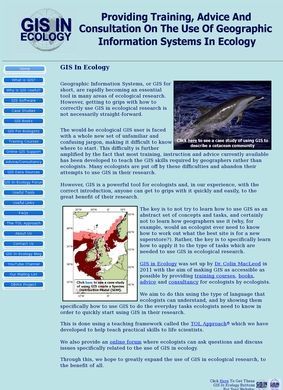
The TOL Approach(R), a trademarked teaching framework, sits at the center of what Geographic Information Systems in Ecology sells: a way to learn spatial software through ecology-specific language and examples instead of the geography-first path most GIS courses take. Dr. Colin MacLeod founded the site in 2011, and the pitch is narrow on purpose. This is training built for biologists, ecologists, and researchers who need maps and spatial analysis for their own work, not a general GIS bootcamp with a wildlife slide bolted on the end.
That focus runs through the catalogue. In-person and online courses teach the software, a set of books and workbooks cover GIS and statistics for biologists, and consultation services take on ecological GIS projects directly for people who would sooner hire the expertise than build it from scratch. Geographic Information Systems in Ecology bills all of it from one place, aimed at one kind of reader.
What the site puts in front of an ecologist
The offering is coherent, and it stays inside its lane. Everything on Geographic Information Systems in Ecology points back at the same person: someone with a biology or ecology problem and a spatial component they cannot ignore. There is no attempt to be all things to all mappers, which is a defensible choice for a small specialist operation. The narrowness is the whole selling point, and a broad GIS shop with a wildlife section bolted on could not credibly make the same claim about knowing what a fisheries scientist actually needs from a map.
The training is the spine of Geographic Information Systems in Ecology. Courses come in both in-person and online formats, the books and workbooks let a self-directed reader work through GIS and statistics at a desk without booking a session, and a YouTube channel adds instructional video for anyone who wants to sample the teaching before paying for it. Taken together, the paid and free pieces give a newcomer several ways in at different price points and commitment levels.
Courses, books, and the TOL Approach
The TOL Approach is the branded method holding the courses together, and it is the clearest reason a biologist might pick Geographic Information Systems in Ecology over a generic GIS class. The premise is that a geography-first course spends its early hours on cartographic theory a working scientist does not need yet, while an ecology-first one gets a species distribution map on the screen faster.
So a marine biologist or a field ecologist learns the same software through problems and vocabulary they already recognize, which shortens the distance between a lesson and a real analysis on their own data. Whether the trademark lives up to that is something a prospective student can gauge from the free videos ahead of paying for a course or a workbook, and the presence of that free sample is a point in the site's favor.
A forum, data sources, and a YouTube channel
Beyond the paid material, Geographic Information Systems in Ecology runs an online forum where ecologists post GIS questions and compare notes, and it points to data sources and tools an ecological project tends to need. A forum counts for more here than it would in a general course, since the sticking points in ecological GIS are specific: projecting field coordinates correctly, handling patchy survey data, or turning tracking points into a home range. Having somewhere to ask those questions of people working the same problems is a real convenience.
A mailing list and a social presence on Facebook and Twitter, under the handle GISinEcology, keep a thread of updates going. These are the pieces that push it past a plain course catalogue toward something closer to a standing hub for the field, where a returning user has a reason to check back between courses.
Finding a way to make contact
Contact takes a small extra step. A separate contact page exists, but the landing page itself carries no phone number, email, or address, so reaching Geographic Information Systems in Ecology means clicking through to that page rather than reading a detail off the front screen. It is minor friction, and a working route is there once a visitor goes looking, but someone who found the listing through a business directory and expects the basics on the first page will have to hunt for a moment before finding them.
For a training business that wants a hesitant academic to book a course, one extra click between a question and an answer is a small tax worth removing.
Outside verification is a weaker link. A search for independent reviews of Geographic Information Systems in Ecology turns up almost nothing that reviews the actual business. The name collides with a 1998 print book of a nearly identical title by Carol A. Johnston, so Amazon and WorldCat listings for that unrelated volume crowd the results, sitting next to general academic papers about GIS in ecology that have no connection to this training site at all.
The confusion is understandable, since a search engine cannot tell that one is a decades-old textbook and the other is a modern training operation, but it does mean a would-be student cannot lean on a stack of third-party reviews to decide. The evidence for quality has to come from the free videos, the published books, and the specificity of the course descriptions instead.
One more wrinkle is worth flagging for anyone checking reputation. A search for the site's reviews surfaces a batch of pages sitting under a reviews-and-product path on its own domain, pointing at unrelated consumer goods: a multi-fuel burner, food containers, artificial plants, napkins, sandals, a recliner, a spatula, a shelf. Opened directly, every one of those pages returns a 404 Not Found. None of them holds a genuine third-party review of the GIS training that Geographic Information Systems in Ecology otherwise runs, which leaves the search for outside opinion almost exactly where it started.