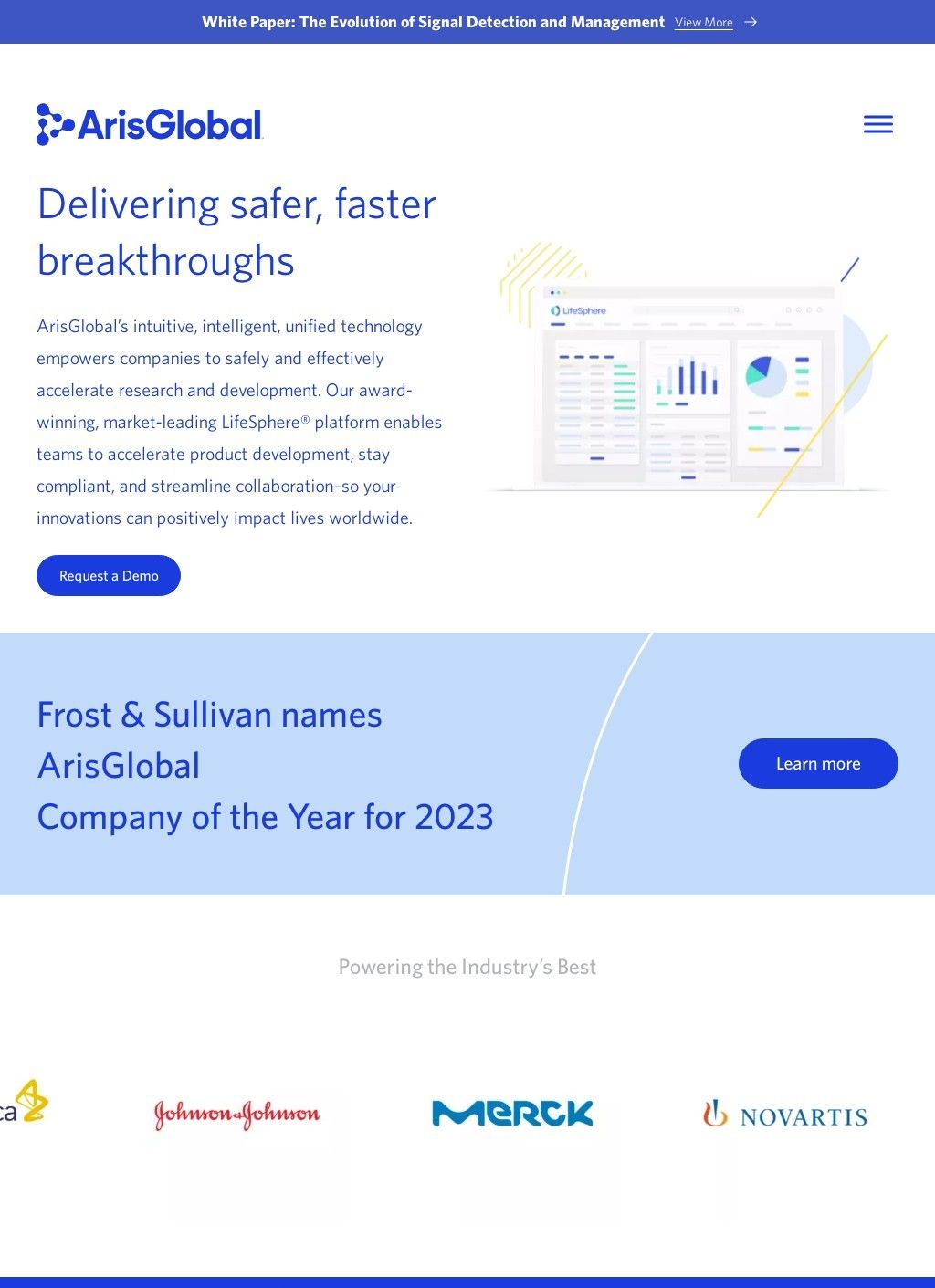
For a vendor claiming 220-plus pharma customers and production relationships with the FDA, Health Canada, and China's NMPA, ArisGlobal is surprisingly hard to evaluate from the outside. Independent software reviews are essentially absent from the major platforms, and that gap leaves prospective buyers with almost nothing peer-sourced to go on. The regulator relationships are credible, the product scope is real, but the evaluation burden falls almost entirely on the buyer to do their own digging.
LifeSphere platform and four compliance domains
ArisGlobal is a US-headquartered life sciences software company with a substantial development operation in Bangalore, India. Its platform, LifeSphere, addresses four compliance-heavy domains: pharmacovigilance (Safety), regulatory information management (Regulatory), quality systems (Quality), and medical affairs (Medical Affairs). The audience is specific: mid-to-large pharma companies running adverse-event surveillance, CROs managing trial safety for sponsors, and regulatory affairs teams filing across multiple jurisdictions. A startup writing its first IND or a single-product clinic has no practical use for LifeSphere's scope.
Safety module with literature intelligence automation
Safety is the largest module, built around components called MultiVigilance, Literature Intelligence, Advanced Signals, and ReporterX. Literature Intelligence is the operationally interesting piece here, because manual monitoring of published adverse events has historically burned enormous analyst hours at safety teams worldwide. Automating that feed has a clear, measurable payoff. The Regulatory module handles RIM, product compliance, submissions, labeling, and regulatory analytics. Quality covers quality management systems and document control for both R&D and manufacturing. Medical Affairs brings medical information management and reporter systems.
Modular licensing for partial platform adoption
The modular structure means a buyer can license one or two components without a full-platform commitment. A CRO that trusts its existing safety database may only need Regulatory. A pharma company rebuilding its quality infrastructure post-audit can come in through Quality alone. In an industry where implementation costs and switching costs compound, that flexibility matters in practice.
NavaX product line with agentic AI agents
ArisGlobal runs a second product line called NavaX, built around what it describes as agentic AI. It includes MedDRA Coding Agents, Signals Agents, Distribution Agents, and Intelligence Agents. MedDRA coding is granular, error-prone work at most organizations, matching adverse-event terms to a controlled medical dictionary with thousands of codes and strict hierarchy rules. Automation there is not marketing; the consistency gains are documented across the industry. Two further products extend the portfolio: XDI for data intelligence and SPORIFY, which tracks regulatory changes across markets. SPORIFY targets a chronic operational problem, since EU, US, and Asian requirements shift on different timelines and keeping labeling or submissions synchronized demands constant monitoring.
Where are the independent software reviews?
Here is where the picture gets uncomfortable. The available third-party data on ArisGlobal comes almost entirely from employee review sites, and those measure the organization, not the software. Glassdoor holds 714 reviews at roughly 3.5 out of 5 overall; the Bangalore office sits at 3.3 from 182 reviews. Indeed shows 18 to 22 reviews also near 3.5. AmbitionBox lands lower at approximately 2.8 from 417 reviews. None of these platforms say anything about whether LifeSphere performs under regulatory scrutiny.
On the software side, G2 lists no verified reviews for ArisGlobal. A Gartner Peer Insights vendor page exists, but its review count could not be confirmed. For a vendor serving over 220 pharma companies, the absence of a public software review trail is not a minor footnote. It does not cancel the named regulator relationships or the stated customer count, but it means any evaluation team is flying without peer benchmarks. There is no independent volume of user experience to triangulate against.
Regulator relationships as credibility markers
The FDA, Health Canada, and NMPA using ArisGlobal software is the strongest fact in this listing. Regulatory agencies applying vendor software go through procurement and validation processes that most commercial buyers do not reach. ArisGlobal has cleared that bar across multiple jurisdictions, and that is not a trivial credential. The 220-plus pharma company count is harder to assess independently, but it is plausible given the regulator footprint.
The problem is that neither data point substitutes for software performance reviews from comparable buyers. A pharma company evaluating LifeSphere for its own pharmacovigilance operations cannot assume regulator procurement standards align with their own implementation requirements, timelines, or support expectations. The regulator relationships prove ArisGlobal can win and retain complex clients; they do not say how painful implementation was or how the support desk performs at two in the morning before a regulatory deadline.
Sales contact and demo request process
Sales inquiries go through a demo-booking form collecting name, email, company, and area of interest. No direct phone number or named contact appears on public-facing pages. For enterprise software at this price point and complexity, gated-demo motions are common, but teams that want a direct conversation before scheduling a demo will find that path closed.
ArisGlobal has genuine, checkable credentials: regulator clients, a defined product covering the right compliance domains, and an AI layer addressing real operational pain points in pharmacovigilance. What it does not have is a public record of software performance reviews from peer companies doing comparable work. That absence alone would not be disqualifying for every buyer, but it means the evaluation rests entirely on what ArisGlobal tells you directly, plus whatever reference calls they choose to arrange. In a category where independent analyst assessments and peer review data do exist (Veeva Vault, Oracle Health Sciences, IQVIA SafetyOne all have published buyer evaluations), the complete silence on G2 and Gartner is a real disadvantage. Push ArisGlobal specifically for reference contacts at comparable organizations and ask to speak with those contacts unscripted, without ArisGlobal on the line.