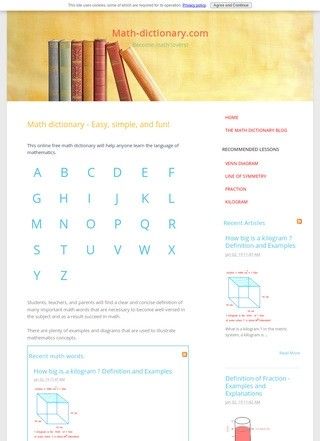
What does a student actually get from a site that calls itself a math dictionary? In the case of Math-dictionary.com, the answer is a free, alphabetical reference of mathematical terms, each definition paired with worked examples and small diagrams so the meaning lands rather than floating as a sentence to memorize. Type in or browse to a term, and you reach a short explanation that tries to show the idea through illustration. That focus on illustration is what the whole site is built around, and it is a sensible choice for the audience it names: students, teachers, and parents who need a quick, plain answer to "what does this word mean."
How the A-Z glossary works
The spine of Math-dictionary.com is the A-Z glossary. You can scan the index letter by letter and land on entries that range across general mathematical vocabulary, which is the format most people expect when they hear the phrase. I tested a few entries by reading them as a confused eleven-year-old might, and the pairing of a definition with a picture does more work than either would alone. A glossary of this kind lives or dies on coverage and clarity, and the entries here lean toward clarity, keeping the language at a level a school-age reader can follow without a teacher hovering nearby.
Lessons on fractions and symmetry
Beyond the bare definitions, Math-dictionary.com folds in a set of featured and recommended lessons that go deeper than a single term. The examples on offer include Venn diagrams, line of symmetry, fractions, and unit conversions such as kilograms, which is a practical spread for primary and lower-secondary work. These are the topics where a one-line definition is rarely enough, so giving them their own walk-through is a reasonable use of space. A reader who arrives looking up "symmetry" can stay for the lesson that explains how to find a line of it.
Blog articles on mathematical concepts
There is also a blog with articles on mathematical concepts, which sits alongside the reference material as the more discursive part of the site. I would not lean on it as a curriculum, but it adds context that a flat dictionary cannot, and it suggests the author keeps adding to the thing over time. The mix of a fixed glossary plus rotating articles is a familiar shape for a reference site run by one person, and it works here because the two halves point at the same audience.
The pieces fit together cleanly. Someone helping a child with homework can move from a quick definition to a fuller lesson to a longer article without leaving Math-dictionary.com, and all of it is free to read. That is the practical case for bookmarking it: the site covers the same ground a printed math glossary would, with the advantage of search and the small visual aids that print struggles to match.
Free access and funding model
This is a personal project, and the site does not hide that. There is an About Me page where the author introduces the work, and a Patreon link for anyone who wants to chip in toward keeping it going. Nothing is gated behind that support. There are no paid courses, no subscription tier, no premium content waiting past a paywall, just the Patreon option for readers who find Math-dictionary.com useful enough to fund voluntarily. For a reference site, that model is honest and low-pressure, and it sets expectations correctly: you are reading one person's ongoing effort, not a publishing house's product.
From social sharing to contact forms
Social sharing buttons for Facebook, Twitter, and Pinterest sit on the pages, which makes sense for a resource teachers might pass to a class or parents might send to each other. A privacy policy page is present too, which for a site aimed partly at children is the right thing to have. A contact form lets readers ask questions or flag errors in a definition without requiring a published email address. For a one-person educational project, that setup is normal and manageable. None of this is flashy. It is the quiet groundwork you would want under a site of this kind.
Traffic and third-party reviews?
On outside opinion, there is not much to report. A search for reviews of Math-dictionary.com turns up unrelated books, apps, and competing sites, with no notable third-party write-ups of this specific resource. Scamadviser flags it as appearing legitimate and safe, while noting a low Tranco traffic ranking, and no user reviews are posted there either. The picture is of a small, clean site that has not drawn a crowd of reviewers, neither praise nor complaints, just a quiet corner of the web doing one job.
That low traffic figure is worth holding in view without overstating it. It does not mean the content is weak; plenty of genuinely useful niche references stay small because they serve a narrow need and never chase virality. It does mean a visitor is taking Math-dictionary.com largely on its own merits, since there is no chorus of outside voices to lean on. Read a few entries, judge whether the explanations land for the child or class in front of you, and you will know within a session whether it fits your need.
Weighed up, Math-dictionary.com is a focused, free reference that does the narrow thing it sets out to do: define math terms in language a school-age reader can follow, and back the definitions with examples and diagrams. The lessons on fractions, symmetry, Venn diagrams, and conversions extend the resource beyond bare vocabulary, and the absence of any paywall keeps the whole thing open. It is the work of one author, supported by an optional Patreon, with a contact form for questions and a privacy policy in place. The glossary index runs A through Z, and each letter opens onto definitions written to be read by the people who most often get stuck on them. Math-dictionary.com covers that ground without fuss, which is what a reference of this type needs to do.
Business address
United States