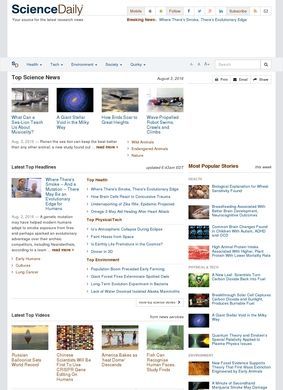
Where do you go when a headline screams that scientists have cured something or proven something, and you want the actual study behind it? Science Daily answers that fairly well. It pulls breaking research announcements straight from universities, research institutions, and scientific journals, then rewrites each one into a short summary that a non-specialist can follow. The original announcement is linked at the bottom, so a curious reader can jump to the source rather than trust a paraphrase. That single habit (summarize then point back) is the whole reason the site has stayed useful across three decades.
Six subject areas and daily updates
The catalogue spans six broad areas, wide enough to cover most of what a general reader stumbles onto. Health is the largest, with medicine, neuroscience, nutrition, mental health, and pharmacology folded under it. Physical Science and Technology runs through physics, quantum computing, space exploration, materials science, and engineering. Environment gathers climate change, ecology, paleontology, geology, and oceanography. Then there is Society and Education, which leans into education policy, economics, public health, and the social sciences, and a Plants and Animals section built around biology, agriculture, conservation, and zoology. The sixth, called Quirky, collects the offbeat findings that do not fit anywhere else, the kind of study that gets shared at dinner because it sounds slightly absurd but turns out to be genuinely interesting.
Health, physical science, environment
None of these are research papers in themselves. Science Daily is a republisher and a summarizer, and it does not pretend otherwise. What you get is the gist: what was studied, what the researchers reported, and where it came from. For someone who is not going to read a forty-page journal paper, that compression is the point. For someone who needs the primary literature, the value is the link out, not the summary. Knowing which of those two readers you are tells you most of what you need to know about whether Science Daily fits your habit.
Summaries linked to original sources
Volume is part of the character here. Science Daily publishes multiple stories every day, drawing from hundreds of universities and research centres around the world. That pace cuts both ways. On one hand, almost any field you follow will see fresh entries regularly, and the searchable archive, organized by topic, lets you dig backward through years of coverage instead of only catching what scrolled past today. On the other hand, the firehose means breadth wins over depth, and the summaries stay deliberately brief. A topic feed is a starting point, a list of leads to chase, more than a destination where analysis ends.
Volume and breadth over depth
Science Daily has been running continuously since 1995, which puts it among the older science news aggregators still operating in the same form. Longevity like that is not proof of quality on its own, but it does mean the editorial approach has been tested against three decades of changing web habits and survived without abandoning its simple premise. The format barely changed because it did not need to: take a real announcement, condense it, credit and link the institution that produced it.
Three decades of consistent format
A few practical points shape how it feels to use. There is no registration wall, so the full archive and every daily story are open to anyone who arrives. The trade is advertising, which funds the operation and which a reader will notice on the page. For people who want the stream delivered instead of visited, Science Daily runs an email newsletter through Substack, a reasonable way to keep up without checking the homepage. None of this is fancy, and that is in keeping with the rest of the experience.
Open access and email delivery
The sourcing discipline is what keeps the summaries from sliding into noise. Each story traces back to a named originator (a university press office or a journal), so the chain from headline to evidence stays visible. In science coverage, the gap between what a study found and how a headline phrases it is where most misreading happens, and losing the link to the source is where that gap becomes permanent. Science Daily does not always close that gap, since a short summary can flatten nuance, but by keeping the link to the institution one click away, it gives a careful reader the tools to check the claim instead of swallowing it. The work of reading critically still falls to you.
Sourcing discipline limits misreading
It helps to be honest about the limits that come with the aggregation model. Science Daily reports what institutions announce, and institutions announce findings they want noticed, so the mix tilts toward results that sound striking. A single study summarized in two hundred words is not a settled conclusion, and Science Daily generally does not add the surrounding context that tells you whether a result has been replicated or where it sits in a longer debate. Readers who treat each item as a headline to verify, not a verdict, will get far more out of it than readers who take the summary as the last word. The platform supplies the lead; the judgement is yours to supply.
Independent assessments of Science Daily on common review platforms turn up no notable volume of ratings or commentary. That is not unusual for a reference aggregator of this kind; people use it more than they rate it. The academic community has cited it in discussions about science communication, and it appears routinely on recommended reading lists for students and journalists, which is a different kind of public record than star ratings but a more meaningful one for a resource of this type.
Science Daily does the job it set out to do thirty years ago and keeps doing it without much fuss. Its strength is the combination: breadth across six subject areas, daily updates, a deep topic archive, and a consistent habit of linking back to the source. The Quirky section gives the whole thing a bit of personality that pure aggregators often lack. The same width that makes the site useful also means individual entries stay short by design, and anyone who wants depth has to follow the trail outward from each summary. That trade-off is structural, and the site is worth using once you understand it on those terms.