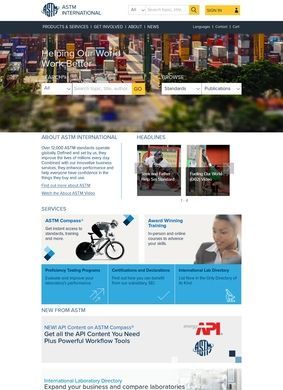
More than 12,000 active standards sit behind ASTM International, covering everything from the steel in a bridge to the flammability of a child's pajamas. That number is the first thing worth understanding about the organization, because it explains why a chemist, a playground equipment manufacturer, and a petroleum refiner all end up reading documents from the same source. The catalogue is enormous and deliberately broad, and the site exists mainly to give people access to it.
How standards are developed
The standards themselves are the product. Formerly the American Society for Testing and Materials, ASTM International develops voluntary consensus technical standards through a committee structure that pulls together producers, end users, consumers, and people who represent the general interest. There are more than 140 technical committees doing this work, and the consensus model is the part that counts: a standard is not handed down by a single lab or a single company, it is hammered out by parties who often have competing stakes. That process is slower than a top-down rule, and it is also why the output ends up referenced in U.S. federal and state regulation or adopted by bodies abroad.
Formats and pricing for access
What the site sells, in practical terms, is access to that library in several formats. Individual standards can be bought as PDFs or in print, which suits an engineer who needs one specification for a project. The Annual Book of ASTM Standards runs past 80 volumes and gathers the full body of work into committee-grouped compilations, useful for a reference shelf or a library that wants the complete set. For anyone who needs to consult standards regularly, there is Compass, the subscription platform that opens the entire collection online, with separate tiers for institutions and individuals. The pricing logic is straightforward enough: pay per document if you need a handful, subscribe if standards are part of your daily work.
Proficiency testing and laboratory accreditation
The publishing side is only part of what ASTM International runs. There are proficiency testing programs, where a laboratory periodically tests known samples and compares its results against peer labs, which is how a lab demonstrates it can actually do what it claims. There are training courses and professional development offerings tied to the standards, certification programs, and laboratory accreditation services. I find the proficiency testing piece quietly telling, because it shows the organization is not content to publish a method and walk away; it provides a mechanism for checking whether the people using the method get reliable answers.
That combination (write the standard, then offer the tools to verify compliance with it) is what makes the operation cohere. A construction firm can buy the relevant standard, send its technicians to a course on applying it, and use accreditation services to prove to a client or regulator that its testing is sound. ASTM International designs these pieces to connect, and they serve a wide audience: manufacturers, engineers, testing laboratories, government agencies, academia, and regulators across many countries.
Industries covered by the standards
The sector coverage rewards a closer look. Metals and construction are the categories most people associate with the name, but the ASTM International portfolio reaches into petroleum, plastics, textiles, consumer products, medical devices, environmental work, and aerospace. A standard for the grip strength of a medical syringe and a standard for jet fuel volatility live under the same roof. That reach is part of why the documents end up cited so widely; once an industry coalesces around an ASTM method, that method tends to become the common reference point that buyers, sellers, and inspectors all agree to use.
Who benefits from these resources
It is worth being clear about who this is and is not for. A casual reader curious about how standards work will find the public-facing material somewhat opaque, because the site is built around purchase and subscription rather than browsing. The value lands for people who already know which standard they need, or who work in a field where compliance is not optional. For a student writing a paper, a single PDF may be the entry point; for a testing lab, Compass plus proficiency testing plus accreditation may all be in play at once.
Weighing subscription costs against usage
There is a practical tension in any subscription model wrapped around essential reference material, and it applies here. Standards that are referenced in law become, in effect, things you must follow, yet access to the precise text often sits behind a paywall. ASTM International is hardly unique in this; it is how most standards bodies fund the considerable work of developing and maintaining their catalogues. Anyone deciding between buying individual documents and committing to a subscription should map their real usage first, because the per-document route adds up fast once you need more than a few, and Compass only pays off if the library gets used regularly.
Finding the right specification
The breadth can also be its own hurdle. With more than 12,000 active standards and an 80-volume printed compendium, finding the exact specification that applies to a given material or test is a task in itself, and the committee numbering scheme is not intuitive to newcomers. Search tools help, but the sheer scale means a first-time user often needs to know the standard designation before they can locate it efficiently. ASTM International built this as a reference resource for repeat professional use, not for exploration.
ASTM as global industry infrastructure
Headquartered in West Conshohocken, Pennsylvania, ASTM International has assembled a catalogue that functions as connective tissue across global industry. It is the agreed-upon language that lets a buyer in one country trust a test run in another. For the people who depend on that consistency, the organization is less a website to visit than infrastructure to draw on. A manufacturer needs the right specification to certify a product, a lab needs the method to run a test, a regulator needs a citable reference to point to in a rule. ASTM International supplies all three from the same body of work, and the publishing, testing, training, and accreditation arms are arranged so they reinforce each other rather than sit as separate silos.
For someone who has never had reason to open one of these documents, the whole enterprise can look abstract. The clearest way to grasp its role is to notice how often ASTM standards turn up cited in a regulation, a product spec, or a purchase contract without fanfare. The number on a steel plate, the test that a toy passed, the grade of asphalt on a road: behind a great many of these sits a document that traces back to a committee at ASTM International, doing the unglamorous work of getting different parties to agree on how a thing should be measured.