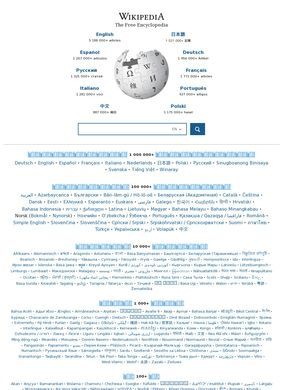
Somewhere around 7.19 million articles exist in the English edition of Wikipedia alone, each one written and revised by volunteers who receive no payment for the work. The German edition adds another 3.13 million. Across all language editions, which now exceed 300, the total runs into the hundreds of millions of individual edits accumulated since the project launched in 2001. Some editions have over a million articles; others cover languages that professional reference publishers never found worth the investment. The breadth is not incidental. It is what Wikipedia was designed for from the start.
Scale of the encyclopedia
Any given article follows a familiar pattern: a structured entry on a subject, with inline citations marking the source of each claim. Science, history, law, medicine, geography, biography, mathematics, technology, culture: the coverage is close to total. An entry on a major historical battle sits next to one on an obscure regional dialect or a single species of beetle, and both go through the same sourcing requirements. That evenness across subjects is genuinely unusual in reference publishing, where niche topics often receive a paragraph at most, or nothing.
Coverage across every subject
The parts of Wikipedia that casual readers tend to skip are where the project is most transparent about itself. Every article carries a full edit history, logging each change with a timestamp and the name or IP address of the person who made it. Alongside that sits a talk page where editors work out disputes over wording, sourcing priority, and what belongs in the article at all. The disagreements are often substantive and sometimes heated, which makes the talk pages genuinely useful for understanding why an article says what it says.
Edit history and talk pages
That transparency doubles as a practical reading guide. The citations let a reader trace a claim back to its source and decide independently whether that source holds up. Someone checking a quick date or definition can stop at the Wikipedia article itself. Someone writing something that requires accuracy should click through to the references, which the structure invites openly rather than burying. Wikipedia's own guidelines say as much, recommending it as a starting point rather than a final authority, and the architecture reflects that recommendation in a way most reference sites do not.
Citations as a reading guide
All content sits under a Creative Commons Attribution-ShareAlike license. The text can be reused, republished, and adapted as long as attribution and the same license carry forward. That licensing decision is why Wikipedia text appears quoted, mirrored, and folded into other projects across the web. It is free in the legal sense as well as the price sense, and both freedoms matter for anyone who wants to build on it.
Licensing for reuse and remixing
Wikipedia is one project among several maintained by the Wikimedia Foundation, the US non-profit that runs the infrastructure. Wiktionary covers dictionary definitions across many languages. Wikibooks collects free textbooks, Wikivoyage handles travel content, Wikiquote gathers quotations, and Wikinews does reporting. Two of the companion projects do heavier lifting than their lower profiles suggest. Wikidata stores structured, machine-readable facts that feed back into Wikipedia articles and into external applications. Wikimedia Commons holds the shared pool of images, audio files, and video that the articles draw from. Knowing these exist changes how you navigate the main site, because a question that an article only half answers often has a fuller answer in one of the companion projects.
Search runs full-text across all language editions, which is useful when comparing coverage between, say, the English and German versions of the same topic. The two can diverge noticeably in emphasis and depth, and neither is always the more thorough one. Reading is optimised for mobile, and native Android and iOS apps support offline reading and synced reading lists, practical for saving long articles to read somewhere without a signal.
Comparing coverage across language editions
The funding model is worth understanding because it shapes the whole operation. Wikipedia takes no advertising and runs on reader donations, with the Wikimedia Foundation publishing annual financial reports detailing how the money is spent. No advertiser sits between the reader and the content. That removes one of the standard pressures that bends online reference material toward commercial interests, and it is one reason Wikipedia's coverage does not cluster around profitable topics the way ad-supported sites tend to.
There is no perfect way to use Wikipedia, but there is a wrong one: reading an article and stopping there without checking what is underneath it. The citations and edit logs exist precisely because the project knows its own limits. Follow the trail to the primary sources, read the talk page on anything contested, and Wikipedia functions as a genuinely powerful research tool. Treat it as a destination and stop at the article surface, and the gaps eventually show.